Clear Sky Science · en
High efficiency, high color purity red micro-light-emitting diodes
Why tiny red lights matter
From ultra-sharp augmented reality glasses to wall-sized TVs, the next wave of displays depends on microscopic light sources called micro-LEDs. Blue and green versions are already impressive, but making equally good red pixels has proven stubbornly difficult. This study reports a new kind of red micro-LED that shines with exceptionally pure color, high efficiency, and remarkable stability—key ingredients for lifelike, power‑saving displays and fast optical communications.
Sharper color for future screens
Every color image on a screen is built from tiny red, green, and blue dots. For the richest, most accurate pictures, each dot should emit a very narrow range of wavelengths, like a finely tuned musical note rather than a noisy chord. Today’s red micro-LEDs tend to glow over a broad spread of colors and shift toward orange as they are driven harder, which blurs the overall color quality. The team behind this work set out to create red micro-LEDs that hold their hue and produce a razor-thin slice of the spectrum, enabling a wider color gamut and crisper contrast than current technologies.
Building a forest of nanoscale light poles
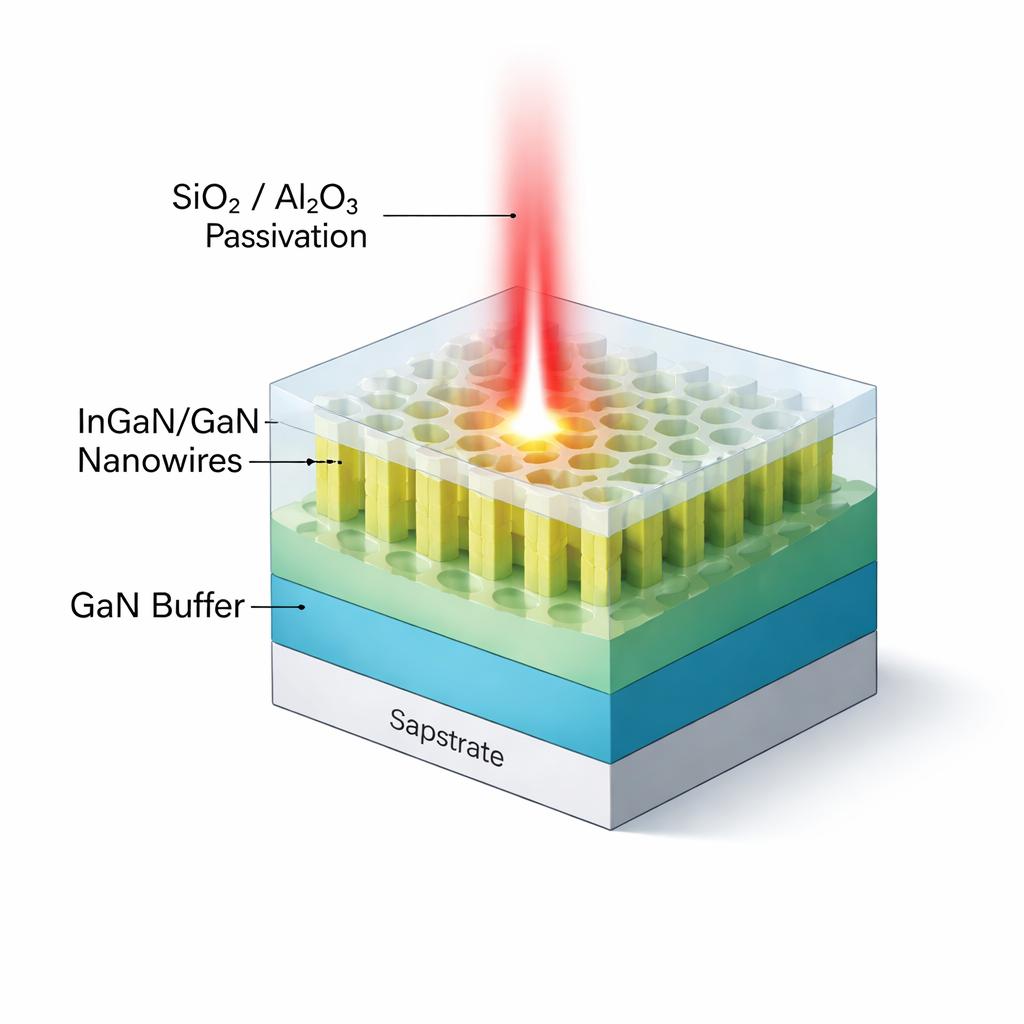
Instead of making a flat LED, the researchers grew a regular forest of semiconductor nanowires—each only a few hundred nanometers across—arranged in a precise repeating pattern known as a photonic crystal. These nanowires are made from InGaN and GaN, materials prized for their robustness and ability to cover blue, green, and red within a single family. Carefully engineered layers inside each nanowire encourage the material to emit deep red light. Thin coatings of aluminum oxide (Al2O3) and silicon dioxide (SiO2) protect the nanowire sidewalls, reduce defects, and help shape how light escapes from the structure.
Taming light with a built-in optical lattice
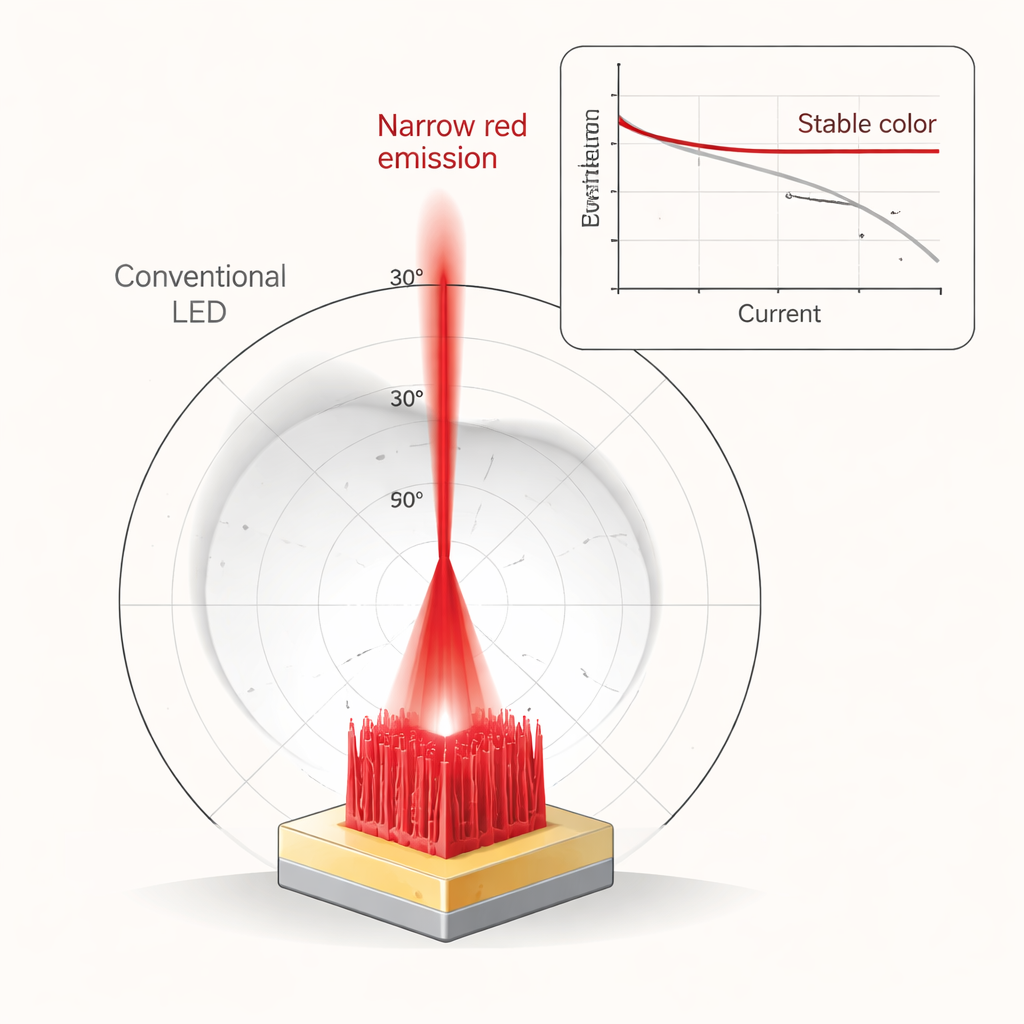
The ordered nanowire array does more than just house the emitting material—it acts like a tiny optical lattice that steers the light. By tuning the spacing and diameter of the nanowires, the team made the spontaneous emission from the red layer lock into a special “band-edge” mode of the photonic crystal. In this mode, light is funneled into a very narrow range of wavelengths and directed mostly straight out of the device, rather than leaking sideways. Measurements showed an emission peak at 617 nanometers with a full width at half maximum of only about 5 nanometers—roughly ten times narrower than typical red InGaN LEDs. Crucially, this peak position barely moved even when the drive current changed by more than an order of magnitude, meaning the perceived color stays constant from dim to bright.
Bright, efficient, and incredibly stable
Surface passivation with a thin Al2O3 layer proved essential: it suppressed leakage currents along the nanowire sidewalls, improved the rectification behavior, and enabled high external quantum efficiency (EQE)—the fraction of electrons that successfully produce photons. The optimized devices, just one square micrometer in area, reached an EQE of about 12%, several times higher than comparable red InGaN micro-LEDs and more than two orders of magnitude better than unpassivated versions. Experiments also showed that the emitted beam is narrowly focused around the vertical direction, with a small divergence angle, in good agreement with computer simulations. This directionality makes it easier to capture the light for displays or free-space optical links.
What this means for everyday technology
For non-specialists, the bottom line is that the researchers have demonstrated some of the purest and most efficient red micro-LEDs yet made from the same nitride materials already used for blue and green. Their color point matches the “primary red” used in standard TV specifications, and the emission stays red and sharp even as brightness changes. Because these nanowire-based devices can be densely packed and integrated with electronics on the same chip, they offer a promising route to full-color, high‑resolution micro-LED displays and fast, low‑power optical communication systems—all powered by a single, robust semiconductor platform.
Citation: Wu, Y., Xiao, Y., Reddeppa, M. et al. High efficiency, high color purity red micro-light-emitting diodes. Light Sci Appl 15, 133 (2026). https://doi.org/10.1038/s41377-026-02227-3
Keywords: micro-LED displays, red InGaN LEDs, nanowire photonic crystals, color purity, external quantum efficiency