Clear Sky Science · en
Integrated tunable green light source on silicon nitride
Brighter Green Light on a Tiny Chip
Green lasers power everything from undersea data links to precision cutting and quantum experiments, but today they are often bulky, power‑hungry, or hard to tune. This research shows how to shrink a powerful, adjustable green light source onto a silicon nitride chip, the same kind of platform used in modern photonics, opening the door to compact devices that can plug directly into communication and sensing systems.
Why Green Light Is Hard to Make
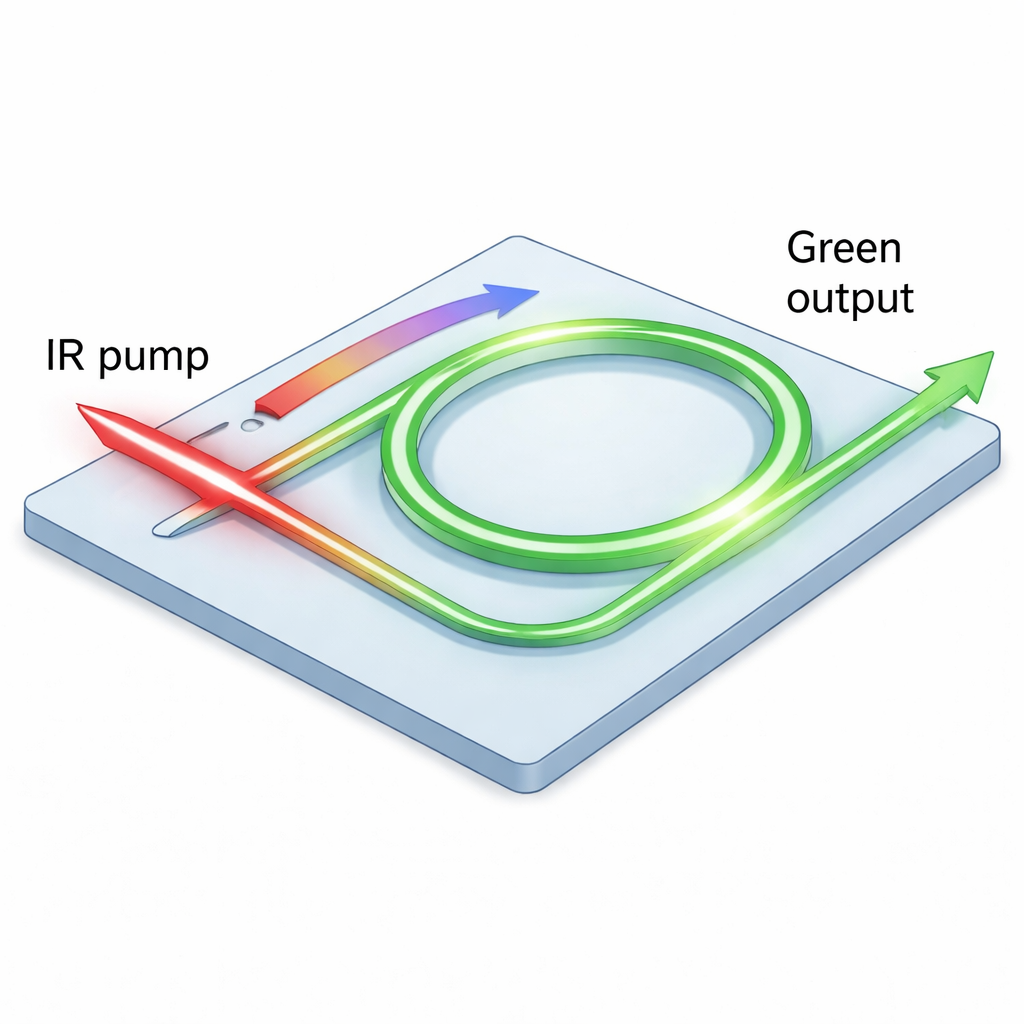
Light in the green band, roughly 510–560 nanometers, is technologically valuable yet surprisingly difficult to generate efficiently on a chip. Semiconductor lasers easily cover the red and blue regions, but in the green their internal efficiency drops, making them weak and hard to tune. To get around this, engineers usually double or mix the frequency of infrared lasers inside special crystals on tabletop setups. Translating that approach to integrated chips has proven challenging: earlier devices either produced only microwatts of green power or could be tuned over just a fraction of a nanometer, limiting their usefulness.
Turning Infrared into Green Inside a Microscopic Ring
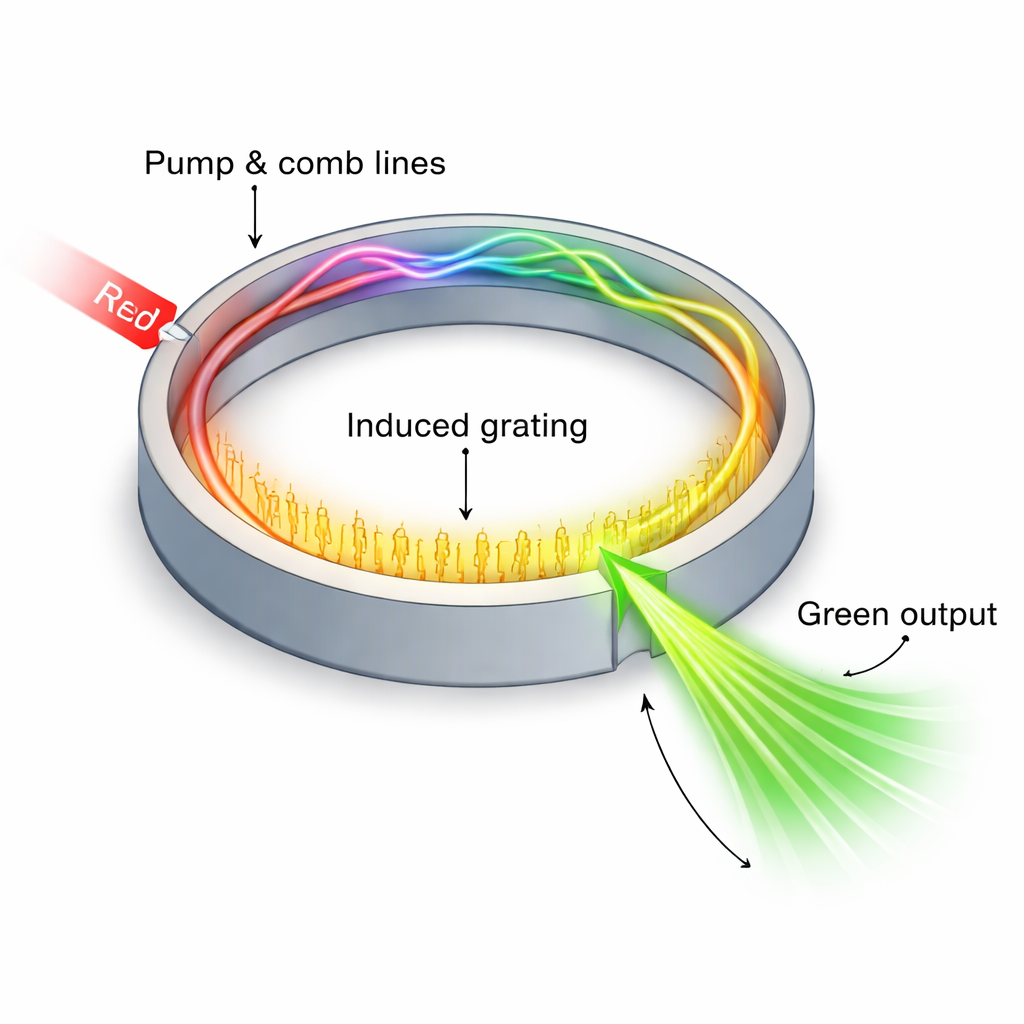
The team tackles this challenge using silicon nitride microrings—racetrack‑shaped waveguides etched into a chip that trap light and let it circulate thousands of times. They pump the ring with a continuous‑wave infrared laser near 1 micrometer wavelength. Inside the ring, the intense light triggers a process called all‑optical poling: multi‑photon absorption generates a tiny directional electric current, which in turn builds up a static electric field arranged in a regular pattern along the ring. This field effectively writes a built‑in grating that lets the material convert infrared light to its second harmonic—precisely in the green—much more efficiently than would otherwise be possible.
High Power and Low Power Needs at the Same Time
Using this self‑written grating, the researchers achieve up to 3.5 milliwatts of on‑chip green light, a record for silicon nitride in this spectral region. Just as important, they show that the same type of device can reach the threshold for grating formation with only a few milliwatts of pump power—low enough to be supplied directly by an on‑chip laser without external amplifiers. They monitor how the green output grows over time and confirm that it is being built from scratch by the optical field itself, not merely reading a pre‑existing pattern. In many ring resonances across a 1050–1070 nm pump range, the device can be “re‑poled” to generate green light at different wavelengths, demonstrating that the grating pattern is reconfigurable rather than fixed.
Using Light Combs to Steer the Color
The microring’s properties also allow it to form optical frequency combs—sets of evenly spaced colors around the pump that are phase‑locked to one another. When such a coherent comb forms, pairs of its infrared lines can combine to generate new green wavelengths through sum‑frequency processes. Remarkably, these mixed signals can write their own gratings inside the ring, independent of the original second‑harmonic process. By slightly shifting the pump laser while staying in a single resonance, the authors can switch the dominant green line over an 11‑nanometer span. Scanning the pump across a wider range, they demonstrate dense coverage of the green band from 511 to 540 nanometers, with many closely spaced usable lines.
What This Means for Future Devices
For non‑specialists, the main message is that the researchers have built a chip‑scale green light source that is simultaneously powerful, highly tunable, and energy‑efficient. Instead of fabricating complex fixed structures, they let light itself inscribe and re‑inscribe the patterns needed for efficient conversion inside a simple silicon nitride ring. Combining this with frequency combs adds a built‑in “color dial” for fine control of the output. Such devices could enable compact green lasers for quantum networks, precision timing, biomedical imaging, underwater links, and industrial processing, all integrated on the same kind of photonic chips that already underpin modern optical communications.
Citation: Wang, G., Yakar, O., Ji, X. et al. Integrated tunable green light source on silicon nitride. Light Sci Appl 15, 132 (2026). https://doi.org/10.1038/s41377-026-02222-8
Keywords: integrated green laser, silicon nitride photonics, all-optical poling, frequency combs, second-harmonic generation