Clear Sky Science · en
Multifunctional movable-type coding metasurface enabling reconfigurable diffractive neural networks
Building Smarter Machines with Light and Waves
Much of today’s artificial intelligence runs on energy-hungry electronic chips. This paper explores a very different route: using carefully designed surfaces to think with electromagnetic waves themselves. By physically shaping how microwaves travel and scatter, the researchers create hardware that can recognize handwriting, project holograms, and even monitor breathing—all using the same reusable building blocks.
A Lego Set for Controlling Waves
At the heart of the work is a new kind of “metasurface,” a thin panel patterned with many tiny metallic elements that can bend, delay, or transmit electromagnetic waves in precise ways. Instead of fixing these elements permanently, the team borrows an idea from ancient movable-type printing: each tiny unit, or “meta-atom,” is a detachable tile that can be plugged in or pulled out like a modular block. The authors design eight types of such tiles, each giving a different phase delay to microwaves at around 14 gigahertz. By snapping hundreds of these tiles into a grid, they can quickly reassemble the same hardware into many different functional devices, much like rearranging printing blocks to make a new page of text. 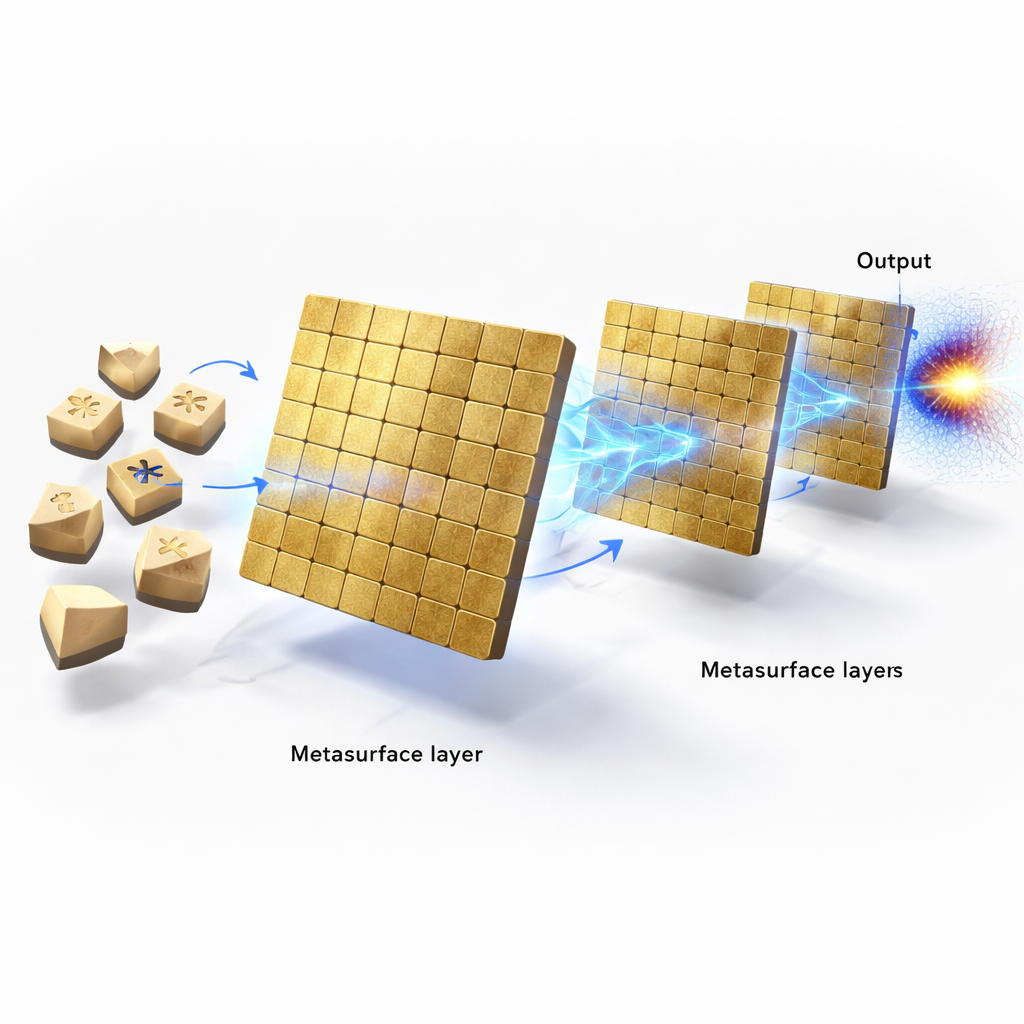
Turning Metasurfaces into a Physical Neural Network
To show how powerful this modular idea can be, the researchers stack three of these reconfigurable panels between an input mask and an output plane, creating what they call a movable-type reconfigurable diffractive neural network, or MT-RDNN. Here, instead of numbers in a computer, microwaves act as the signal that flows through layers. A pattern representing a handwritten digit is cut into a metal plate; microwaves passing through this mask then travel through the three metasurface layers. The precise arrangement of tiles in each layer is found using computer training, similar to how a conventional neural network is optimized. After training, the waves naturally focus their energy onto specific regions at the output, with each region corresponding to one digit class.
Adapting to New Tasks by Rearranging Tiles
A key advantage of this approach is that the network can be repurposed without rebuilding it from scratch. After training the layered metasurfaces to recognize four handwritten digits, the team adapts the same hardware to classify four English letters instead. Rather than reconfiguring every tile, they keep the first two metasurface layers unchanged and only adjust a portion of the tiles in the final layer. Using a transfer-learning strategy at the physical level, they preserve most of the existing structure and fine-tune just what is necessary. This cuts both training and hands-on reassembly time by more than two-thirds, while still achieving over 92 percent accuracy in experiments for both digit and letter recognition.
From Holograms to Contactless Breathing Monitors
The same movable-type metasurface also proves useful as a stand-alone functional sheet. With a single layer of tiles, the authors generate microwave holograms—two-dimensional intensity patterns that form shapes such as the letter “T” or a logo-like “CM” at a plane behind the surface. They compute the best tile configuration using a gradient-based algorithm that maximizes similarity between the desired pattern and the predicted field. In another demonstration, they steer and tightly focus microwaves onto the chest of a person standing nearby. Subtle movements caused by breathing modulate the reflected signal, which is then analyzed using a signal-processing method known as variational mode decomposition. In tests with two different volunteers at different positions, the metasurface is reconfigured so that each person’s chest becomes the focal spot, allowing accurate, contactless tracking of respiration rate that matches a wearable reference sensor. 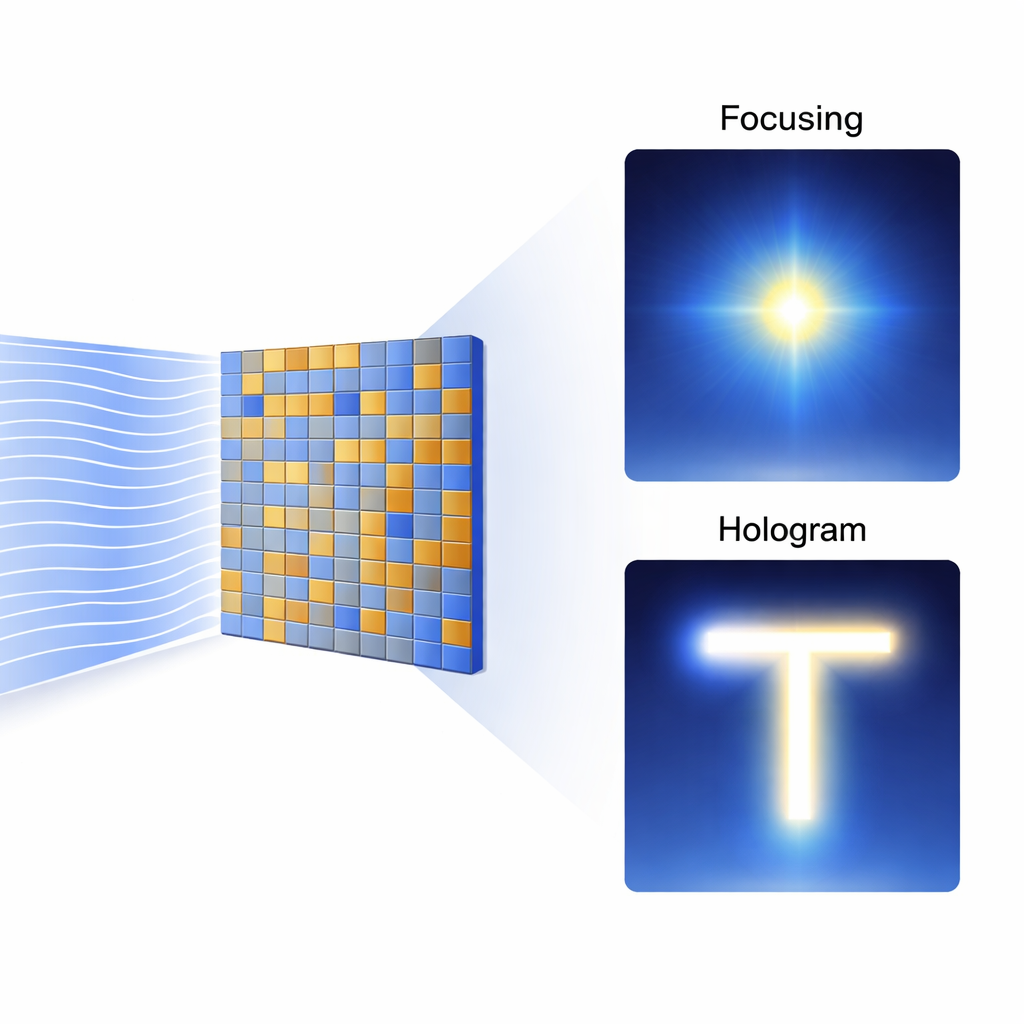
Why This Matters for Future Intelligent Devices
In plain terms, this work shows how a single, reusable “wave chip” made from plug-in tiles can be retuned for very different jobs—recognizing images, forming holograms, or sensing vital signs—simply by rearranging its pieces. Mechanical reconfiguration is slower than flipping electronic switches, but by changing only a fraction of the tiles and borrowing ideas from transfer learning, the authors keep both cost and effort reasonable. Their approach points toward flexible, low-power, and task-adaptive hardware that does some of the work of artificial intelligence directly in the physics of waves, potentially opening paths to new types of smart communication systems, interactive interfaces, and health-monitoring devices.
Citation: Yu, Z., Li, X., Gu, Z. et al. Multifunctional movable-type coding metasurface enabling reconfigurable diffractive neural networks. Light Sci Appl 15, 127 (2026). https://doi.org/10.1038/s41377-026-02216-6
Keywords: metasurface, optical computing, diffractive neural network, holography, vital sign sensing