Clear Sky Science · en
Multifunctional ligand engineering enables high-performance CsPb(Br/Cl)3 nanocrystals toward efficient and stable pure-blue perovskite LEDs
Brighter Blue Screens for Everyday Devices
From smartphones to giant TVs, today’s displays rely on tiny light sources called LEDs. Blue LEDs are particularly tricky to make bright, pure in color, and long-lasting at the same time. This article describes a new way to engineer the surface of promising blue-emitting materials, called perovskite nanocrystals, so that they shine more efficiently and keep working longer—paving the way for sharper, more energy‑efficient screens and lighting.
A New Kind of Tiny Light Source
Perovskite nanocrystals are crystals so small that thousands of them could fit across the width of a human hair. They can be made from solution like an ink, tuned to emit different colors, and produce very pure shades of light. Green and red versions already work well, but making deep, pure blue light has been much harder. The blue-emitting nanocrystals studied here are based on a mix of bromine and chlorine. This mixture allows precise control of the blue color, but also introduces many tiny flaws—missing atoms and mobile ions—that dim the light and make devices degrade quickly.
Fixing Flaws on an Atomic Surface
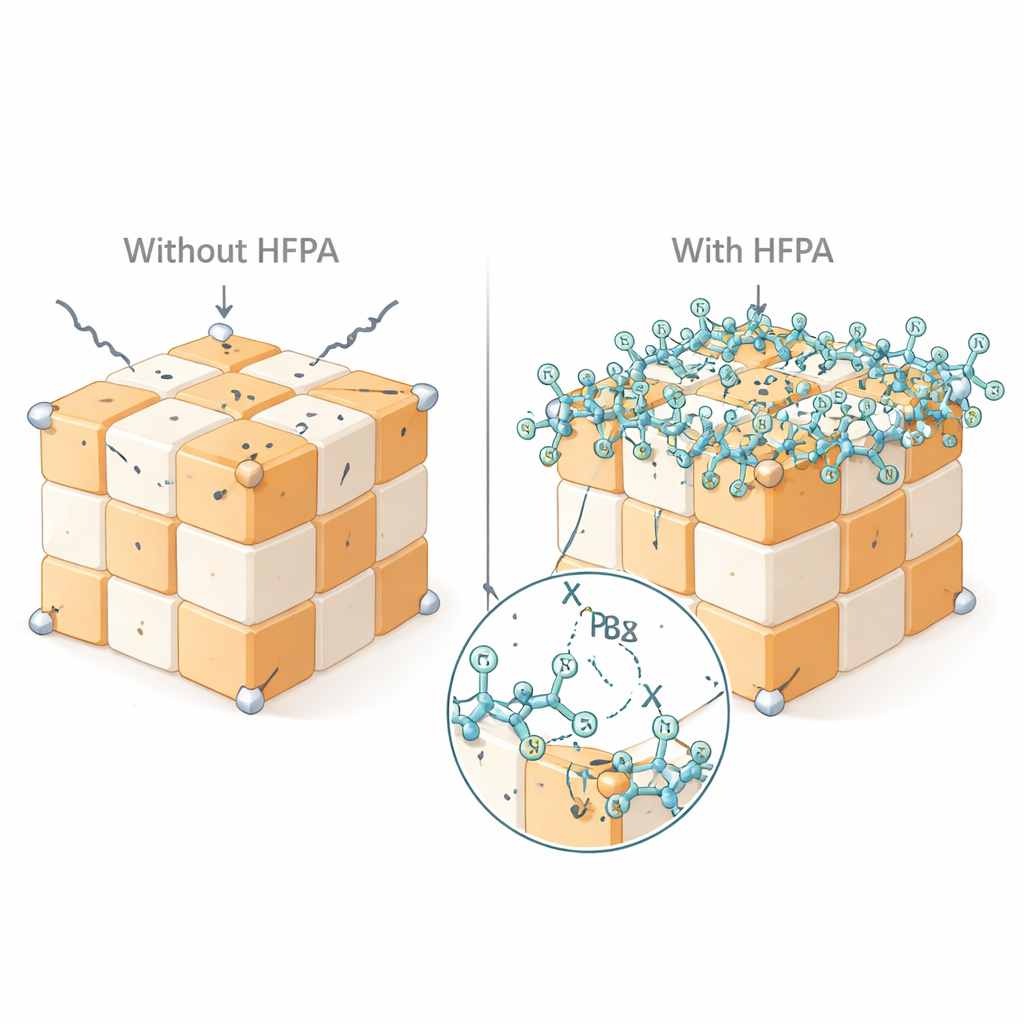
The researchers tackle these flaws by adding a specially designed molecule—an engineered “ligand” called HFPA—while the nanocrystals are being formed. You can think of HFPA as a molecular toolkit that latches onto the surface of each nanocrystal. One part of the molecule binds strongly to exposed lead atoms, which otherwise behave like open hooks that trap electrical charges. Another part forms gentle hydrogen bonds with surrounding bromine and chlorine ions, helping to hold them in place. Fluorine atoms built into HFPA cling tightly to the crystal framework, further locking the structure together. Together, these interactions smooth out the nanocrystal surface and block the tiny pathways along which ions would otherwise wander under electric stress.
From Dim and Unstable to Bright and Steady
To see whether this surface treatment really works, the team compared treated and untreated nanocrystals with a battery of measurements. They found that treated crystals convert incoming energy into light more than three times as efficiently, and their glow lasts longer before fading. Electrical tests showed fewer “trap” sites where charges can be lost, confirming that the surface has become cleaner and less defective. The treated crystals also stand up better to heat, ultraviolet light, and storage in air, all of which usually accelerate aging. Microscopy and spectroscopy reveal that the added molecules sit mainly on the outer shell of each particle, forming a fluorine-rich protective skin that resists breakdown.
Building Better Blue LEDs
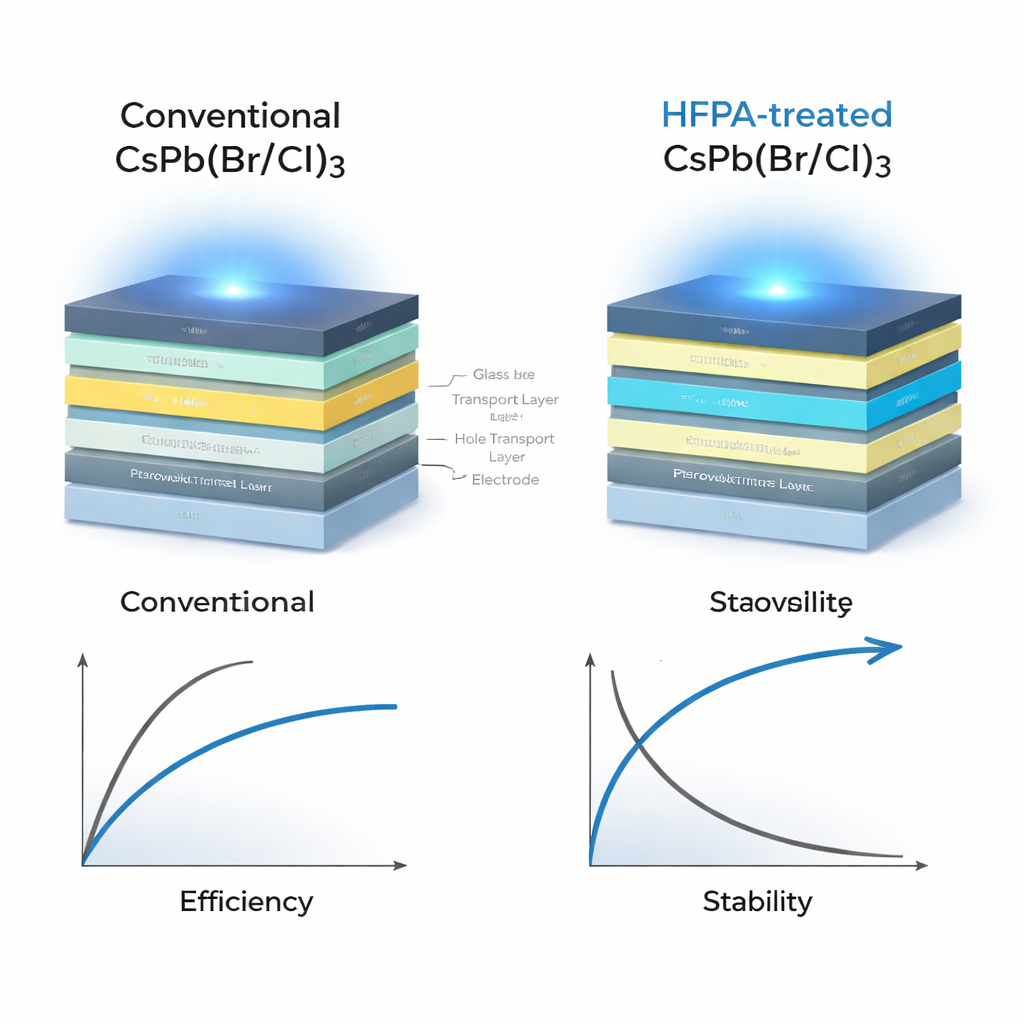
Armed with these improved nanocrystals, the researchers built full LED devices by stacking multiple thin layers—including charge-transport layers and metal contacts—around the emitting film. The resulting diodes produce a pure blue color at 467 nanometers, close to the standard used for ultra‑high‑definition displays. Compared with devices made from untreated nanocrystals, the new LEDs are about nine times more efficient at turning electrical power into light and can reach brightness levels roughly ten times higher. Just as important, the color of the emitted light remains stable as the operating voltage changes, indicating that the troublesome ion migration and phase changes inside the material have been strongly suppressed.
What This Means for Future Screens
For a non-specialist, the key message is that carefully chosen surface molecules can transform a fragile, underperforming blue perovskite into a robust and highly efficient light source. By using HFPA to “heal” defects and pin ions in place, the team has achieved pure-blue LEDs with high efficiency, strong brightness, and much longer operating lifetimes than their untreated counterparts. If this strategy can be scaled and adapted to manufacturing, it could help bring thinner, brighter, more energy‑saving displays and lighting a step closer to everyday use.
Citation: Maimaitizi, H., Ågren, H. & Chen, G. Multifunctional ligand engineering enables high-performance CsPb(Br/Cl)3 nanocrystals toward efficient and stable pure-blue perovskite LEDs. Light Sci Appl 15, 135 (2026). https://doi.org/10.1038/s41377-026-02214-8
Keywords: perovskite LEDs, blue light emission, nanocrystals, surface passivation, display technology