Clear Sky Science · en
LightIN: a versatile silicon-integrated photonic field programmable gate array with an intelligent configuration framework for next-generation AI clusters
Why Light-Powered Chips Matter for Future AI
As artificial intelligence systems grow to the scale of entire data centers, the electronic hardware that powers them is hitting fundamental limits in speed, energy use, and communication bandwidth. This paper introduces LightIN, a new kind of light-based, reprogrammable chip that plugs into AI centers much like today’s electronic accelerators, but uses photons instead of electrons to move and process information. By doing so, it aims to speed up key AI tasks, save energy, and even handle secure communication—all on the same tiny piece of silicon.

A Tiny City of Guided Light
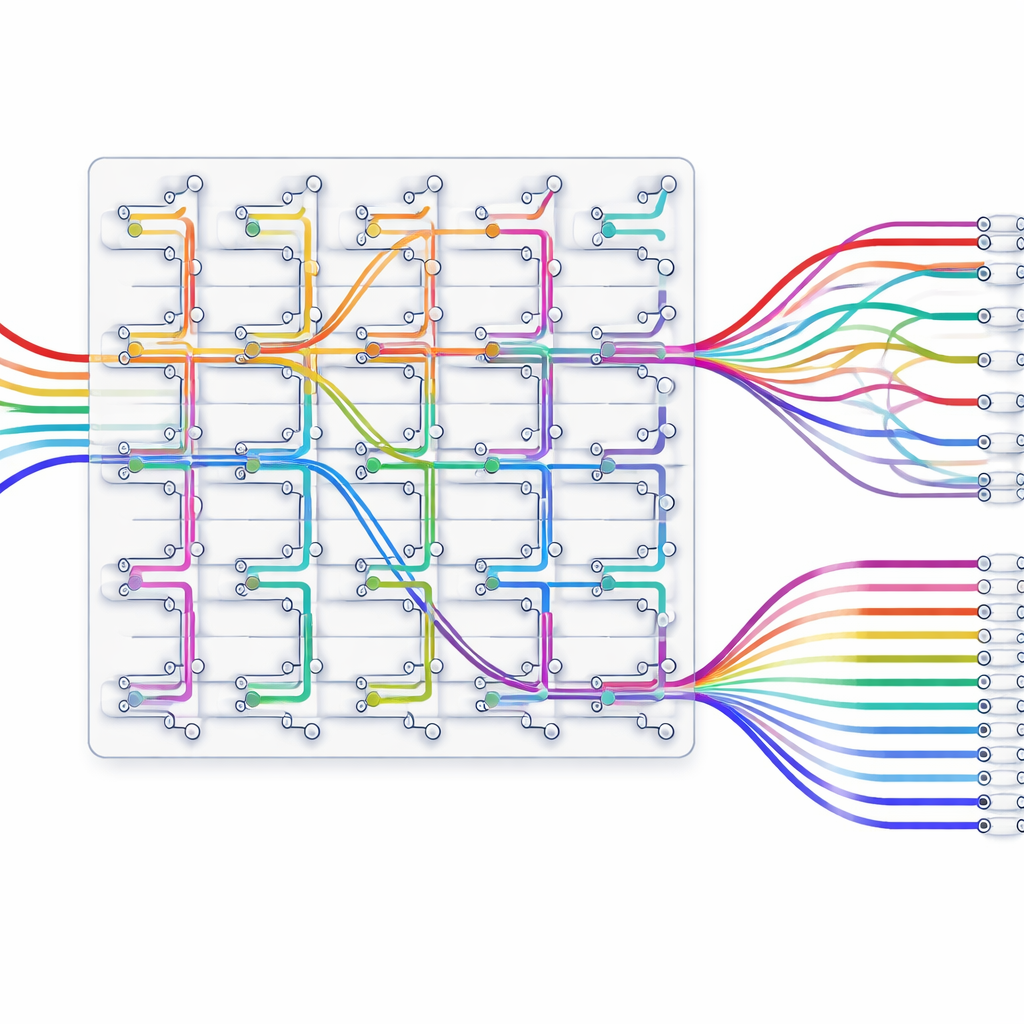
At the heart of LightIN is a silicon chip laid out like a two-dimensional city grid of optical waveguides and junctions. These junctions act as controllable “traffic lights” for light, built from standard silicon photonics technology that is already compatible with today’s chip factories. The grid contains 40 programmable cells and more than 160 individual optical components, all wired to an external control board. Instead of being frozen into one fixed purpose, this grid can be reprogrammed so that light entering the chip follows different paths and combinations, enabling a wide range of functions—from math operations used in neural networks to routing data streams and generating unique digital fingerprints.
An Intelligent Setup System Behind the Scenes
Reconfiguring such a dense web of light paths is not trivial; tiny variations in fabrication and temperature can easily throw off performance. To manage this, the authors designed an intelligent software framework called testing, compilation, and adjustment (TCA). First, the testing phase carefully measures how each tiny optical element responds to control voltages, building a detailed lookup table. Next, the compilation phase chooses a suitable layout inside the grid for a desired function and translates it into phase settings and voltages. Finally, the adjustment phase compares the chip’s real optical outputs with numerical predictions and fine-tunes the voltages until they match. Together, this framework lets the physical hardware behave like a flexible “optical field-programmable gate array” that can be retargeted to very different tasks.
Light-Speed Math and Learning
Using LightIN, the team demonstrates fast linear algebra operations, a core ingredient of modern AI. They realize both lossless-like transformations (unitary matrices) and more general ones (non-unitary matrices) in a compact footprint. In tests, the chip performs matrix multiplications with effective resolutions of about 5–6 bits and reaches a computing rate around 1.92 trillion operations per second while consuming only a few picojoules per multiply-and-accumulate. They further map a simple neural network for classifying flower data onto the chip and achieve accuracy closely matching an electronic version, with a total processing delay under 260 picoseconds—less time than it takes light to traverse a few centimeters of fiber.
Keeping Optical Links in Tune and Data on Track
Beyond computing, LightIN is reprogrammed as a tool for maintaining clean, high-speed optical communication links inside AI centers. Many of these links use microring modulators, which are tiny optical resonators that imprint data onto light but drift with temperature, degrading signal quality. The authors configure the chip as a light-based “differentiator” that compares slightly delayed versions of the signal to sense when the microring is optimally tuned. A control loop then automatically adjusts a tiny heater on the microring to keep it locked in place, sustaining good signal quality over data rates from 5 to 32 gigabits per second, even as temperature changes. In another mode, the same reconfigurable grid acts as a 4×4 optical switch, steering light from any input to any output with low loss and low crosstalk across a broad wavelength range—useful for flexible, high-bandwidth optical networks between servers.
Built-In Optical Fingerprints for Security
LightIN can also be turned into a hardware security element. By feeding in light at two opposite corners and programming certain junctions, the chip produces output patterns that depend sensitively on tiny, uncontrollable differences from manufacturing and on environmental noise. These patterns serve as physical unclonable functions: each chip responds in a unique and hard-to-copy way to a given challenge. The authors show that their optical version produces responses that are highly different between chips, statistically well-balanced between zeros and ones, and repeatable under stable conditions—properties needed for generating secure keys and authenticating devices in large AI installations.
What This Means for Tomorrow’s AI Centers
The work demonstrates that a single, programmable photonic chip can accelerate AI calculations, stabilize high-speed optical links, route data, and provide hardware-level security—all using the same reconfigurable light-guiding fabric. While the current prototype is modest in size, the authors outline clear paths to scale up the grid, reduce energy use, and integrate control electronics more tightly. For non-specialists, the key message is that light-based, reprogrammable chips like LightIN could become central building blocks of future AI clusters, helping them compute faster, communicate more efficiently, and keep data safe, all while easing the growing strain on power and cooling.
Citation: Zhu, Y., Liu, Y., Yang, X. et al. LightIN: a versatile silicon-integrated photonic field programmable gate array with an intelligent configuration framework for next-generation AI clusters. Light Sci Appl 15, 165 (2026). https://doi.org/10.1038/s41377-026-02209-5
Keywords: silicon photonics, AI hardware, photonic computing, optical interconnects, hardware security