Clear Sky Science · en
Quantitative determination of in-plane optical anisotropy by surface plasmon resonance holographic microscopy
Why Ultra-Thin Crystals Bend Light in Special Ways
Flat materials only a few atoms thick can twist and filter light in ways that bulk glass or plastic never could. These “2D materials” are the building blocks for ultra‑compact sensors, cameras, and communications chips that use the polarization of light as an information channel. But to design such devices, scientists must know exactly how strongly a given sheet bends and absorbs light in different in‑plane directions — something that has been surprisingly hard to measure, especially for atomically thin layers.
Light Behaving Differently Along Different Directions
Many crystals are not optically the same in all directions. Light moving along one in‑plane direction can see a higher refractive index (it slows down more) or be absorbed more strongly than light moving at a right angle. This directional behavior, called in‑plane anisotropy, underpins key functions in polarization‑sensitive detectors, optical filters, and waveplates. Traditional ways to probe it shine light from far away and watch what comes back, which works well for thicker films but becomes unreliable when the material is only a few atomic layers thick and the interaction length is extremely short.
Bringing Light Right Up to the Surface
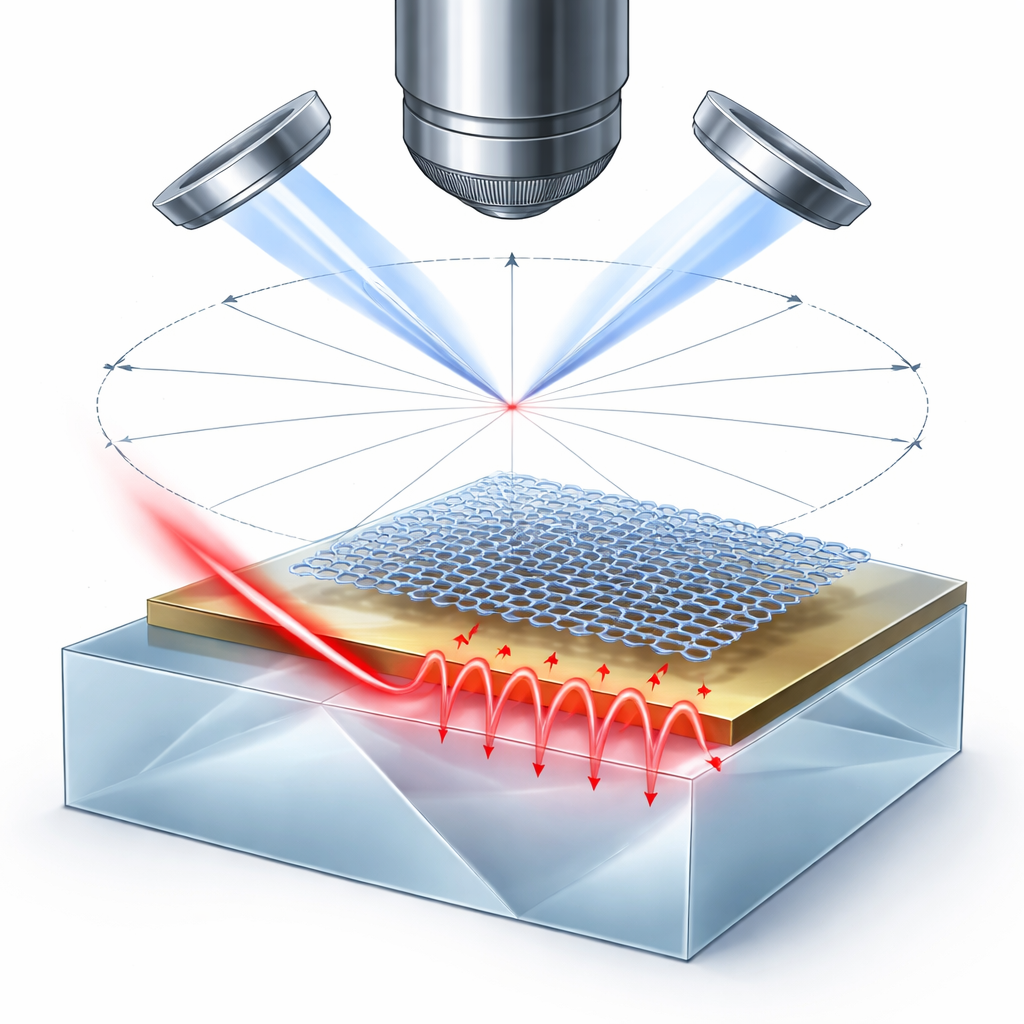
The authors tackle this problem by moving from far‑field to near‑field optics. They use a classic surface‑plasmon setup: a glass slide coated with a thin gold film, on top of which they place the ultrathin sample. When a laser hits the gold at just the right angle, it excites a tightly confined surface wave that hugs the metal surface. This wave, known as a surface plasmon, has an intense electric field that overlaps strongly with the 2D material, even if the material is only a single layer of atoms. By rotating the direction in which this surface wave travels and recording holograms of the reflected light, the researchers can see how the sample’s response changes with in‑plane angle.
Turning Holograms into Quantitative Optical Numbers
In their microscope, the team scans both the incident angle of the light and its direction within the plane while operating under surface‑plasmon conditions. Digital holography lets them reconstruct not just the brightness but also the phase shift of the reflected beam — a very sensitive indicator of how the sample alters the passing wave. They then compare these measured phase shifts with calculations based on a multilayer optical model that includes the glass, gold film, ultrathin sample, and surrounding medium. By adjusting only the sample’s refractive index (how much it bends light), its absorption, and its thickness until theory matches experiment, they extract those quantities precisely, for every in‑plane direction, from the same dataset.
What Happens as You Stack More Layers
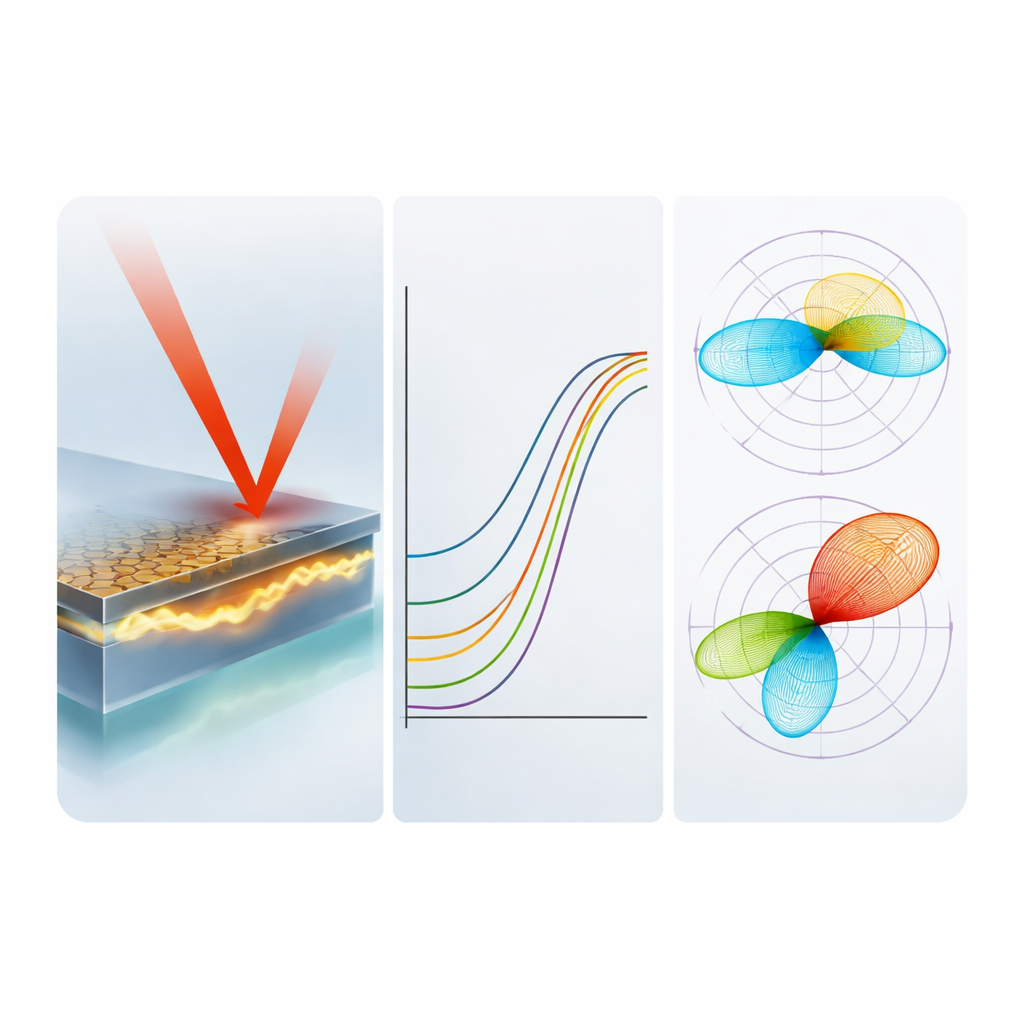
To demonstrate the method, the authors study rhenium disulfide (ReS₂), a 2D semiconductor known for strong in‑plane anisotropy. They measure monolayer, bilayer, and thicker flakes. For a two‑layer sheet, their thickness result agrees well with independent expectations from atomic‑force measurements, confirming the accuracy of the approach. More importantly, by plotting the retrieved optical constants as a function of angle, they obtain neat ellipses that directly encode how much the material differs along and across a preferred in‑plane direction. By repeating this for samples of different thickness, they discover that these ellipses become more circular as the material gets thicker, meaning its in‑plane anisotropy weakens with added layers.
Why This Matters for Future Nanodevices
The study shows that ultra‑thin ReS₂ is actually more directionally “extreme” than thicker flakes, likely because additional layers introduce more complex stacking and phase mixing that dilute the anisotropic response. For engineers, this means that single‑ and few‑layer crystals may be the best choice when a strong polarization effect is desired, for instance in miniaturized optical polarizers or angle‑selective sensors. More broadly, the method introduced here — a wide‑field, near‑field, holographic surface‑plasmon microscope — gives researchers a practical way to obtain hard numbers for how any thin film manipulates light in all in‑plane directions, even down to the atomic‑layer limit.
Citation: Zhang, J., Li, W., Li, J. et al. Quantitative determination of in-plane optical anisotropy by surface plasmon resonance holographic microscopy. Light Sci Appl 15, 152 (2026). https://doi.org/10.1038/s41377-026-02207-7
Keywords: optical anisotropy, 2D materials, surface plasmon resonance, holographic microscopy, ReS2