Clear Sky Science · en
Time-bin encoded quantum key distribution over 120 km with a telecom quantum dot source
Keeping Secrets Safe with the Laws of Physics
As our lives move online, protecting sensitive information—bank details, medical records, government data—becomes ever more critical. Conventional encryption relies on mathematical problems that powerful future computers, especially quantum computers, may eventually crack. This research explores a different path: using individual particles of light, whose behavior is ruled by quantum physics, to create secret keys that are secure not just in practice, but in principle.
From Fragile Polarization to Robust Time Ticks
Many quantum key distribution (QKD) systems encode information into the polarization of light, essentially the orientation of a photon’s electric field. This works well in controlled laboratories, but real-world fiber networks are messy. Temperature changes, vibrations, or tiny imperfections in the glass twist the polarization in unpredictable ways, leading to errors and requiring constant active correction. The team behind this paper instead uses the arrival time of single photons—early or late within a clock cycle—to carry information. These so-called time bins are far less sensitive to disturbances along the fiber, promising more robust and maintenance-friendly quantum communication.
A Solid-State Single-Photon Source at Telecom Wavelengths
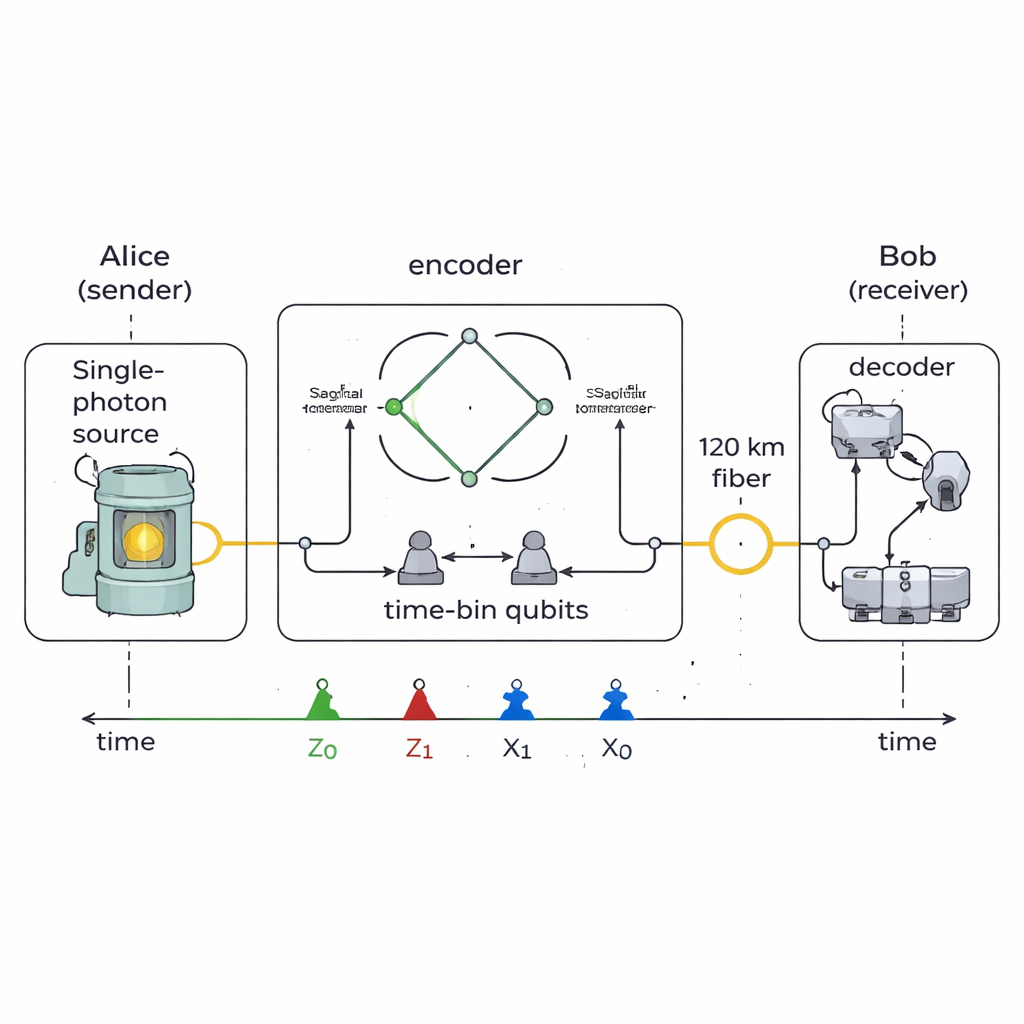
To build a practical long-distance QKD system, you need single photons that can travel through existing telecom fiber with minimal loss. The researchers use a semiconductor quantum dot, a tiny artificial atom embedded in a nanostructure that boosts its brightness. When excited by a pulsed laser, the quantum dot emits one photon at a time around 1,560 nanometers, right in the standard telecom band. The device delivers high-purity, on-demand single photons, overcoming limitations of more conventional “weak laser” approaches, which only approximate single photons and leave subtle loopholes for eavesdroppers.
Carving Time Slots into Quantum Bits
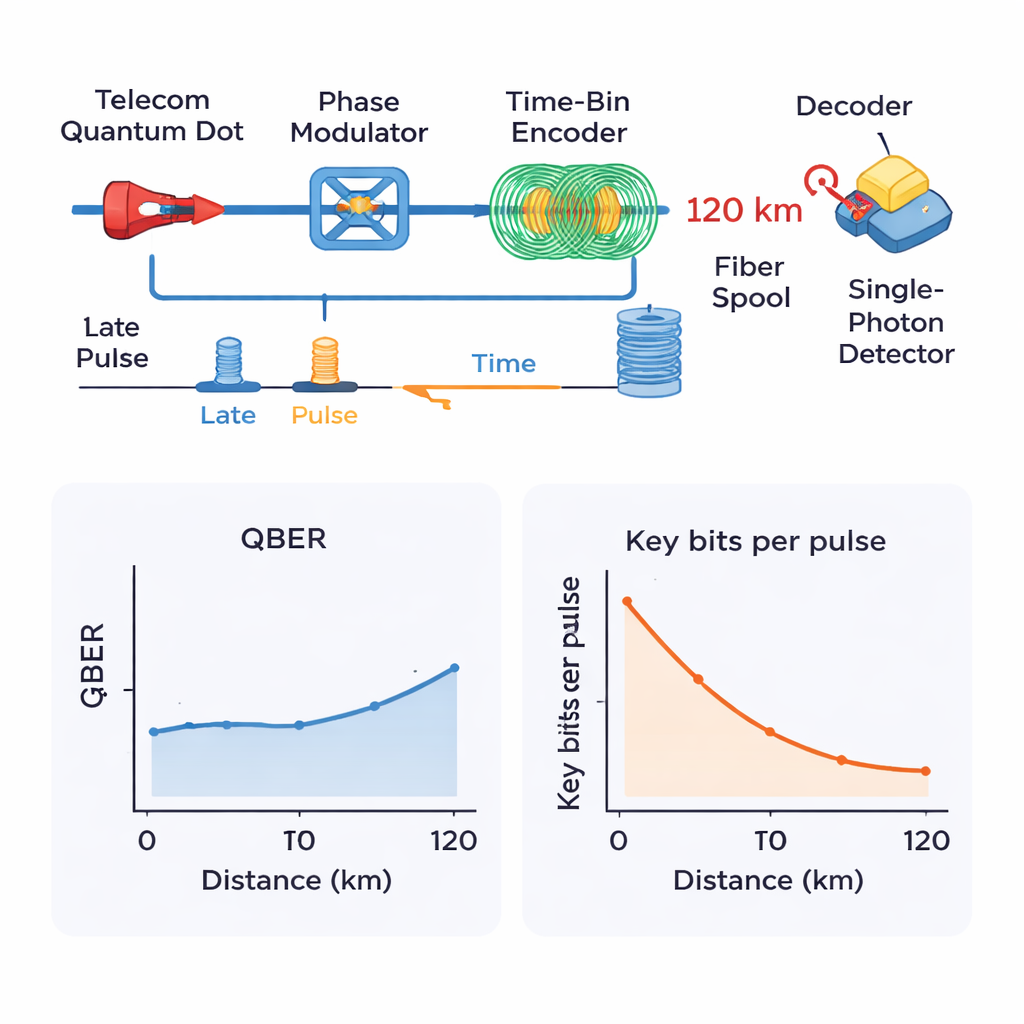
The heart of the setup is an optical circuit that splits and recombines the photon paths to create distinct early and late arrival times. A clever looped interferometer and a phase modulator impose controlled delays and phase shifts, turning each photon into one of three possible time-bin states: an early pulse, a late pulse, or a quantum superposition of both. These states correspond to the logical symbols used by a variant of the standard BB84 QKD protocol. On the receiving end, a matching interferometer and phase shifter convert arrival times back into the same set of states, allowing the receiver to decide, from when a photon clicks the detector, which bit value was sent.
Sending Quantum Keys Across 120 Kilometers
The team links their sender (“Alice”) and receiver (“Bob”) with up to 120 kilometers of standard optical fiber, similar to that used in intercity telecom lines. They operate the system continuously for six hours and monitor both the quantum bit error rate—how often the received bits disagree with what was sent—and the rate at which truly secure key bits can be distilled after error correction and privacy checks. Even at the longest distance, errors stay below about 11 percent, low enough for proven security methods to work. The system achieves around 2×10⁻⁷ secure bits per photon pulse at 120 kilometers, corresponding to roughly 15 secure bits per second, sufficient for encrypting text messages and demonstrating real-world feasibility.
What This Means for Future Quantum Networks
In plain terms, this experiment shows that it is possible to send provably secure encryption keys over city-to-city distances using a chip-based single-photon source and a timing-based encoding that naturally resists environmental noise. While the current key rates are modest, the authors outline clear routes for improvement—brighter sources, lower-loss components, faster operation, and better detectors. Their work is the first demonstration of genuine time-bin quantum key distribution using a deterministic quantum dot at telecom wavelengths, and it marks a significant step toward robust, scalable quantum-secure networks that can plug directly into today’s fiber infrastructure.
Citation: Wang, J., Hanel, J., Jiang, Z. et al. Time-bin encoded quantum key distribution over 120 km with a telecom quantum dot source. Light Sci Appl 15, 126 (2026). https://doi.org/10.1038/s41377-026-02205-9
Keywords: quantum key distribution, single-photon source, time-bin encoding, quantum dots, telecom fiber