Clear Sky Science · en
Deterministic quantum light emitters in DNA origami–engineered molecule–MoS₂ hybrids
Lighting Up the Quantum Future
Imagine computer chips where every tiny point of light carries secure information, one particle at a time. To make such quantum technologies real, engineers need microscopic light bulbs that emit single photons on demand and in precise locations. This paper shows how to build those quantum light sources by marrying two unlikely tools: ultra-thin crystals known from next‑generation electronics, and DNA structures originally invented for nanometer‑scale “origami.” Together, they create a controllable, programmable platform for quantum light on a chip.
Why Tiny Single-Photon Lights Matter
Single-photon emitters are the building blocks of future quantum networks, where information is carried not by electrical current but by individual particles of light. Solid-state versions of these devices—built into solid materials rather than delicate atoms in a vacuum—are especially attractive because they can, in principle, be integrated into real-world circuits. Among the most promising host materials are atomically thin semiconductors such as molybdenum disulfide (MoS₂), which are only a few atoms thick, shine brightly in the visible and near-infrared, and can be laid down like flexible stickers on different surfaces. The challenge has been to create these emitters in specific places with reproducible properties rather than having them appear randomly as defects.
Using DNA as a Molecular Blueprint
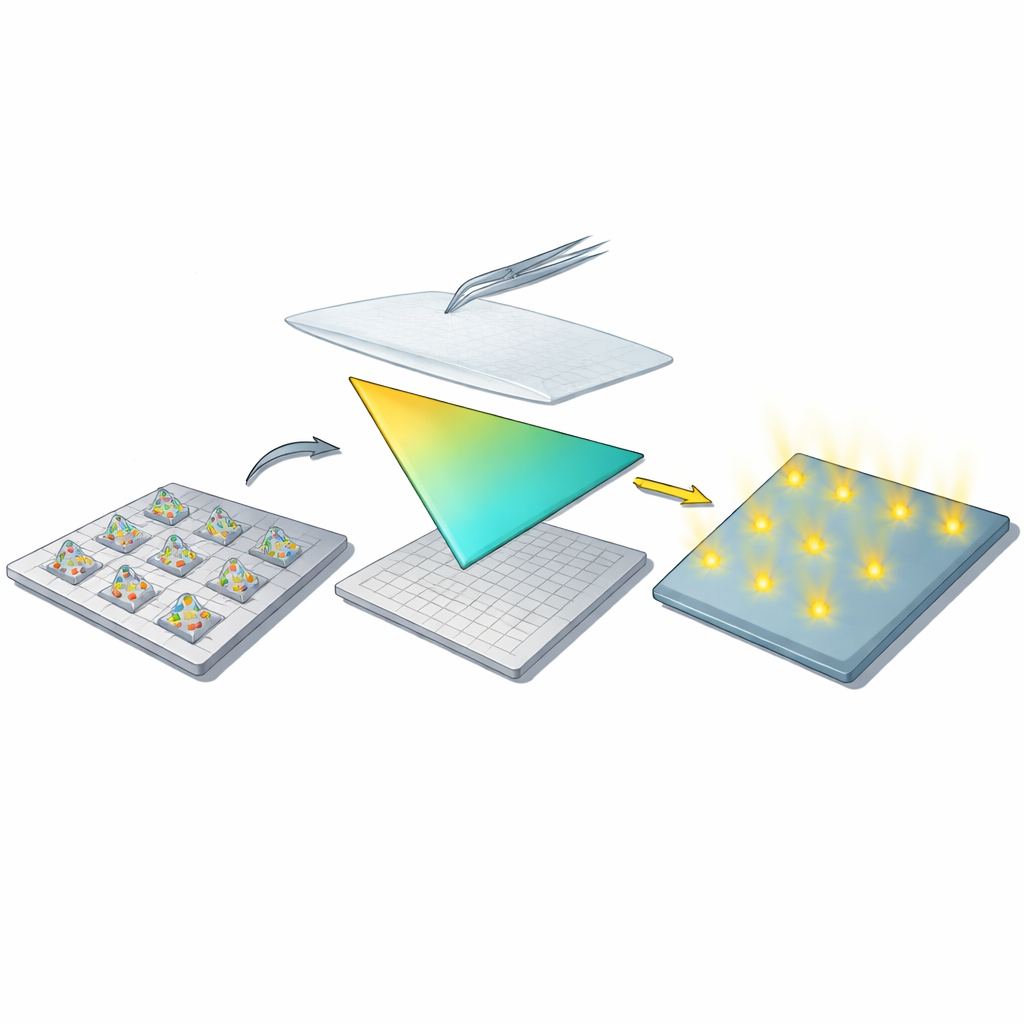
To tackle this challenge, the researchers turned to DNA origami, a technique where a long DNA strand is folded into a chosen shape using many shorter helper strands. Here, they use triangular DNA tiles as molecular “adaptors” that can be accurately placed on a chip in regular arrays, with better than 20-nanometer precision. Each triangle carries multiple small molecules that end in sulfur-containing thiol groups, arranged at well-defined positions along its edges. The team first patterns a silicon chip so that each triangular site attracts exactly one DNA triangle. These DNA tiles are then dried in place, forming a nanoscale stencil of thiol-bearing molecules across the surface, with spacing that can be tuned from hundreds down to less than two hundred nanometers.
Marrying Ultra-Thin Crystals with DNA Patterns
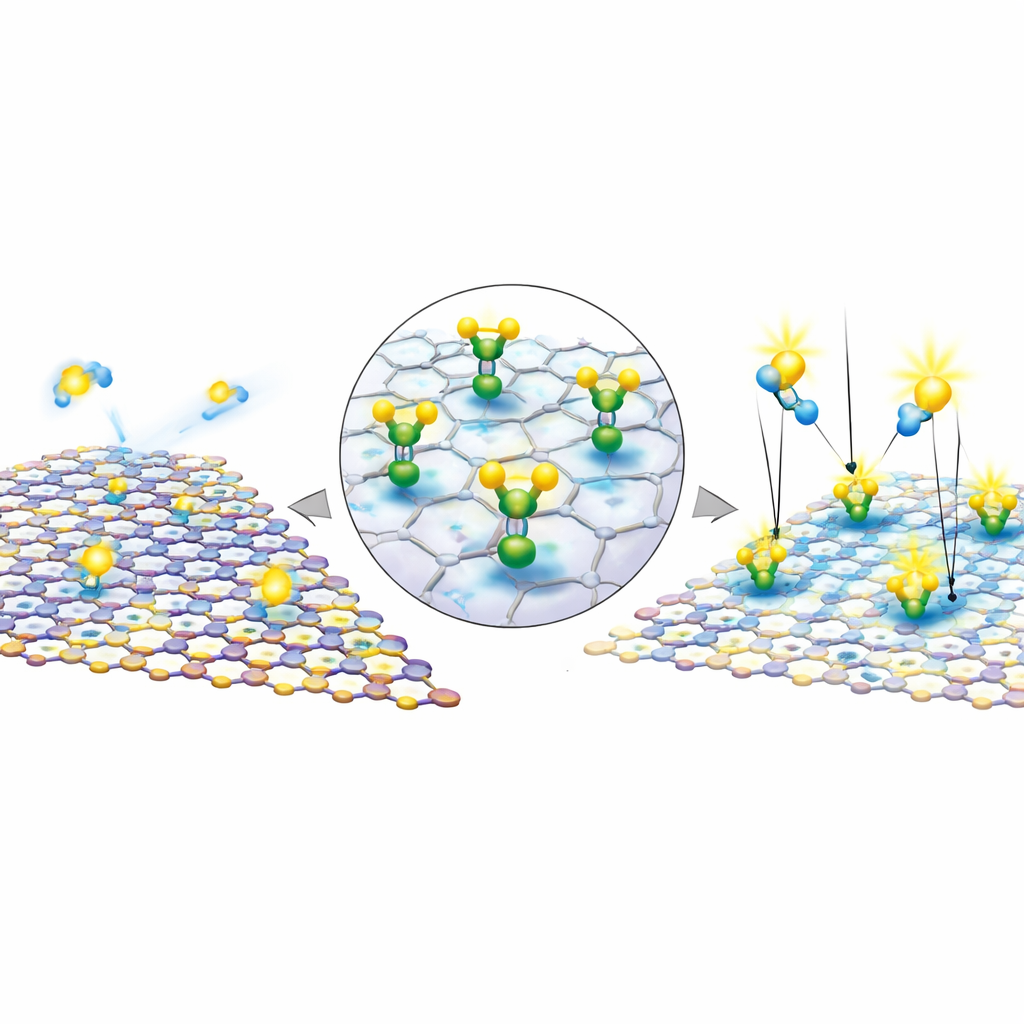
In the next step, a monolayer of MoS₂—an atomically thin, triangular flake grown by vapor methods and encapsulated with a protective boron nitride layer—is gently transferred on top of the DNA–thiol pattern. The thiol molecules reach up from the DNA triangles and chemically bond to missing sulfur atoms in the MoS₂ sheet. These bonds do more than just passivate defects: they create tiny energy traps that can capture the material’s excitons, the bound electron–hole pairs responsible for light emission. Optical measurements at room temperature show that regions with thiol-functionalized DNA patterns develop a new, slightly lower-energy glow compared with unmodified MoS₂, a signature of excitons becoming localized at the thiol-induced sites. The effect strengthens as the density of DNA triangles increases, confirming that the exciton landscape can be tuned simply by adjusting the pattern spacing.
Creating Reliable Quantum Light Sources
When cooled to just a few degrees above absolute zero, the broad localized glow from each patterned site splits into a handful of razor-sharp emission lines. Detailed photon statistics reveal that most of these lines correspond to true single-photon emitters: the devices emit one photon at a time rather than random bursts. Across 33 patterned locations, 29 show clear single-photon behavior, corresponding to an impressive placement yield of about 90 percent. These emitters are bright, with nanosecond lifetimes and relatively stable colors and intensities, and they resist common problems like blinking and bleaching. Theoretical calculations support the picture that thiol molecules bonded at sulfur vacancies create shallow donor-like defect states that trap excitons and release their energy as single photons, in contrast to deeper, longer-lived defects created by methods like ion irradiation.
From Designer Defects to Quantum Circuits
By showing that DNA origami can reliably “write” quantum light sources into specific positions in an atomically thin semiconductor, this work turns random defects into a programmable design feature. Because the approach is non-destructive, compatible with scalable lithography, and based on versatile organic chemistry, it can in principle be extended to other two-dimensional materials and other types of molecules. For non-specialists, the key message is that we are learning to engineer imperfections with molecular precision so that a flat crystal can host dense, ordered arrays of identical quantum light sources. Such designer defects could form the backbone of future quantum communication chips, ultra-small sensors, and photonic circuits where every dot of light is placed exactly where it is needed and emits one photon at a time.
Citation: Li, Z., Zhao, S., Melchakova, I. et al. Deterministic quantum light emitters in DNA origami–engineered molecule–MoS₂ hybrids. Light Sci Appl 15, 159 (2026). https://doi.org/10.1038/s41377-026-02204-w
Keywords: single-photon emitters, DNA origami, molybdenum disulfide, quantum light, two-dimensional materials