Clear Sky Science · en
Plasmonic nanocavity-enabled universal detection of layer-breathing vibrations in two-dimensional materials
Listening to Hidden Vibrations Between Atom-Thin Layers
Many of today’s most exciting materials are only a few atoms thick, stacked like sheets of paper. The way these sheets touch, slide, and press against one another controls how future electronics, sensors, and quantum devices will work. Yet some of the most important motions between layers – gentle “breathing” vibrations in and out – are almost impossible to detect with standard tools. This study shows how tiny metallic cavities made from gold or silver can act as powerful amplifiers, turning these normally invisible vibrations into clear, measurable signals.
Why Soft Light Trapped in Tiny Gaps Matters
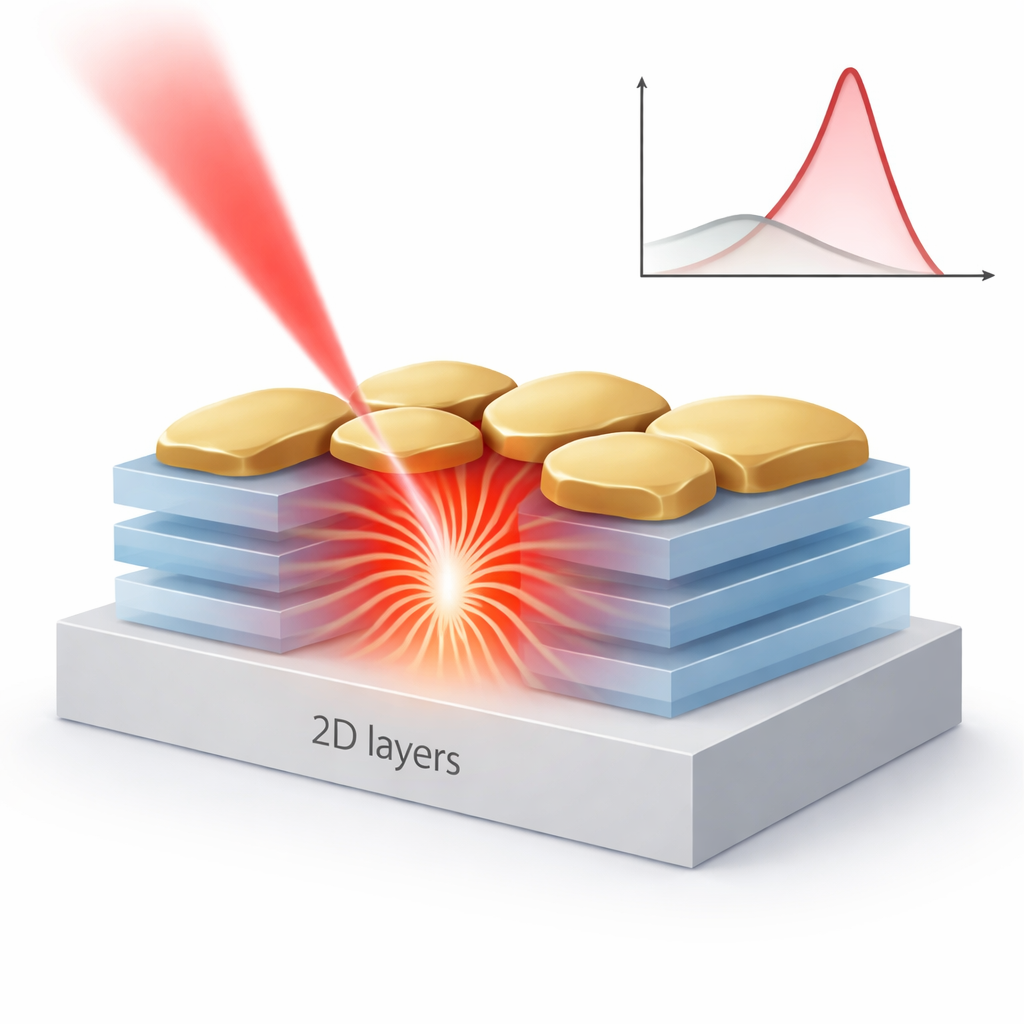
When light hits metal structures that are only a few dozen nanometers across, it can excite collective electron waves called plasmons. These waves squeeze light into volumes far smaller than its wavelength, dramatically boosting the local electric field. Plasmon-enhanced Raman spectroscopy takes advantage of this effect: it uses these intense near-fields to make very weak molecular vibrations visible. Until now, most of this work focused on vibrations within a single layer of atoms. The new study asks a deeper question: can we use the same trick to study the much subtler motions between layers – how entire atomic sheets move toward and away from each other?
Making Quiet Interlayer Motions Speak Up
The authors deposit an ultrathin gold or silver film onto carefully prepared samples of multilayer graphene, hexagonal boron nitride (hBN), and their stacked combinations. These films break up into many nano-islands separated by tiny gaps – plasmonic nanocavities. When illuminated with laser light tuned to their resonance, these nanocavities generate huge local electric fields right where the 2D layers meet the metal. Using Raman spectroscopy, the team observes that vibration modes which involve entire layers moving in and out – so‑called layer‑breathing modes – suddenly become strong and easy to measure, even when they are essentially undetectable in the same samples without nanocavities.
Reading the Signature of Layer Coupling
To understand what they see, the researchers treat the stack of layers like a chain of coupled masses and springs. This simple picture predicts how many layer-breathing modes should exist and at what frequencies, depending on how strongly each layer is tied to its neighbors and to the surrounding materials. In the nanocavity-coupled samples, they find not only the expected breathing modes but also special interface modes, reflecting the way the outermost layers are bound to the metal film on one side and to the solid substrate on the other. By adjusting the model to include these extra “springs,” the calculated frequencies align closely with the measurements, revealing how strongly each interface is coupled.
How Plasmonic Cavities Reshape the Rules
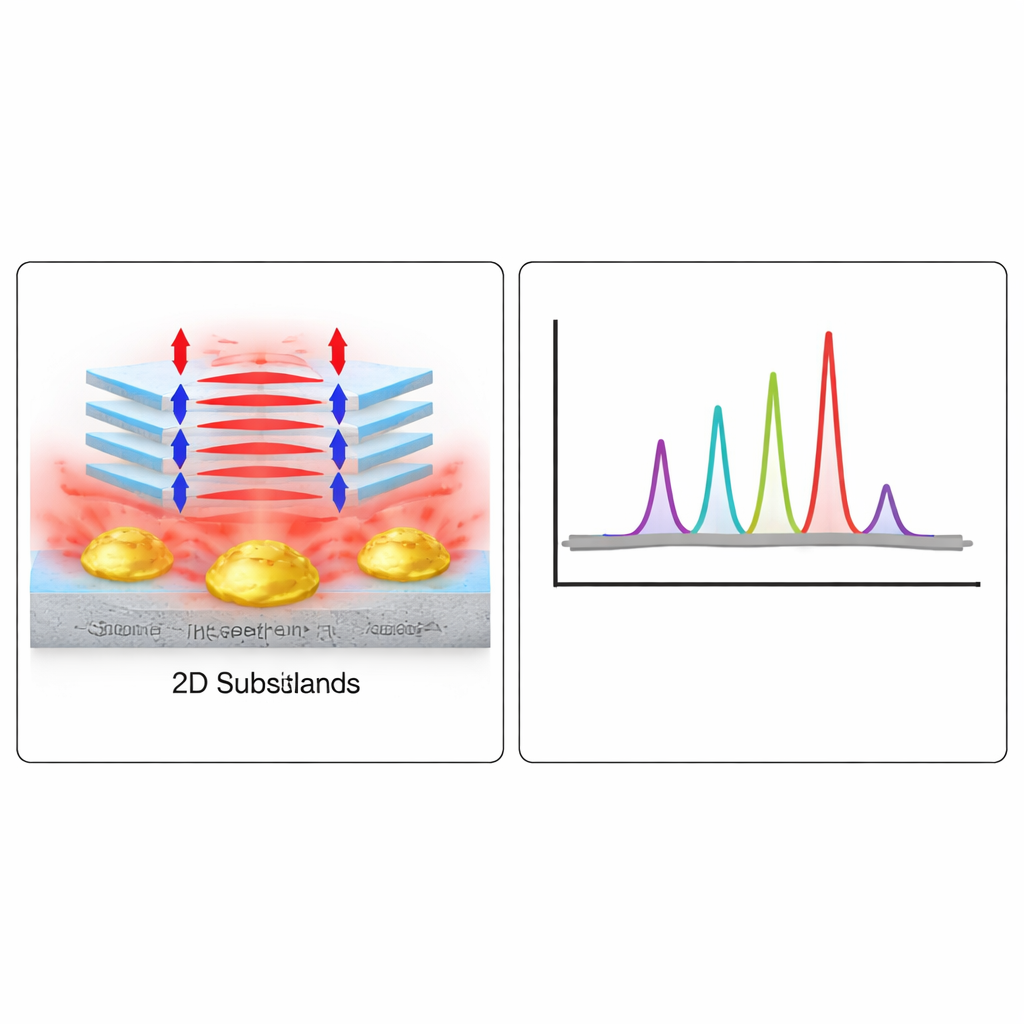
Standard Raman scattering obeys strict rules about which vibrations are allowed to appear and how their intensity depends on light polarization. Inside a nanocavity, those rules change. The team develops a new framework – an electric‑field‑modulated interlayer bond polarizability model – that accounts for two key effects at once: the uneven distribution of the intense local field from the nanocavity and the way the metal‑layer interface itself modifies how easily bonds can be polarized by light. In this picture, each atomic layer contributes a tiny dipole whose strength depends on both its motion and the local field it feels. Because the field is strongest near the metal, vibrations that move the top layers become greatly amplified, while those deeper in the stack contribute less. This model quantitatively reproduces the complex pattern of peak intensities seen in graphene, hBN, twisted graphene stacks, and different cavity shapes and metals.
A New Window into Buried Interfaces
By harnessing plasmonic nanocavities, the authors transform barely detectable interlayer vibrations into sharp, information‑rich spectral lines. For non‑specialists, the core message is that we can now “listen” to how atom‑thin layers breathe and interact deep inside complex stacks, without cutting them open or damaging them. This universal approach works across different materials, metals, and laser colors, and it provides a practical, non‑destructive way to probe hidden interfaces in next‑generation 2D devices. In the future, similar strategies may make it possible to uncover other elusive excitations, such as interlayer excitons and subtle plasmonic resonances, further expanding our ability to engineer materials from the atomic layer up.
Citation: Wu, H., Lin, ML., Yan, S. et al. Plasmonic nanocavity-enabled universal detection of layer-breathing vibrations in two-dimensional materials. Light Sci Appl 15, 109 (2026). https://doi.org/10.1038/s41377-026-02203-x
Keywords: plasmonic nanocavities, Raman spectroscopy, two-dimensional materials, interlayer vibrations, graphene and hBN