Clear Sky Science · en
Time-programmable coloration via 3D metastructures for optical encryption
Color That Thinks in Time
Imagine a secret message that not only appears in a precise color sequence over time, but then physically destroys itself so it can never be read again. This paper reports a new way to do exactly that, using tiny 3D-printed structures that control light. The work points toward future security tags, anti-counterfeiting labels, and data storage systems that are hard to hack, resilient to quantum computers, and able to "burn after reading" without chemicals or electronics.
Why Light-Based Secrets Matter
Most of today’s encryption relies on math running on electronic chips, which may become vulnerable as quantum computers advance. Optical encryption takes a different route: it hides information in the physical behavior of light itself. Here, the authors build their system from microscopic pillars arranged on glass. These “metastructures” generate colors not with dyes or pigments, but through the way they bend, scatter, and resonate with light. Because this is a physical effect rather than a mathematical one, cracking it requires duplicating complex materials and nanostructures, not just solving equations.
Printing a Full Palette in 3D
The team uses femtosecond laser 3D printing—a technique that can sculpt features smaller than the wavelength of light—to fabricate forests of polymer nanopillars with carefully controlled height, diameter, and spacing. By systematically varying these parameters, they create a large “color palette” where each tiny region produces a specific transmitted color under white light, covering a wide gamut across the visible spectrum. They show that color hue is mainly set by pillar height and width, while brightness is tuned by spacing. These structural colors prove extremely stable: their spectra hardly change over more than a year, and they resist photobleaching that quickly fades conventional dyes. This makes them attractive for long-lasting labels and records. 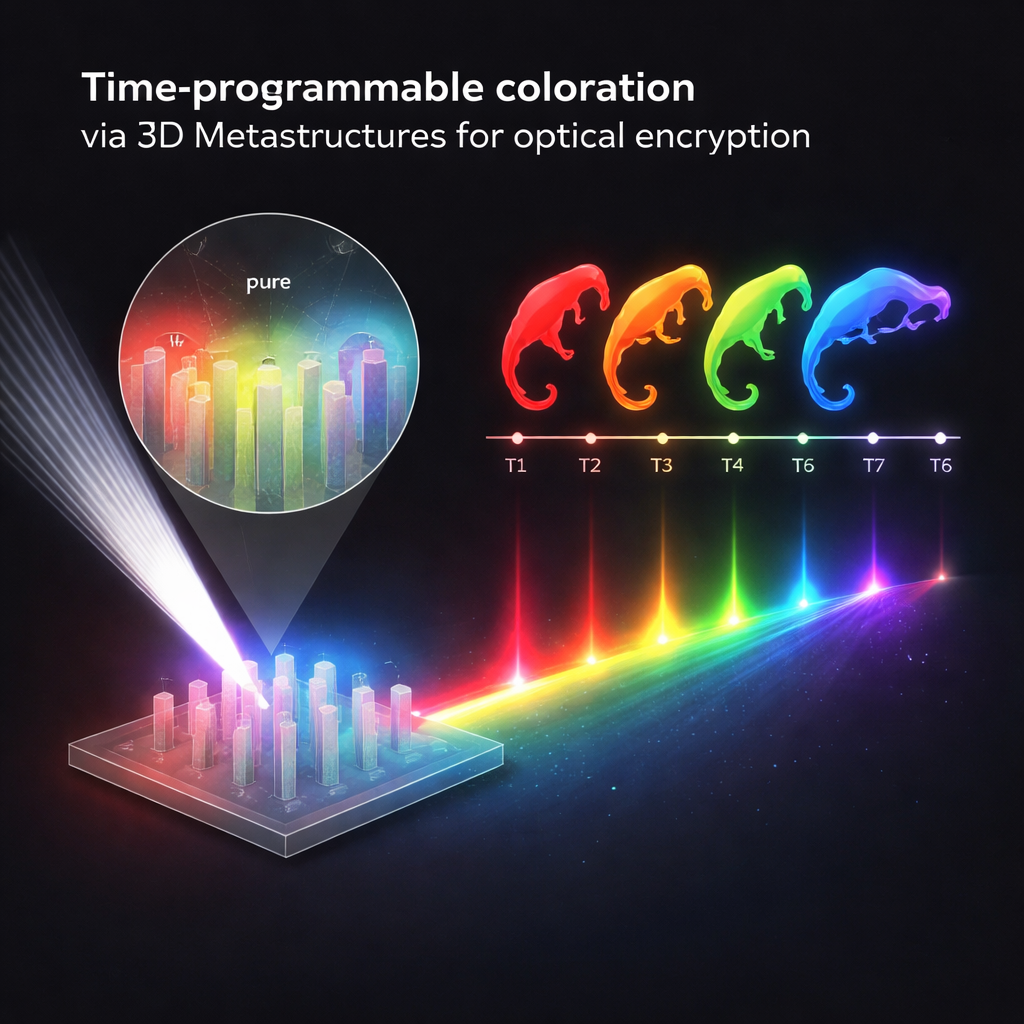
Building Smart Labels and Tiny Libraries
Because each color cell can be made smaller than a micrometer, the metastructures can encode a great deal of information in a very small area. The authors demonstrate anti-counterfeiting labels made of many color pixels arranged in designed patterns. A custom-trained neural network reliably recognizes genuine labels even when images are blurred, rotated, or partly stained, making copying difficult. They also build structural-color barcodes and a tiny matrix that stores the phrase “Imagination is more important than knowledge” by mapping letters and spaces onto combinations of colors and shapes. This scheme already reaches information densities on the order of hundreds of millions of bits per square meter, and could grow further as printing resolution and design complexity increase.
Color That Shifts, Reveals, and Erases
The most striking feature of this system is that its colors can be smoothly reprogrammed over time. The key is that the metastructures are very sensitive to the refractive index of their surroundings—essentially, how much the surrounding material bends light. By gently changing this index with mixtures of water and glycerol, the transmitted color from a given pattern slides continuously through the rainbow. The researchers exploit this to create time-programmable encryption: as the liquid composition evolves, different hidden words appear in sequence in the same physical area. Finally, as the liquid evaporates, capillary forces between neighboring pillars overcome their mechanical strength, causing them to bend and collapse. Once this happens, the color response is destroyed and the message can never be recovered, even if liquid is added again. 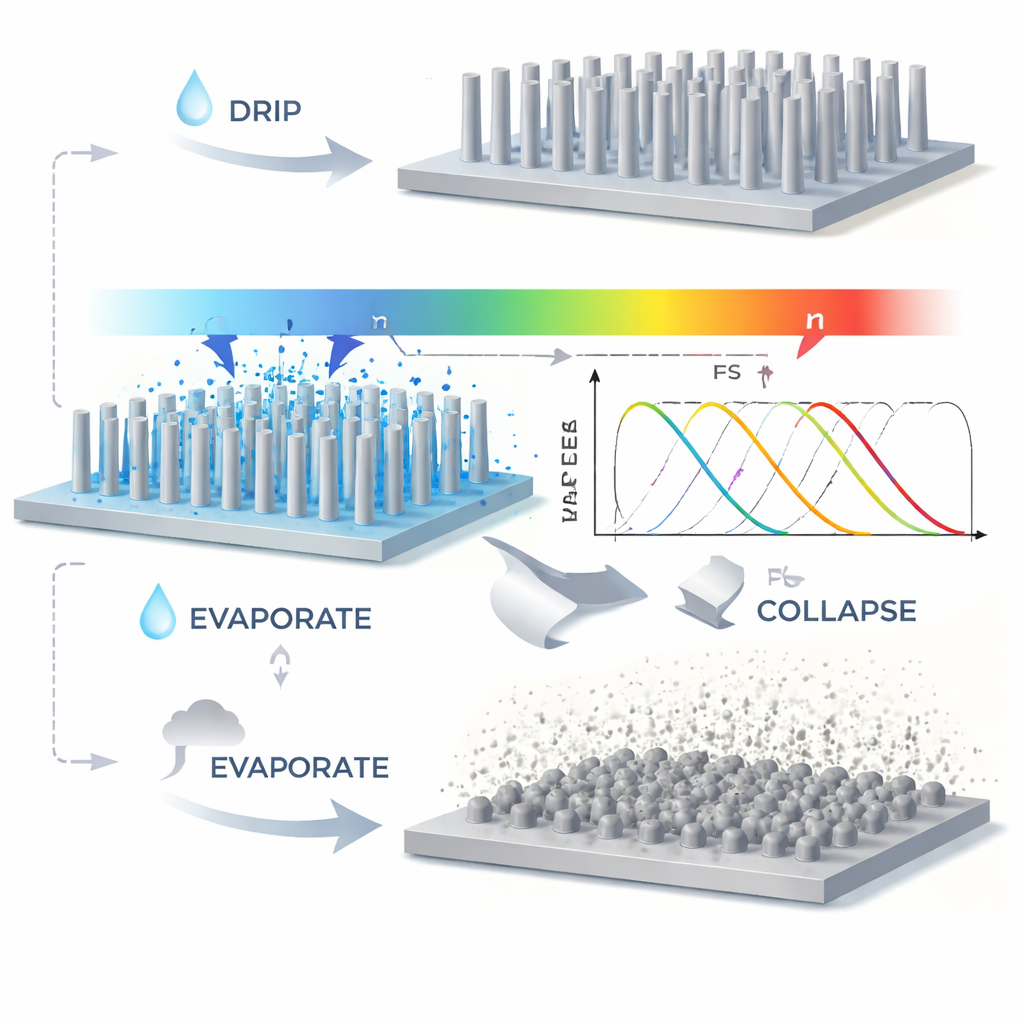
From Lab Demonstration to Future Secure Devices
In everyday terms, the authors have built a tiny, light-controlled “paper” that can be preset to reveal several messages one after another, then shred itself at the nanoscale. Because it needs only small amounts of simple liquids, no electronics, and no harsh chemicals, it offers an environmentally friendly path to secure, one-time-use messages and high-end anti-counterfeiting marks. While the current experiment shows four words and operates on the scale of seconds to minutes, the same principles could be extended to many more messages, faster responses, and richer control of light. This work suggests a future where some of our most sensitive information is protected not by passwords and code alone, but by the engineered physics of light and matter.
Citation: Zhao, MZ., Hu, ZY., Tao, YH. et al. Time-programmable coloration via 3D metastructures for optical encryption. Light Sci Appl 15, 118 (2026). https://doi.org/10.1038/s41377-026-02202-y
Keywords: optical encryption, structural color, metasurfaces, anti-counterfeiting, 3D nanoprinting