Clear Sky Science · en
Multicolor interband solitons in microcombs
Light Pulses That Change Color but Stay in Step
Every time you browse the web, stream a movie, or use GPS, you rely on light pulsing through optical fibers. Engineers would like those pulses to carry far more information and to reach new parts of the spectrum, especially the terahertz band useful for imaging and spectroscopy. This paper reports a way to make tiny devices on a chip generate pairs of ultrafast light pulses at different “colors” (frequencies) that stay perfectly in step with each other—a promising building block for future communications and sensing technologies.
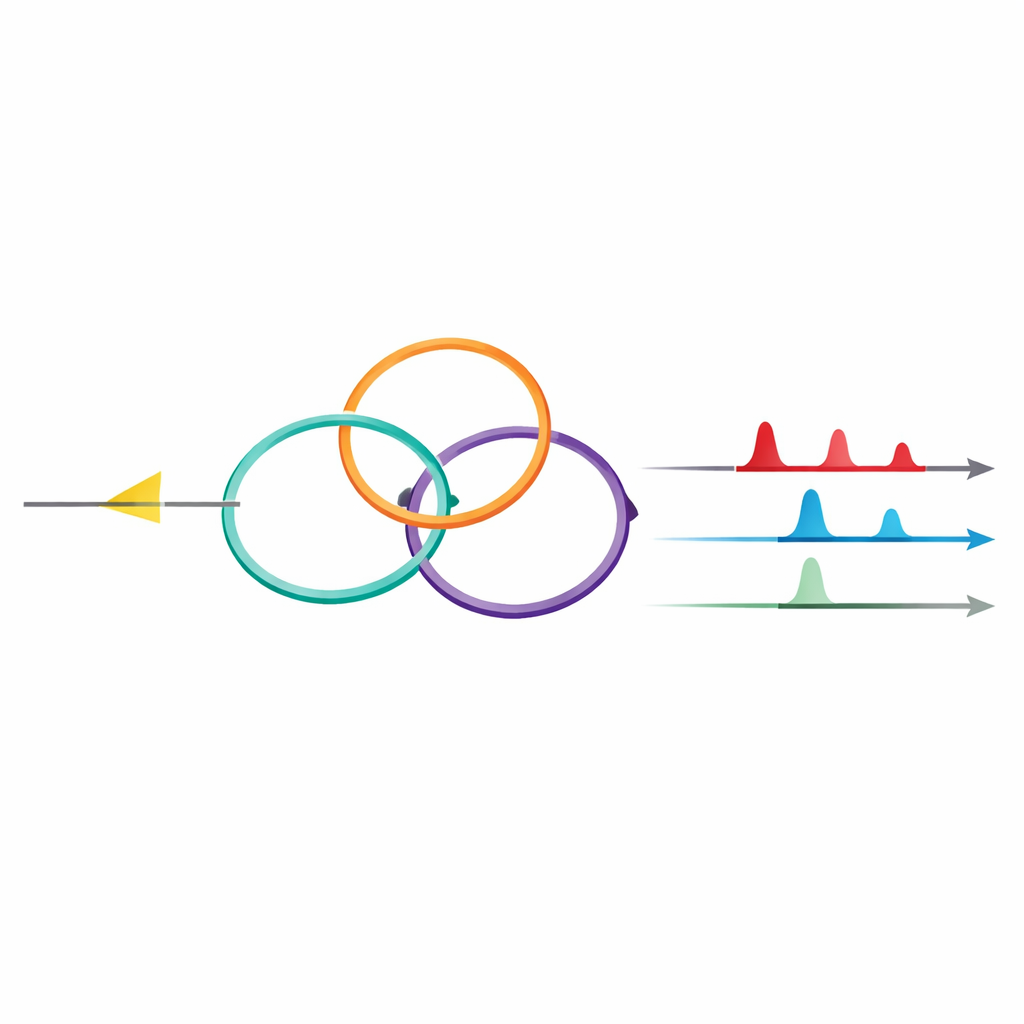
Self‑Organized Pulses in Tiny Light Traps
Inside an optical microresonator—a microscopic ring that traps light—laser light can form a special kind of self‑organized pulse called a soliton. Instead of spreading out, the pulse keeps its shape as it circulates, thanks to a balance between loss, gain, and the way the material bends different colors of light. Such solitons form the basis of “microcombs,” which are optical frequency combs shrunk onto a chip. Normally, a single laser pump produces a single family of soliton pulses. Earlier theory suggested that, under very specific conditions, one soliton could generate additional, phase‑linked solitons at other colors, but those conditions are hard to realize in standard devices.
Making Two Colors Share One Rhythm
The authors engineered a three‑coupled‑ring microresonator that has several distinct bands of resonant frequencies. By pumping one band with a continuous‑wave laser, they first create a primary soliton. That intense, tightly packed pulse acts as both a source of optical gain and a moving “potential well” for other frequencies through the Kerr effect, in which light modifies the medium’s refractive index. Under the right laser–cavity detuning, this environment allows a secondary soliton at a different color to appear abruptly, like a new runner falling into stride with the leader. Although the primary and secondary solitons occupy different frequency bands, they line up in time and circulate around the device with the same repetition rate, accompanied by a weaker third feature called an idler created by four‑wave mixing.
Proving the Pulses Are Real and Linked
To confirm that both colors form true ultrafast pulses, the team measures their temporal profiles using autocorrelation, finding femtosecond‑scale durations—about 700 femtoseconds for the primary soliton and 400 femtoseconds for the secondary one. A fast photodetector reveals only a single strong microwave tone, showing that the two pulse trains share exactly the same round‑trip time. In the optical spectrum, the device output displays two overlapping combs of equally spaced lines, one from each soliton, offset slightly in frequency. This offset means that, left alone, the optical phases of the two combs drift relative to one another, even though their timing is synchronized. The researchers then close a feedback loop that senses the beat between the combs and gently adjusts the pump laser, sharply reducing the phase noise of this beat and effectively locking the two colors into a coherent, extended comb.
Dialing the Color Gap with Heat
Because the three rings are coupled, changing their temperatures slightly reshapes the overall pattern of resonant frequencies. The device incorporates micro‑heaters on each ring, allowing the researchers to tune the dispersion landscape electrically. By adjusting heater voltages, they shift the frequencies where the parametric process is phase‑matched and thereby control the central colors of the primary and secondary solitons. Experiments show that the frequency separation between the two soliton colors can be tuned over a range from about 0.5 to 1.5 terahertz while keeping their repetition rate near 20 gigahertz. Numerical simulations based on coupled equations for the interacting fields back up the measurements and clarify the conditions under which the secondary soliton appears, including a clear threshold in laser detuning and a strong role for cross‑phase modulation in stabilizing the new pulse.
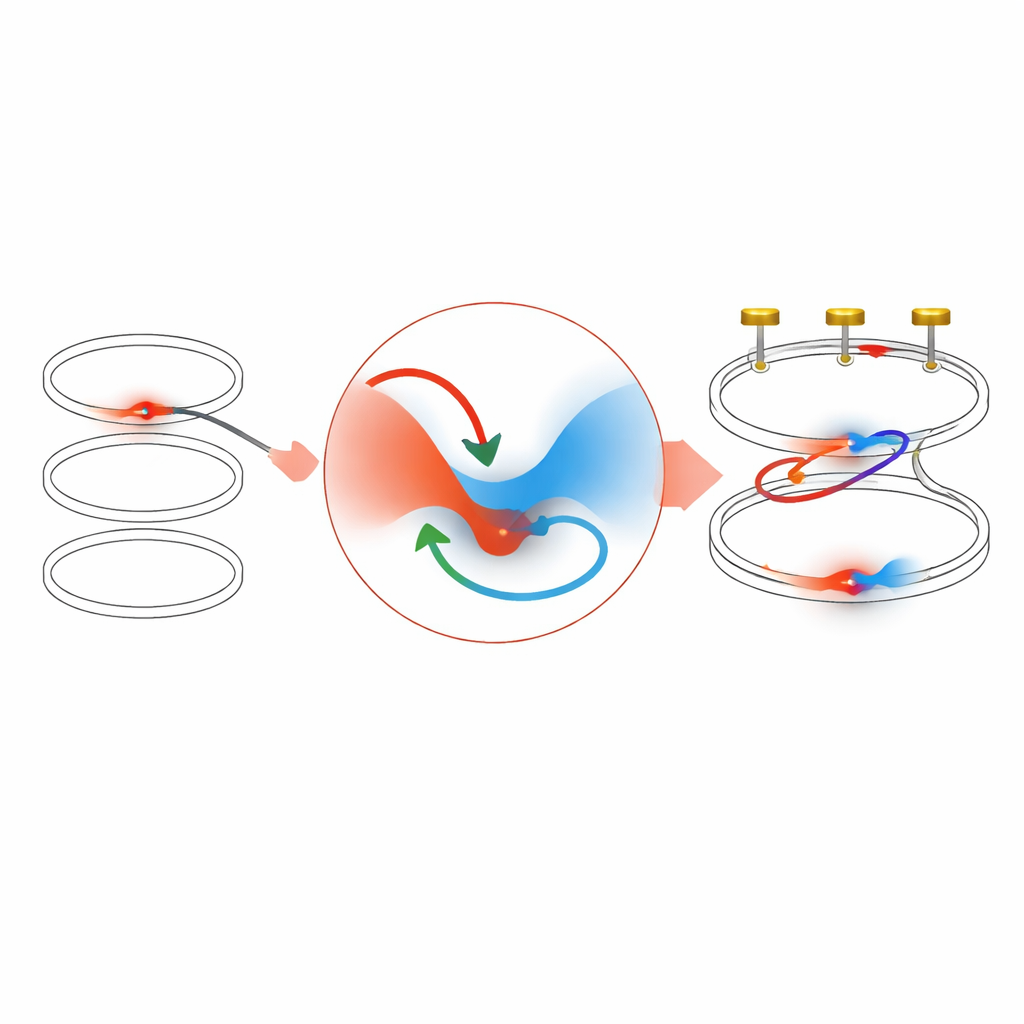
From Colored Pulses to Terahertz Combs
In everyday terms, this work demonstrates a chip‑scale device where a single laser pulse train spawns a second, differently colored pulse train that stays perfectly synchronized and can be tuned over a wide frequency gap. The beating between these two colors naturally produces a terahertz‑rate modulation in the light’s intensity, which can be converted into a terahertz frequency comb using existing photoconductive or nonlinear crystals. Because the terahertz carrier is adjustable while the pulse repetition is in the microwave range, such sources could offer high resolution and convenient detection for terahertz spectroscopy and dual‑comb systems. More broadly, the results expand the known family of optical solitons and point toward new ways to stretch the spectrum of microcombs for future communications, timing, and sensing technologies.
Citation: Ji, QX., Hou, H., Ge, J. et al. Multicolor interband solitons in microcombs. Light Sci Appl 15, 166 (2026). https://doi.org/10.1038/s41377-026-02200-0
Keywords: optical microcombs, dissipative solitons, multicolor pulses, terahertz frequency combs, integrated photonics