Clear Sky Science · en
Flexible, stretchable, on-chip optical tweezers for high-throughput bioparticle manipulation
A Tiny Light Lasso for Germs and Cells
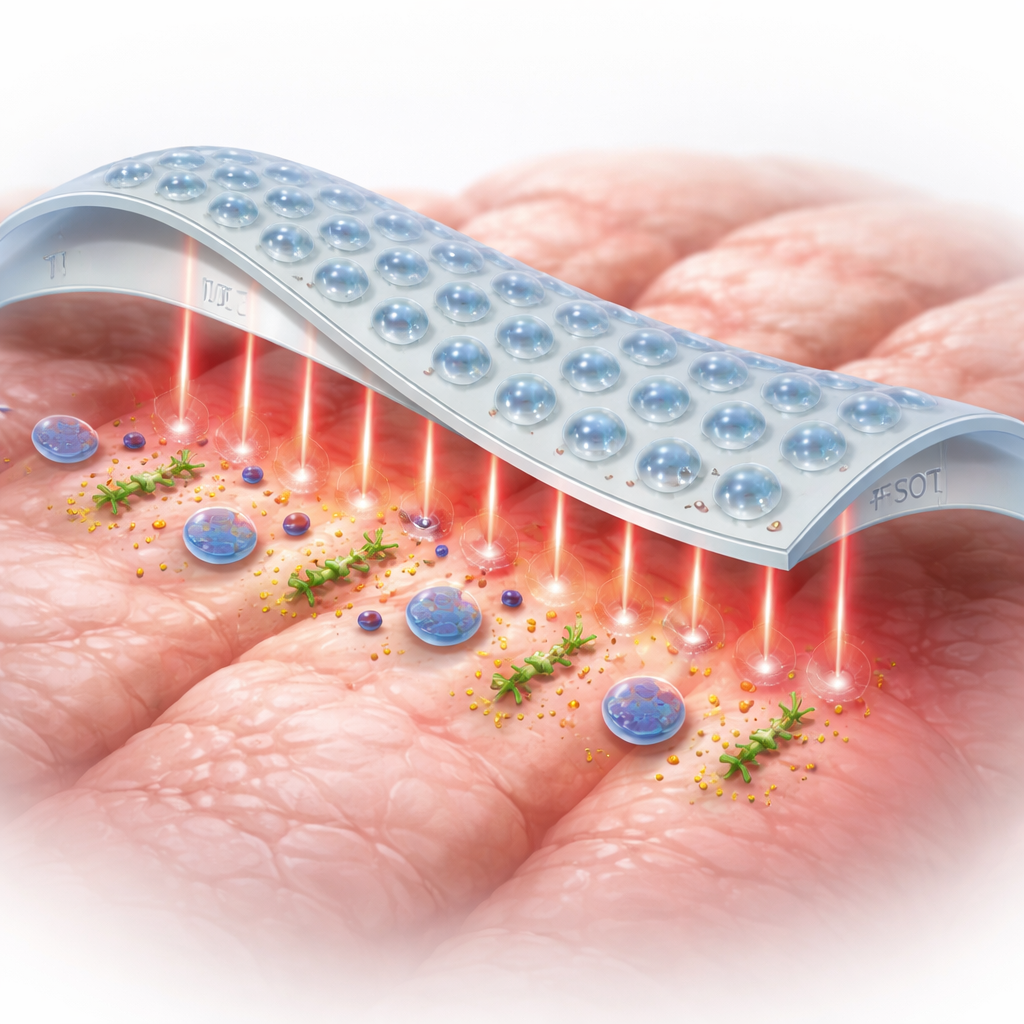
Imagine being able to grab, sort, and study single bacteria, cell fragments, or even virus-sized particles, all without touching them—just by using beams of light laid onto a flexible strip that can sit on real tissue. This is the promise of a new technology called flexible, stretchable on-chip optical tweezers (FSOT), which could help doctors and researchers analyze pathogens, test drugs, and watch how immune cells attack invaders in ways that were previously very hard to do.
Why Catching Single Particles Matters
Many diseases leave their earliest traces in tiny bits and pieces: bacteria, viruses, and nanoscale packages called exosomes that cells release into their surroundings. Being able to capture and move these bioparticles one by one can reveal how infections start, how drugs work, and how cells talk to each other. Existing tools—using sound waves, electric fields, magnets, or tightly focused laser beams—can trap particles, but they often handle only a few at a time, struggle with very small targets, or must sit on rigid chips that cannot be placed comfortably on curved or moving tissues.
Turning Soap Bubbles into Precision Optics
The researchers solved this problem by building forests of tiny lenses on a soft base. They first spread light-sensitive particles of titanium dioxide—each only a few micrometers wide—onto an ultra-thin soap film. Using a weak laser, they gently altered the film’s surface tension so these particles could be pushed and rotated into precise, close-packed patterns, like marbles being nudged into a perfect grid. This ordered microlens array was then lifted off and transferred onto stretchy silicone or directly onto uneven surfaces such as metal tubes, plant leaves, skin, and even intestinal tissue. When a second laser shines through the array, each little lens squeezes the light into a very narrow column, called a photonic nanojet, producing hundreds to a thousand tiny bright spots that act as “light lassos” for particles.
High-Speed Trapping and Smart Sorting
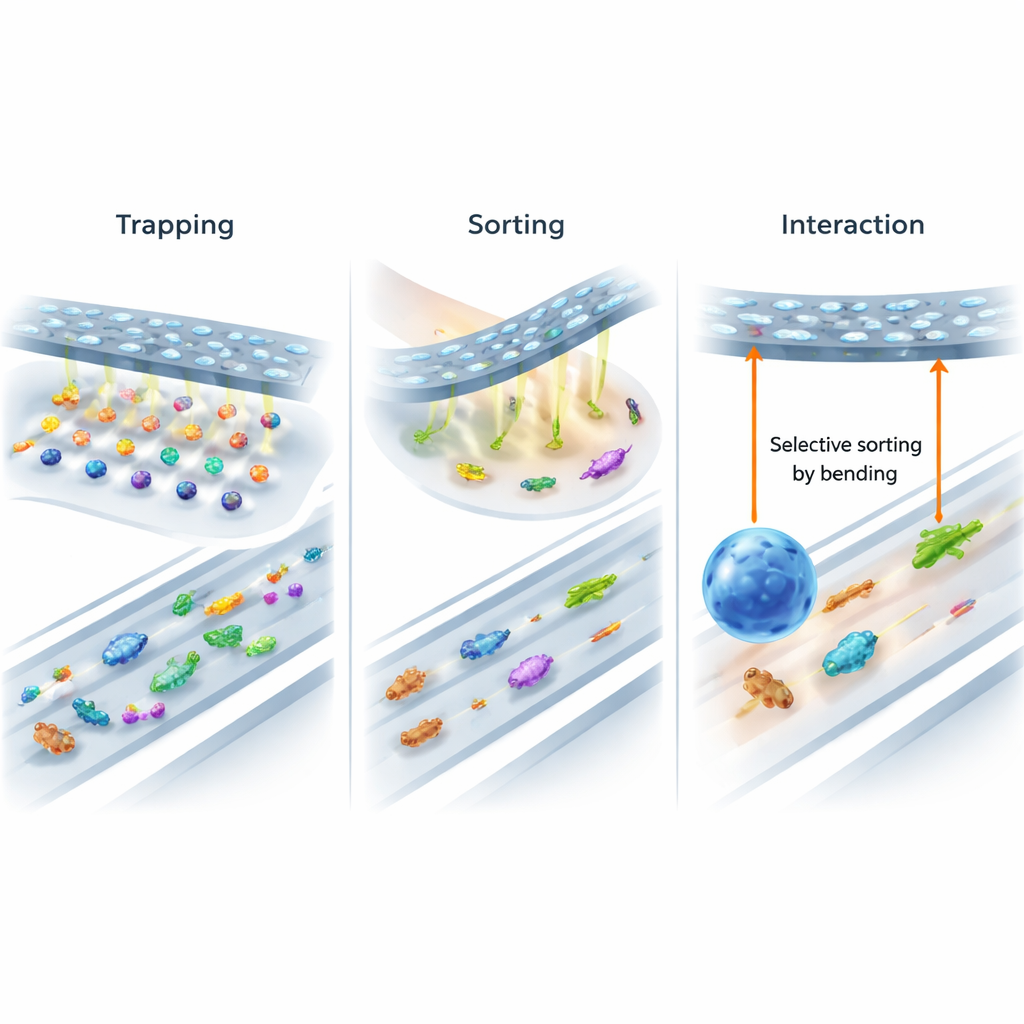
Using these light spots, the team demonstrated that FSOT can capture huge numbers of particles at once. Plastic beads as small as 95 nanometers and as large as 2 micrometers, along with real biological targets—exosomes, E. coli and S. aureus bacteria, and algae cells—were all trapped into orderly arrays within seconds. The strength of the light-based grip depends on particle size and laser power: larger particles feel stronger pulling forces, while smaller ones require more power to hold. By tuning the laser intensity, the researchers could selectively release one size of particle while keeping another, effectively sorting mixed samples. They showed, for instance, that reducing the power below a threshold freed 800-nanometer beads while 1-micrometer beads remained pinned in place. This control turned the flexible strip into a high-throughput optical sieve.
Wrapping Light Around Curves and Stretching Cell Distances
Real biological surfaces are rarely flat, so the team tested FSOT on bent and wrinkled setups. Even when the soft strip was curved by up to 40 degrees or laid over folds in intestine, skin, or leaf tissue, the microlenses still focused light well enough to trap scores to hundreds of particles, including exosomes on living-like tissues. Bending did reduce the light intensity and trapping strength, but the arrays stayed intact, and particles remained organized as the strip was flexed back and forth. Stretching added another powerful trick: because the lenses move farther apart, the distance between trapped objects can be dialed in simply by pulling on the strip. The scientists used this to hold single bacteria and single immune cells (macrophages) at controlled separations and then watched how the macrophages changed shape, extended “arms,” and eventually engulfed bacteria. When the bacteria started farther away, the immune response was slower and weaker, revealing how physical spacing shapes cellular communication.
What This Could Mean for Future Medicine
In plain terms, FSOT is a soft, wearable-like optical lab that can grab and move hundreds of tiny biological targets on complex surfaces while also tuning how close they are to each other. By combining flexibility, stretchability, and nanoscale precision, it overcomes key limits of older optical tweezers and rigid chips. In the future, such devices could help screen drugs by watching how large numbers of individual cells respond, study how pathogens interact with tissues in realistic settings, and even integrate with implantable or skin-mounted sensors. The work points toward a new class of gentle, light-based tools for probing and controlling the microscopic players that drive health and disease.
Citation: He, Z., Xiong, J., Shi, Y. et al. Flexible, stretchable, on-chip optical tweezers for high-throughput bioparticle manipulation. Light Sci Appl 15, 102 (2026). https://doi.org/10.1038/s41377-026-02199-4
Keywords: optical tweezers, bioparticle manipulation, flexible photonics, single-cell analysis, pathogen sorting