Clear Sky Science · en
Synchronization of complex spatio-temporal dynamics with lasers
Lasers That Fall Into Step
From heart cells to fireflies, nature is full of things that mysteriously fall into step. This paper shows that even tiny semiconductor lasers, each flickering in a complex and seemingly random way across space and time, can be coaxed to line up their behavior. Understanding and controlling this kind of "organized chaos" could enable new types of ultra-secure communication systems and brain‑inspired computing hardware, all built from inexpensive, off‑the‑shelf laser devices. 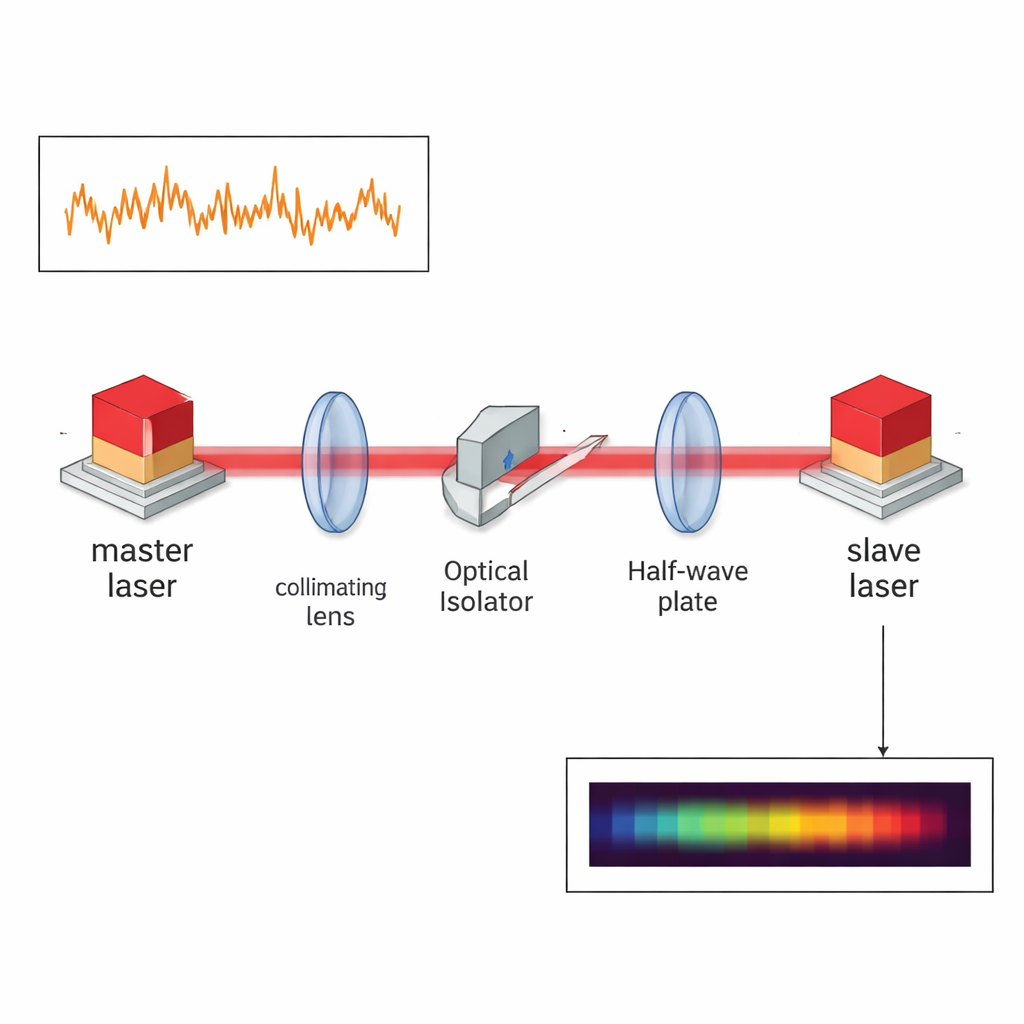
Why Synchrony Matters
Synchronization is what happens when moving systems begin to act together: pendulum clocks tick in unison, power grids lock to the same frequency, and groups of animals coordinate their motion. Scientists have studied such timing effects for centuries, and later discovered that even chaotic systems—those that are very sensitive to tiny disturbances—can synchronize if they are gently linked. But most work has focused on how things change over time at a single point. Many real systems, from weather fronts to brain activity, are spread out in space as well as time, forming complex patterns that swirl and shift. Showing that these rich space‑and‑time patterns can synchronize in a simple laboratory setup has been a long‑standing challenge.
Turning Simple Chips Into Complex Worlds
The authors use broad‑area vertical‑cavity surface‑emitting lasers, or BA‑VCSELs, as a compact playground for complex behavior. Unlike a thin laser beam that shines mainly in one spot and one direction of polarization, these devices emit light in many transverse patterns at once, each pattern with its own shape, color (wavelength), and polarization. As the electrical current through the chip increases, more of these patterns switch on and compete for energy. That competition leads to a cascade of changes—from steady flashing to quasi‑periodic motion and finally to chaos—with the light intensity and polarization hopping around on timescales from tens of megahertz up to tens of gigahertz. In effect, a single laser chip becomes a high‑speed, high‑dimensional chaotic system.
Making Two Chaotic Lasers Listen to Each Other
To explore synchronization, the team couples two nearly identical BA‑VCSELs in a “master–slave” arrangement, where light from the master is injected into the slave but not the other way around. By adjusting the currents and temperatures, they can finely tune which spatial patterns lasing in the slave lie closest in color to those in the master. They then monitor both lasers in great detail, using cameras to see spatial and spectral patterns and fast detectors to record the rapid intensity changes. The key finding is that strong synchronization appears whenever a powerful pattern (mode) in the master lines up in frequency with one of the modes in the slave—even if the two modes look quite different in space. In these cases, the measured correlation between the master and slave signals can reach very high values once fast wiggles are filtered out, showing that the slower polarization‑hopping dynamics fall into step. 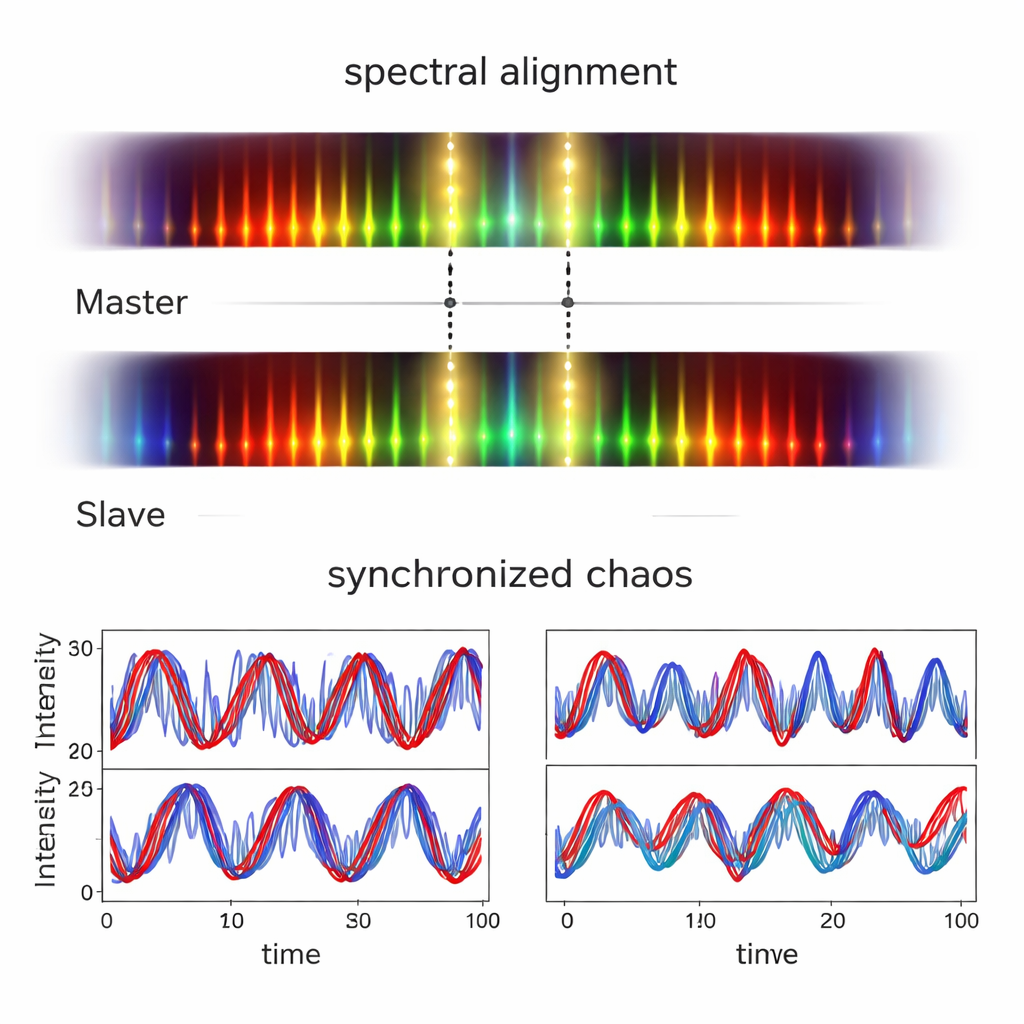
Different Flavors of Togetherness
The experiments reveal not just ordinary synchrony but several distinct "flavors". In some settings, the slave closely follows the master, rising and falling in brightness at nearly the same times. In others, the slave does the opposite: whenever the master grows brighter, the slave dims, a behavior known as inverse synchronization. This tends to occur when the injected light interacts strongly with modes of the opposite polarization inside the slave, so that different polarizations pull against each other. The authors also compare two operating regimes. When the master’s dynamics includes relatively slow polarization hopping, synchrony of the low‑frequency components becomes very strong, with correlations up to about 90%. When the master operates in faster, broadband chaos without polarization hopping, synchronization is weaker and harder to improve by filtering, underscoring that ultra‑fast chaotic details are more difficult to lock together.
From Lab Curiosity to Future Technologies
For a non‑specialist, the main message is that complex, noisy‑looking light from simple commercial lasers can be organized in a controlled way, even when the spatial patterns and spectra of the devices are far from identical. What needs to match is mainly the color of a few strong modes, not the full optical fingerprint. This flexibility makes it more realistic to build practical systems that harness synchronized laser chaos—for example, to hide information in fast, unpredictable light patterns for physical‑layer secure communication, or to use the rich spatio‑temporal dynamics as a resource in optical "reservoir" computers that mimic certain aspects of brain‑like processing. The work shows that synchronization in space and time is not just a curiosity of natural systems but a powerful design tool for future photonic technologies.
Citation: Mercadier, J., Bittner, S. & Sciamanna, M. Synchronization of complex spatio-temporal dynamics with lasers. Light Sci Appl 15, 131 (2026). https://doi.org/10.1038/s41377-026-02198-5
Keywords: laser chaos, synchronization, VCSEL, secure communications, spatiotemporal dynamics