Clear Sky Science · en
Experimental observation of topological Dirac vortex mode in terahertz photonic crystal fibers
Why this fiber breakthrough matters
Our wireless world is hungry for ever-faster connections, from streaming and cloud gaming to future augmented reality and sensing. Terahertz (THz) waves—frequencies between microwaves and infrared light—could offer huge data rates and ultra-low delay, but they are quickly absorbed in air. To put THz technology to practical use, engineers need special fibers that can guide these waves cleanly, without scrambling their polarization or distorting their pulses. This paper reports the first experimental realization of a new kind of guided wave in such a fiber: a topological “Dirac vortex mode” that carries terahertz signals in a uniquely stable and robust way.
A new way to tame terahertz signals
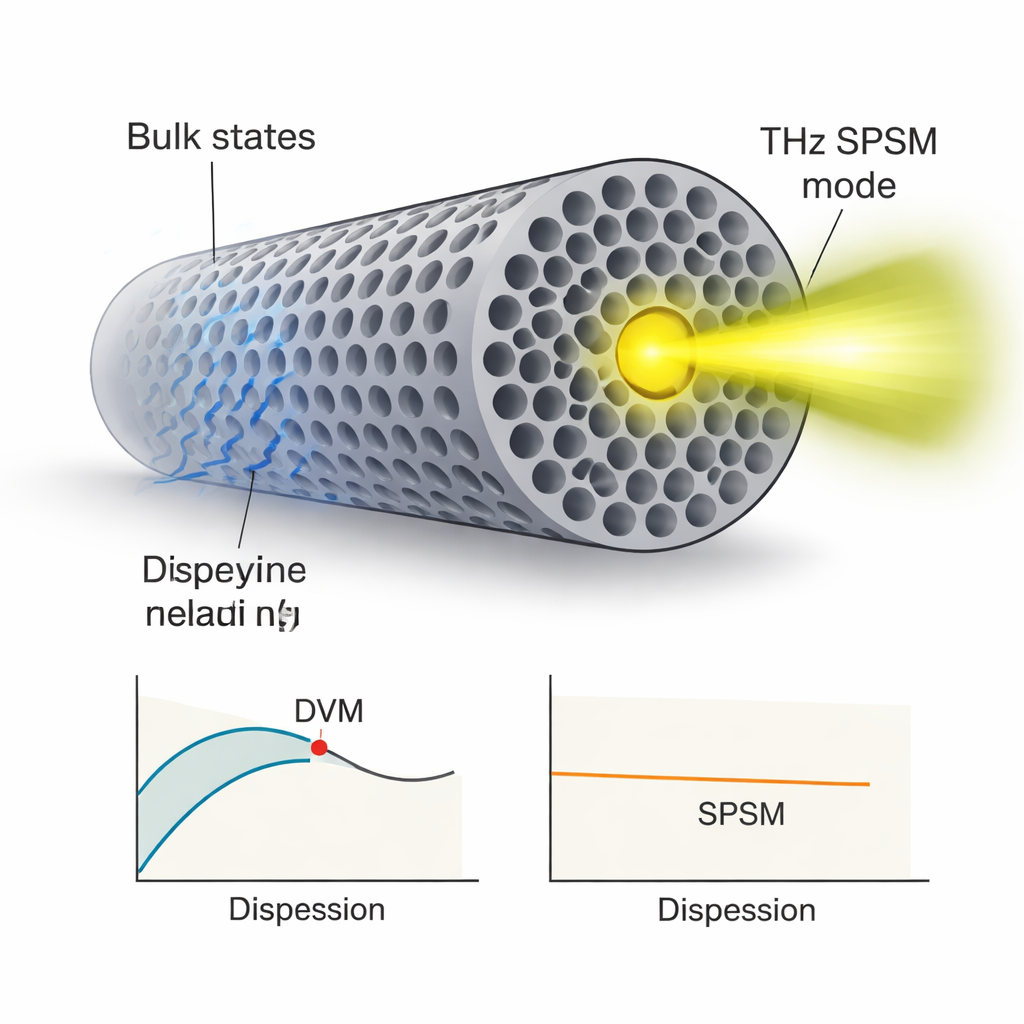
Conventional optical and terahertz fibers often support multiple polarizations and modes, which can mix and interfere as a signal travels. This mixing leads to crosstalk, pulse broadening, and loss of information—serious drawbacks for high-speed communication and precision sensing. Engineers have tried to enforce “single-polarization, single-mode” (SPSM) behavior by building asymmetries or strong birefringence into the fiber, or by selectively filtering out unwanted modes. However, these methods typically leave some residual polarization distortion and tend to work only over a relatively narrow frequency band. The authors instead turn to ideas from topological physics, where special wave patterns can be protected by the geometry and symmetry of a structure, making them much harder to disturb.
Topological waves in a patterned fiber
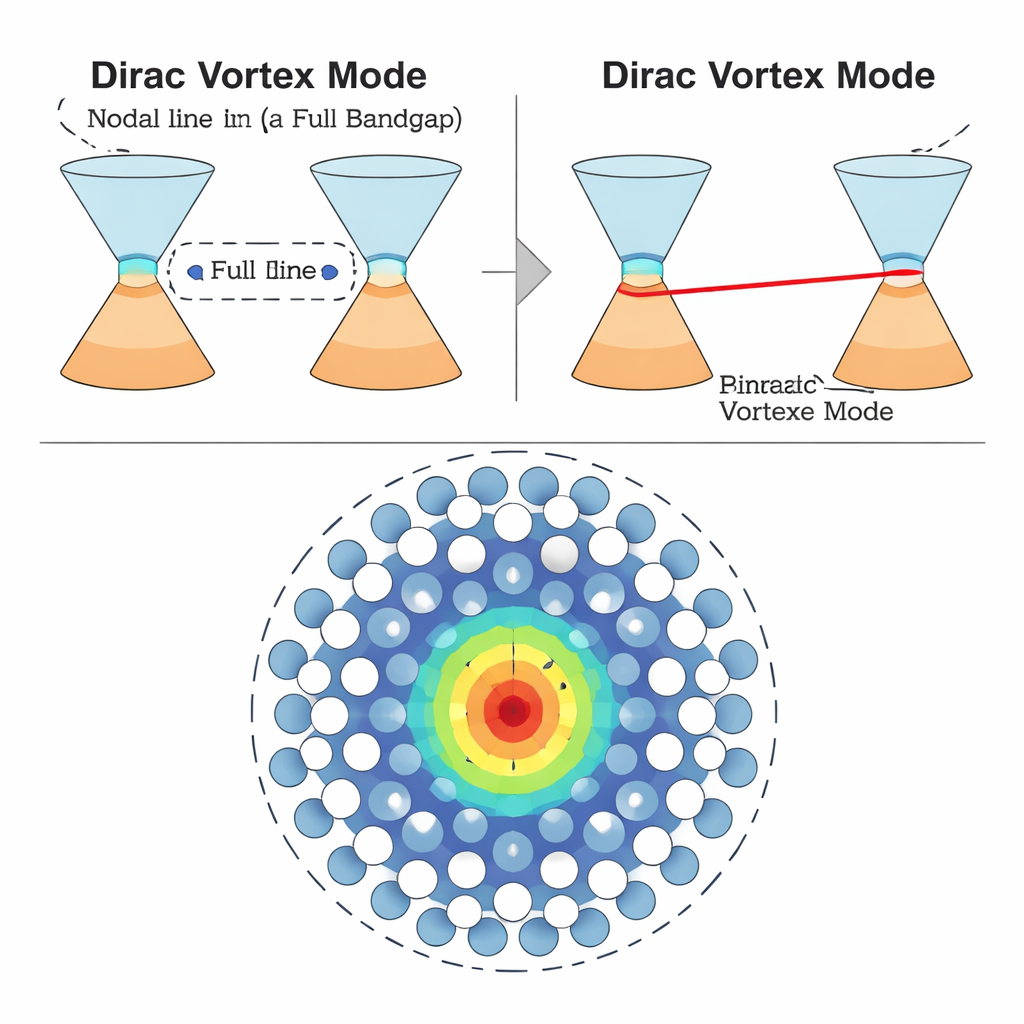
The team designs a photonic crystal fiber: a solid material pierced by a regular lattice of air holes, forming a pattern that strongly shapes how light or THz waves propagate. They use a hexagonal “superlattice” of air holes and introduce a carefully controlled distortion known as a Kekulé modulation, which slightly changes the size of the holes in a repeating pattern. By also winding the phase of this modulation around the center of the fiber, they create a vortex-like defect region at the core. Theory predicts that this combination produces a special wave—called a Dirac vortex mode—that lives in the middle of a bandgap, meaning it is isolated in frequency from all other bulk modes and tightly confined to the central core.
Building and mapping the Dirac vortex mode
To test this design, the researchers 3D-print the fiber using a high-temperature resin that is transparent in the terahertz range, then drill the air-hole pattern to match the Kekulé design. They probe the guided waves using terahertz scanning near-field microscopic spectroscopy, a technique that scans a tiny detector across the fiber’s output face with micrometer precision. By recording the electric field as a function of both time and position, and then applying a short-time Fourier transform, they reconstruct how the Dirac vortex mode behaves across frequency, space, and time. The measured field maps show a single, tightly confined mode at the core whose shape matches simulations, and whose dispersion—the relation between frequency and wavevector—is almost perfectly linear across a broad frequency range.
Strong confinement, wide band, and a vortex twist
The experiments reveal several striking properties. First, the Dirac vortex mode supports pure single-polarization, single-mode propagation over an 85.7% fractional bandwidth in the 0.2–0.5 THz range—much wider than previous SPSM terahertz fibers. The mode area is extremely small, using only about 0.05% of the full cross-section, which means the THz energy is strongly concentrated and the fiber could be very compact. The group velocity is well-defined and nearly dispersionless, so pulses maintain their shape as they travel. Losses are dominated by the resin material itself; the inherent “confinement loss” from leakage is relatively low and could be further reduced with better, lower-loss materials. Crucially, by rotating the input polarization and imaging the resulting patterns, the team confirms that the electric field vectors swirl around the core, forming a vortex-like polarization that is topologically protected and does not suffer from the usual polarization-mode dispersion.
What this means for future technologies
In everyday terms, the authors have demonstrated a terahertz fiber that carries a single, well-behaved vortex-polarized wave over a wide band of frequencies, without the polarization tangling and mode mixing that plague conventional designs. Because the guiding mechanism is topological, it is inherently robust to many imperfections, promising more reliable THz links for high-speed communications, nondestructive imaging, and sensing. With improved low-loss materials and more precise fabrication, such topological Dirac vortex fibers could become key building blocks for future terahertz networks, integrated photonic circuits, and even quantum technologies that rely on clean, controllable light fields in the terahertz domain.
Citation: Xing, H., Xue, Z., Shum, P.P. et al. Experimental observation of topological Dirac vortex mode in terahertz photonic crystal fibers. Light Sci Appl 15, 97 (2026). https://doi.org/10.1038/s41377-026-02197-6
Keywords: terahertz photonic crystal fiber, single-polarization single-mode, topological photonics, Dirac vortex mode, vortex polarization