Clear Sky Science · en
Suspended waveguide-enhanced near-infrared photothermal spectroscopy for ppb-level molecular gas sensing on a chalcogenide chip
Why Shrinking Gas Sensors Matters
From tracking greenhouse gases in the atmosphere to monitoring our breath for signs of disease, there is a growing need for gas sensors that are small, inexpensive, and incredibly sensitive. Today’s most precise instruments are usually bulky and power-hungry. This research shows how to squeeze that performance onto a tiny glass chip by using light and heat in a clever way, opening paths toward portable environmental monitors, medical wearables, and compact safety detectors.
Turning Light into Heat, Then into a Signal
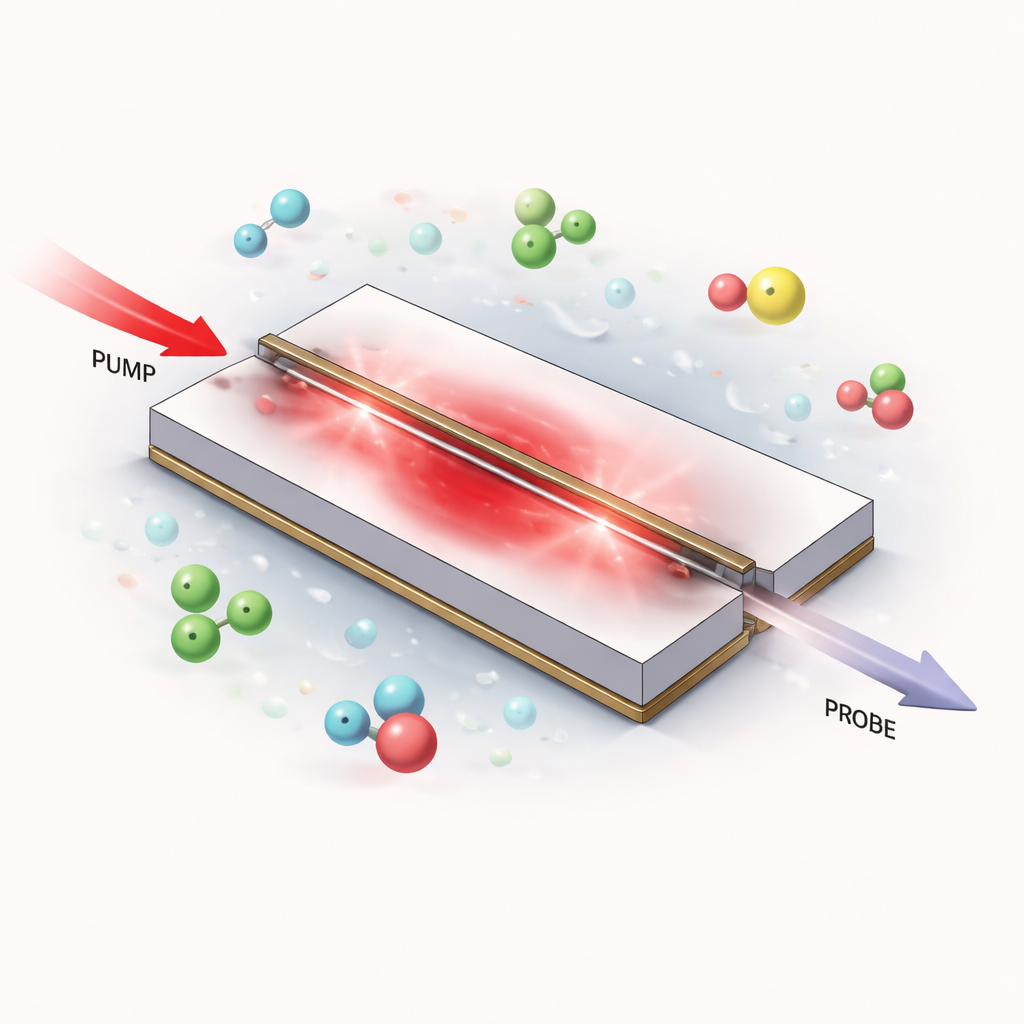
Most chip-based gas sensors work like miniature breathalyzers: they shine light through or alongside a gas and measure how much is absorbed. But because the light interacts with the gas over only a short distance on a chip, the signal is usually weak, limiting sensitivity to parts-per-million levels. The team behind this study uses a different trick called photothermal spectroscopy. Instead of looking for a small dip in light intensity, they let gas molecules absorb a modulated laser beam, which gently heats their surroundings. A second laser then detects the tiny change in the material’s optical properties caused by this heating, translating it into a phase shift that can be measured with high precision and very little background noise.
A Suspended Light Highway for Better Interaction
The core innovation is a specially engineered "suspended" waveguide made of a chalcogenide glass, a type of glass that responds strongly to temperature. This narrow ridge of glass is supported like a bridge, with air above and below instead of a solid layer underneath. As light travels along the waveguide, a portion of its electric field leaks out into the air, where gas molecules reside. Suspending the structure dramatically increases this overlap between light and gas, so more pump light is absorbed. At the same time, the air gap acts as a thermal blanket, slowing heat loss into the underlying silicon. As a result, the tiny bursts of heat from absorbed light build up more effectively around the waveguide.
From Careful Modeling to Practical Design
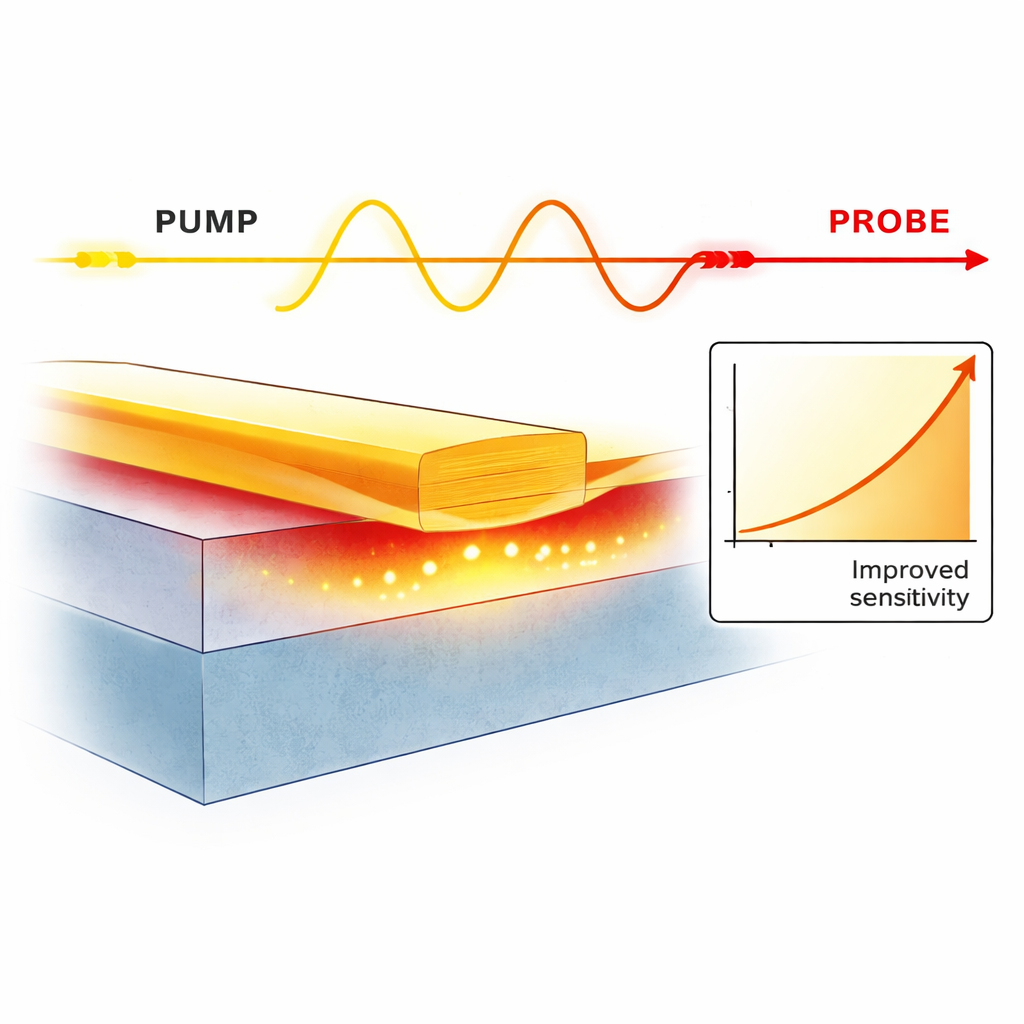
To get the most out of this suspended structure, the researchers developed a mathematical model that treats the combined optical and thermal behavior in an "equivalent" way. This allowed them to tune the dimensions of the glass ridge and the thickness of the air gap to maximize the phase shift on the probe beam per unit of absorbed light. Their analysis showed that, compared with a conventional waveguide sitting on solid glass, the suspended design can generate roughly four times more heat from the same amount of absorbed pump power and reduce effective heat leakage by more than a factor of ten. In total, this yields about a 45-fold boost in the strength of the photothermal phase signal for a waveguide just over a centimeter long.
Building and Testing a Chip-Scale Gas Detector
The team fabricated the optimized waveguides using a process compatible with standard semiconductor manufacturing. Microscopic holes etched around the glass ridge allow an acid bath to remove the underlying oxide layer, leaving the structure suspended while still mechanically robust. They then formed a simple on-chip interferometer by using the natural reflections at the chip facets, converting the thermally induced phase shift of the probe laser into an intensity signal that can be read out electronically. With this setup, they targeted acetylene gas, a common test molecule, shining in a near-infrared wavelength band where absorption is relatively weak and thus challenging to detect.
Reaching Billionth-Level Detection on a Tiny Chip
Despite the modest interaction length and weak absorption in the near-infrared, the suspended waveguide sensor achieved a detection limit of about 330 parts per billion of acetylene. It could also track gas concentrations across nearly six orders of magnitude, from trace levels up to tens of percent, all while responding in under a second—fast enough to follow rapid changes in a gas stream. The overall sensitivity, expressed as the smallest detectable absorption per unit length, outperforms previous waveguide-based sensors by one to four orders of magnitude and sets a new benchmark for on-chip gas sensing in this spectral region.
What This Means for Everyday Sensing
In simple terms, this work shows that by suspending a tiny glass light guide and using heat instead of mere dimming of light, a chip the size of a fingernail can detect vanishingly small amounts of gas. Because the materials and fabrication methods are compatible with mainstream photonics and electronics, the same approach could be extended to other gases, including pollutants and biomarkers, and to mid-infrared wavelengths where many molecules absorb more strongly. That combination of ultra-high sensitivity, compact size, and potential low cost brings us closer to everyday devices—drones, wearables, home monitors—that quietly and continuously keep track of the invisible chemicals around and within us.
Citation: Zheng, K., Liao, H., Han, F. et al. Suspended waveguide-enhanced near-infrared photothermal spectroscopy for ppb-level molecular gas sensing on a chalcogenide chip. Light Sci Appl 15, 116 (2026). https://doi.org/10.1038/s41377-026-02196-7
Keywords: on-chip gas sensing, photothermal spectroscopy, suspended waveguide, chalcogenide glass, near-infrared sensors