Clear Sky Science · en
Dual-mode 0D/2D spatial asymmetry optoelectronic device enabled by in situ microzone femtosecond laser deposition
Smarter Electronic Eyes for Future Robots
Modern robots and wearable gadgets increasingly need vision that is not only sharp and fast, but also capable of learning from what they see. Today those abilities usually require many separate components and complex wiring. This research introduces a new kind of tiny “electronic eye” that can both detect rapid changes in light and remember visual information, all in a single simple device. Such technology could help build more compact, energy‑efficient cameras for artificial intelligence, humanoid robots, and augmented reality systems.
A Tiny Device That Sees and Remembers
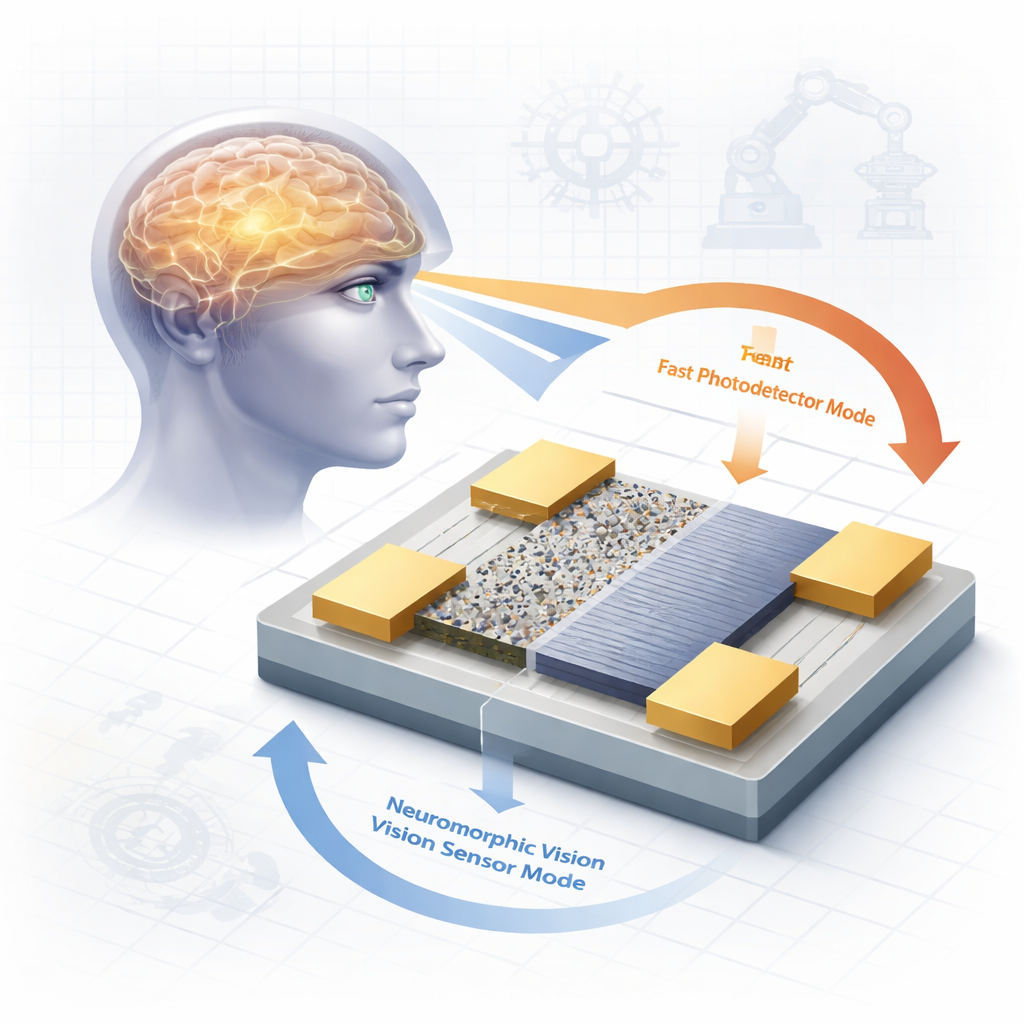
Our own eyes do two things at once: they sense light quickly and feed the brain with information that can be stored as memories. By contrast, most cameras and chips split these tasks across many elements. In this work, the authors combine both functions into one miniature component they call a dual‑mode optoelectronic device. Depending on how it is wired, the same structure can act either as a high‑speed light detector or as a neuromorphic vision sensor that behaves a bit like a biological synapse, strengthening its response based on past illumination. With a simple flip of the voltage direction, the device switches between these two personalities.
Building with Flat Sheets and Tiny Dots
The device is built from extremely thin materials. The base is a flat sheet of molybdenum disulfide, or MoS₂, just a few dozen atoms thick, which serves as the main pathway for electrical current. On top of part of this sheet, the team deposits zero‑dimensional black phosphorus nanoparticles—tiny specks only a few nanometers across—while another part is shielded by a protective layer made from hexagonal boron nitride. This deliberate imbalance, where one side is coated with particles and the other is masked, gives the device a built‑in left–right asymmetry that turns out to be crucial for its dual behavior.
Sculpting Matter with Ultrashort Laser Pulses
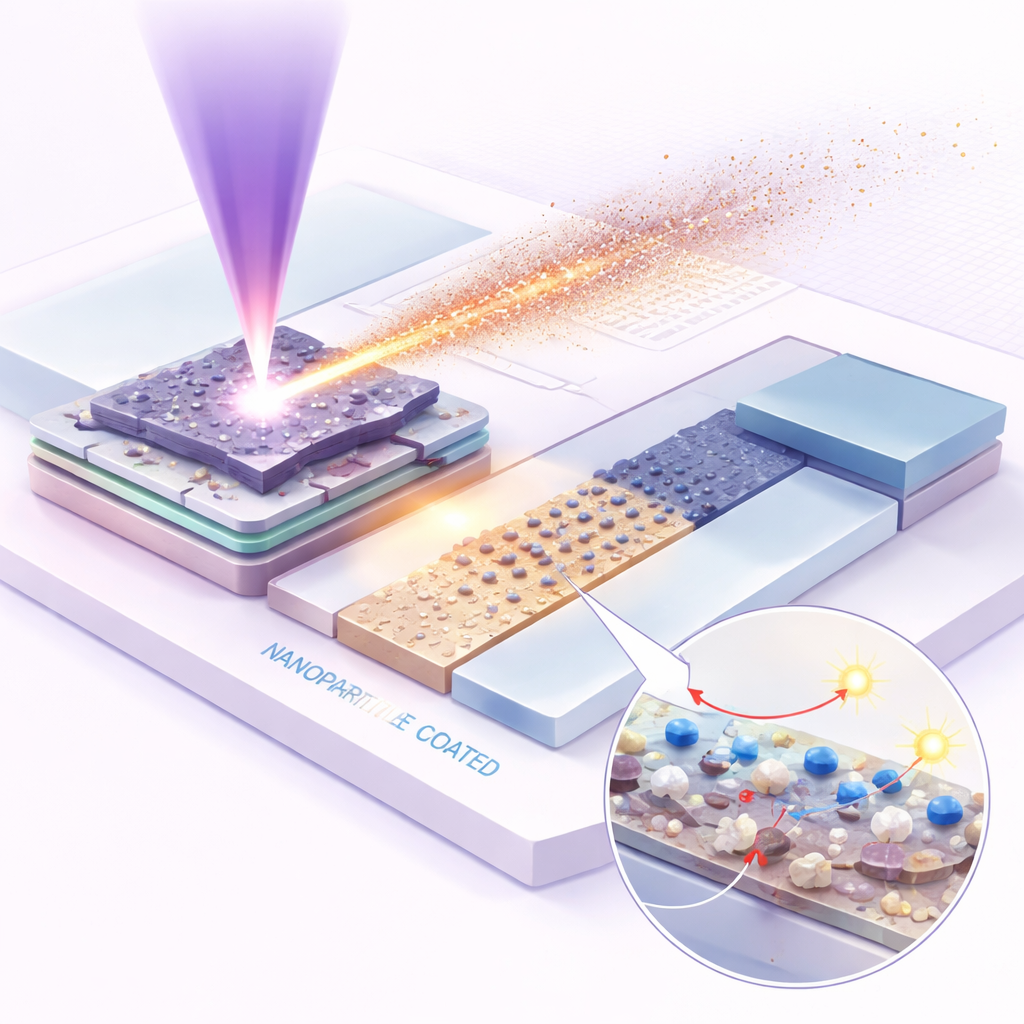
To place the nanoparticles exactly where they are needed, the researchers developed a method called Microzone Femtosecond Laser Deposition. Instead of spreading particles across a whole chip with liquids or large‑area coating, they focus an ultrafast laser onto a tiny flake of black phosphorus. Each laser pulse lasts only a few quadrillionths of a second, which lets it blast off material without heating and damaging nearby structures. The ejected material forms a spray of nanoparticles that travels only about 16 micrometers—roughly one‑fifth the width of a human hair—before landing on the exposed MoS₂. By tuning the laser energy and geometry, the team can control how many particles form, how large they are, and how far they spread, creating clean, precise patterns on demand.
From Fast Camera to Learning Pixel
Once in place, the nanoparticles do double duty. First, they donate electrons to the MoS₂ sheet, making it more conductive and improving its sensitivity to light over a broad range, from ultraviolet to near‑infrared. Second, when light shines on the structure, some charges become trapped in the particles and linger there, effectively “gating” the current in the underlying sheet even after the light is turned off. This memory‑like effect allows the device, under one wiring direction, to behave as a neuromorphic sensor: repeated flashes of light strengthen its electrical response in a way similar to how biological synapses reinforce connections. Under the opposite wiring direction, only the fast, transient part of the response is used, giving a rapid photodetector that can follow flickering light up to several thousand times per second.
Toward Compact, Energy‑Frugal Machine Vision
The researchers show that their single device can both track very fast light signals—faster than the human eye can resolve—and store visual patterns using extremely little energy per event. In computer tests, arrays of such devices could recognize handwritten digits with high accuracy, hinting at their potential as building blocks for future machine‑vision hardware. For a layperson, the takeaway is that this work offers a way to shrink an entire camera plus parts of a brain‑like processor into a much simpler, more efficient element. That could eventually lead to slimmer smart glasses, nimbler robots, and other systems whose “eyes” can see quickly and learn from experience at the same time.
Citation: Li, Z., Zou, G., Huo, J. et al. Dual-mode 0D/2D spatial asymmetry optoelectronic device enabled by in situ microzone femtosecond laser deposition. Light Sci Appl 15, 153 (2026). https://doi.org/10.1038/s41377-026-02195-8
Keywords: neuromorphic vision, photodetector, 2D materials, black phosphorus nanoparticles, femtosecond laser deposition