Clear Sky Science · en
Low-threshold interlayer exciton multiplication in twisted transition metal dichalcogenides heterobilayers
Turning One Particle of Light into Many Charges
Solar cells and light sensors normally turn each incoming particle of light into at most one usable electrical charge. This paper shows a way to break that rule using ultra-thin stacks of crystals only a few atoms thick. By cleverly twisting and stacking these sheets, the authors coax a single high‑energy photon to generate multiple long‑lived electrical excitations, offering a route to future solar cells and detectors that harvest more energy from the same light.
Why Flat Crystal Sandwiches Matter
Modern materials science can peel certain crystals down to single atomic layers, like sheets of graphene or related compounds called transition metal dichalcogenides. When two different layers are stacked, they form a "van der Waals" sandwich held together by weak forces. In some combinations, electrons naturally prefer one layer while the matching positive charges, or holes, prefer the other. When light excites such a pair, the result is an interlayer exciton: a bound electron–hole pair stretched across the interface. These interlayer excitons sit in an energy range useful for infrared light and can be tuned by the choice of materials and by rotating one sheet with respect to the other.
Making More Than One Excitation per Photon
The central achievement of the study is to show that twisted stacks of MoS2 and WSe2 can use a single energetic photon to generate more than one interlayer exciton, a process called interlayer exciton multiplication. Above a certain threshold energy, roughly twice the energy gap between the two layers, the brightness of the interlayer light emission and the number of excited charges both increase more quickly than expected. Careful measurements reveal that the quantum yield—the number of excitons created per absorbed photon—jumps above one and can reach close to 1.9 in nearly aligned stacks, meaning almost every high‑energy photon makes a second exciton instead of wasting its excess energy as heat. 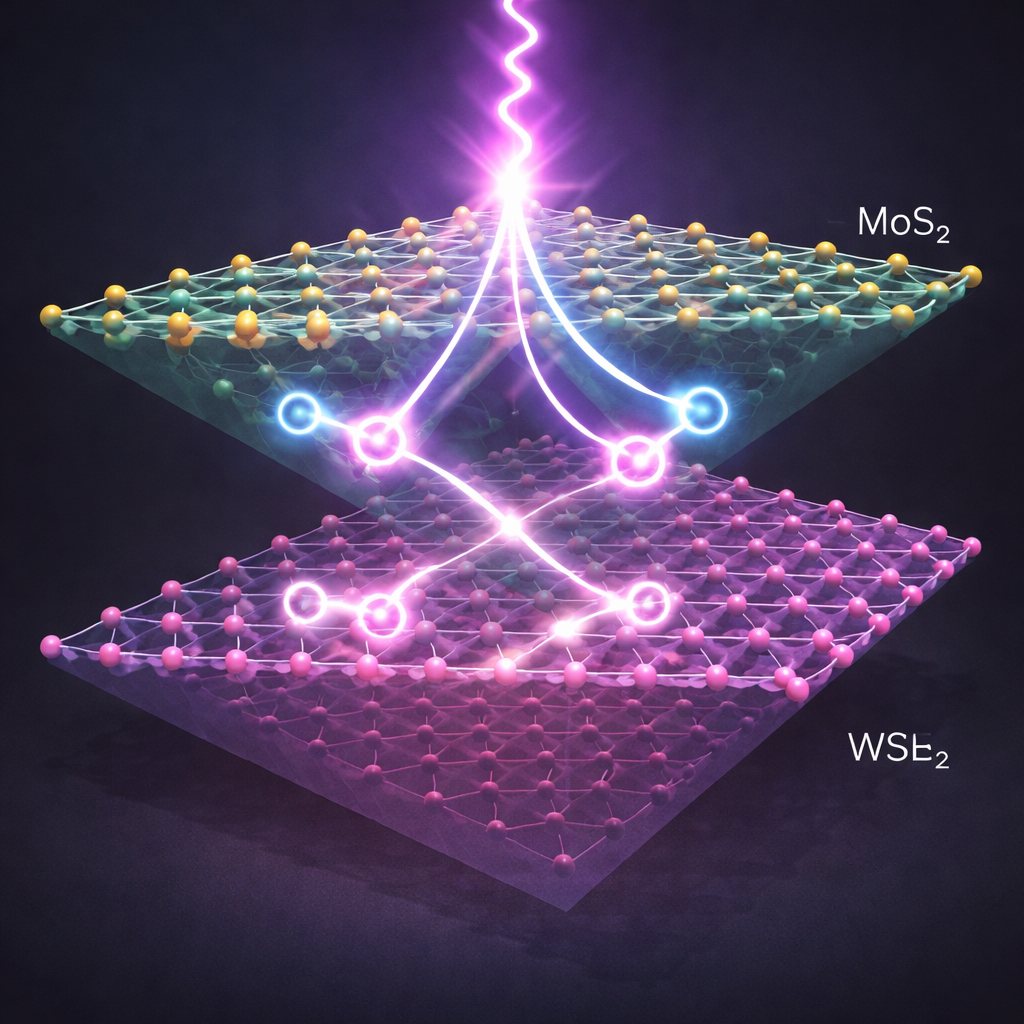
How Twisting and Scattering Enable the Effect
At first glance, this multiplication should be hard because energy and momentum must both be conserved when an excited “hot” electron transfers its extra energy to create an additional pair. Twisting the layers misaligns their electronic landscapes, which would normally worsen this problem. Experiments and detailed calculations show that fast scattering processes come to the rescue. After a photon excites hot carriers in one layer, these carriers rapidly hop across the interface and exchange energy with other carriers, assisted by vibrations in the lattice. This impact ionization uses the built‑in energy offsets between layers, keeping the threshold near the ideal factor of two, and continues to function even when the layers are twisted by tens of degrees. However, the efficiency slowly drops with larger twist angles and higher photon energies, as the relevant scattering events become less frequent.
Long‑Lived Interactions and Collective Behavior
Unlike many earlier multiple‑exciton systems, where the extra excitations vanish within trillionths of a second, the interlayer excitons in these stacks persist for billionths of a second or more—one to two orders of magnitude longer. Because the electron and hole sit in different layers, their wavefunctions overlap less, suppressing rapid recombination. At high densities created above the multiplication threshold, the researchers observe that the exciton energies shift to lower values, signaling attractive interactions over distances of several nanometers. These long‑range, dipole‑like attractions arise from many interlayer excitons influencing each other and suggest that dense, interacting exciton fluids can be created and controlled in such structures.
From Exotic Physics to Better Photodiodes
To show that this physics can benefit real devices, the team builds a small photodiode from a lightly twisted MoS2/WSe2 stack. When light shines on the device, the multiplied interlayer excitons are pulled apart by an electric field and collected as current. The measured photocurrent per absorbed photon reveals the same threshold near twice the interlayer gap, confirming that multiplication survives the journey from optical excitation to electrical output. Applying a modest reverse voltage gives the hot electrons an extra push, lowering the effective threshold and boosting the current further. In practice, this leads to roughly a doubling of internal efficiency and a several‑fold increase in responsivity compared with operation at lower photon energies. 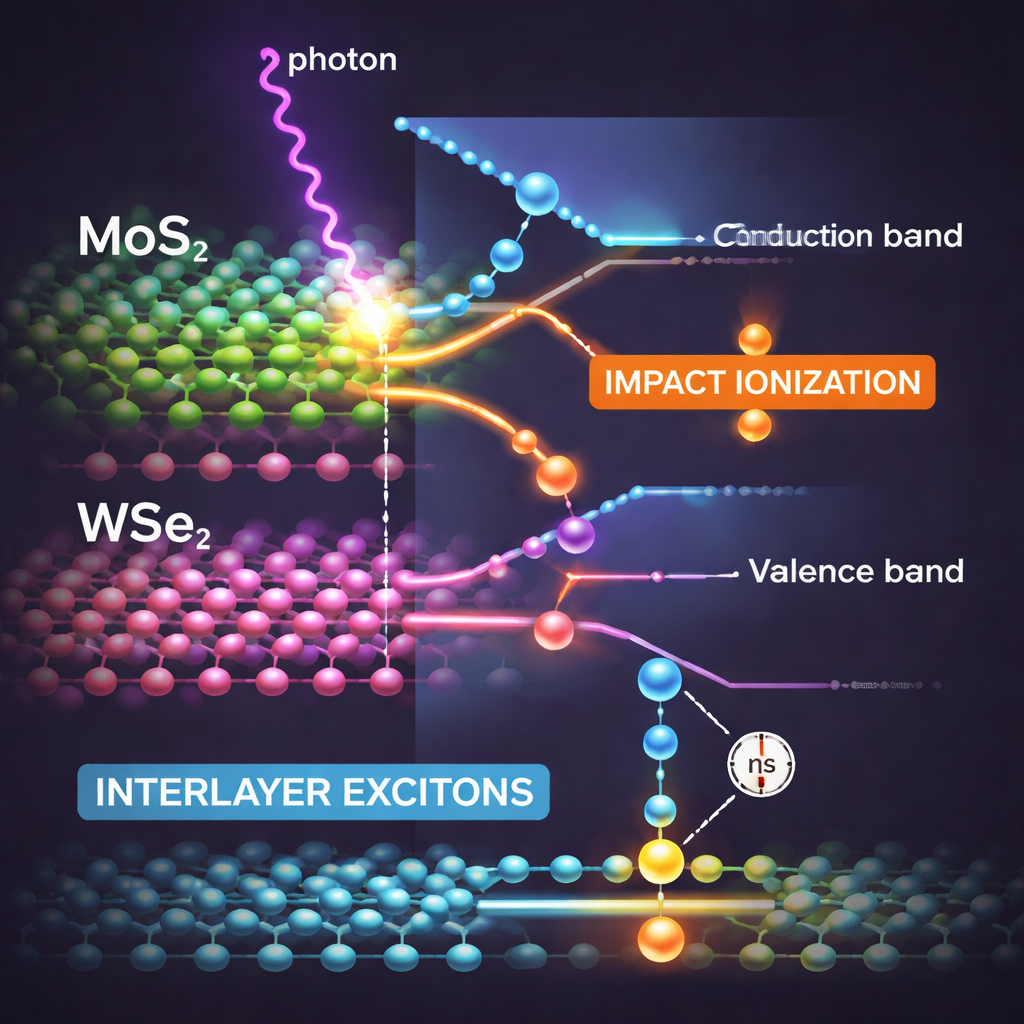
What This Means for Future Light Harvesting
For a non‑specialist, the key message is that atomically thin, twisted semiconductor sandwiches can turn one high‑energy photon into almost two useful excitations that live long enough to be collected. This combination of near‑ideal energy use, tunable infrared response, and long lifetimes sets a new benchmark for carrier‑multiplication materials. It points toward future solar cells and photodetectors that can surpass traditional efficiency limits, while also providing a clean platform for exploring how many interacting excitons behave in two dimensions.
Citation: Wang, P., Wang, G., Wang, C. et al. Low-threshold interlayer exciton multiplication in twisted transition metal dichalcogenides heterobilayers. Light Sci Appl 15, 113 (2026). https://doi.org/10.1038/s41377-026-02193-w
Keywords: interlayer excitons, carrier multiplication, 2D materials, twisted heterobilayers, high-efficiency photodetectors