Clear Sky Science · en
1-MHz linewidth VCSEL enabled by monolithically integrated passive cavity for high-stability chip-scale atomic clocks
Why tiny, quiet lasers matter
Modern life leans heavily on ultra-precise timekeeping, from GPS navigation to secure communications and future quantum technologies. Many of these systems are moving toward “atomic clocks on a chip,” which need very small lasers that shine at an extremely pure color and stay stable over long periods. This paper presents a new kind of microscopic laser that dramatically improves that purity and stability, opening the door to more accurate and portable timing and sensing devices.
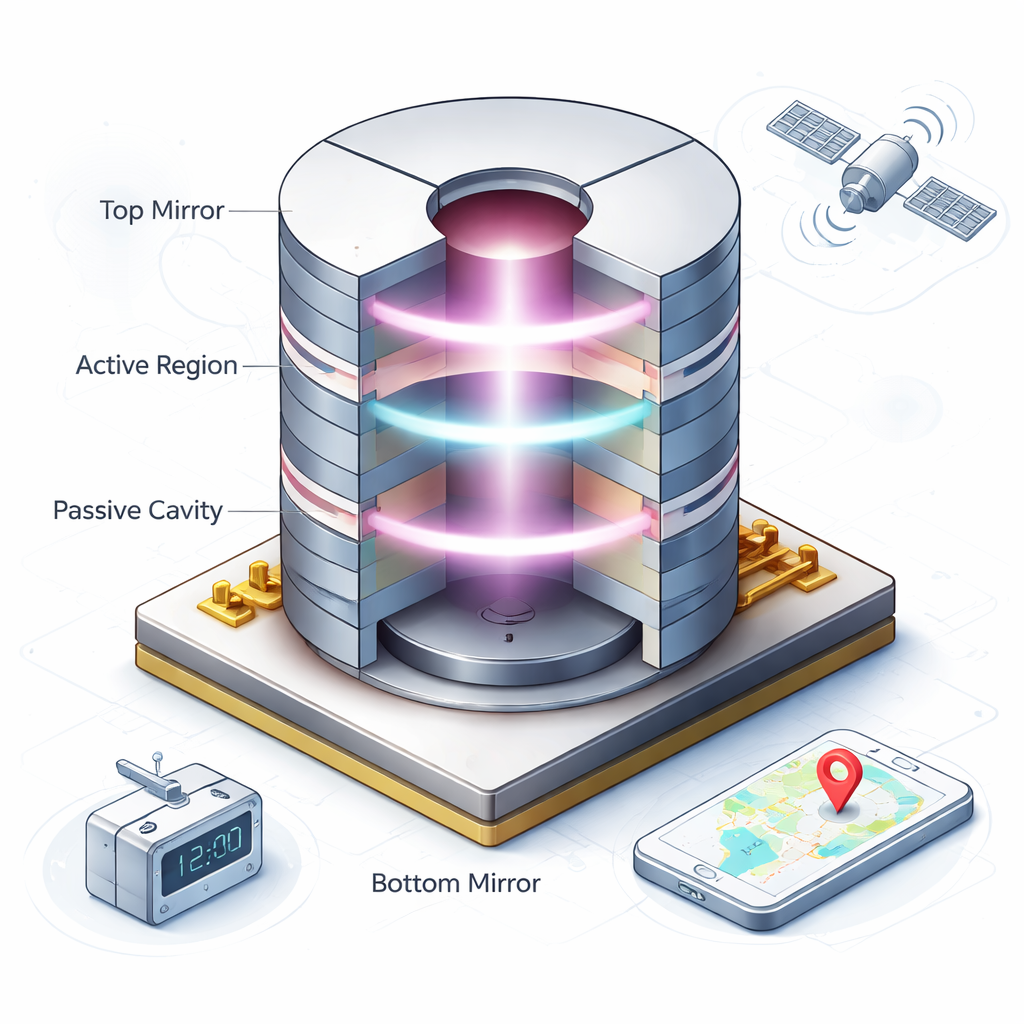
Building a better laser for chip clocks
Atomic clocks keep time by locking an electronic signal to a very specific color of light that atoms prefer to absorb. For cesium atoms used in many chip-scale clocks, that color is near 894.6 nanometers. The light source must be tiny, energy-efficient, and above all spectrally “quiet”—its color should fluctuate as little as possible. Vertical-cavity surface-emitting lasers, or VCSELs, fit the size and power requirements and are already widely used in telecom and sensing. However, their compact design usually gives them relatively broad color spread (linewidths above 100 megahertz), which introduces noise that degrades clock precision. The challenge is to keep the VCSEL small and manufacturable while dramatically sharpening its color.
Stretching the light path without enlarging the chip
The authors solve this by engineering the inside of the laser rather than bolting on bulky external components. They insert a “passive cavity” – a specially designed, non-light-emitting region – directly beneath the active lasing region inside the stack of mirror layers that form the VCSEL. This extra cavity subtly reshapes where light bounces around inside the device, pushing more of the optical field into a low-loss zone and effectively lengthening the distance photons travel before escaping. A longer photon lifetime naturally sharpens the laser’s color. At the same time, the team carefully tunes the cavity thickness and position so that only one longitudinal color and a single transverse beam shape are strongly favored, avoiding the usual trade-off where a longer cavity encourages multiple competing modes.
Keeping a single, clean beam under real-world conditions
Through detailed simulations and wafer growth, the researchers identify an internal structure that strikes this delicate balance. Their optimized device uses a passive cavity about four-and-a-half optical wavelengths thick, placed in the first mirror pair beneath the active region. Electron microscope images and optical measurements confirm that the light is confined as intended. When tested, the VCSEL turns on at currents below 1 milliamp and delivers a few milliwatts of power while maintaining a single spectral line with strong suppression of unwanted side modes and orthogonal polarizations. Importantly, this clean single-mode behavior persists across a wide temperature range from typical room conditions up to 95 °C, with only a predictable, small drift in wavelength. The output beam remains nearly Gaussian and narrow, with a divergence of about 7 degrees—better than many conventional VCSELs.
Measuring noise and turning light into time
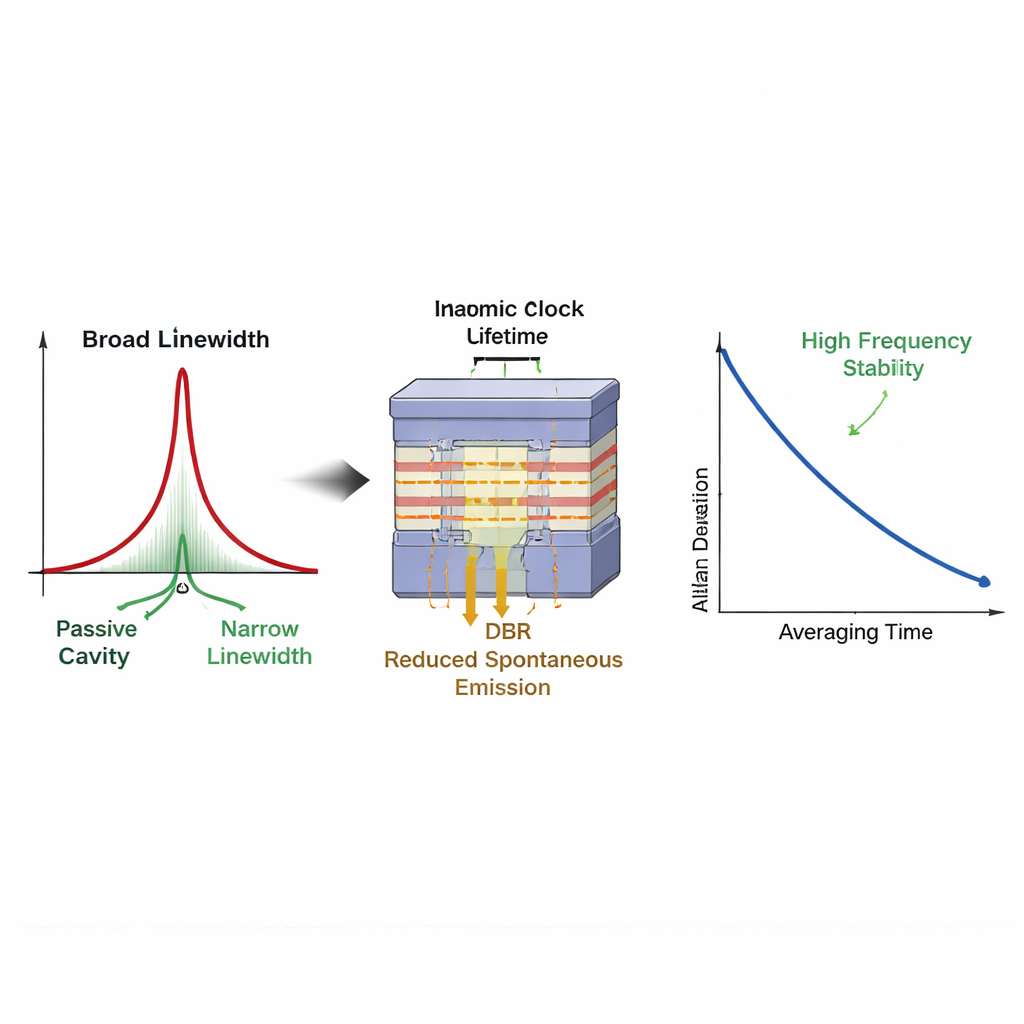
To see how quiet this laser really is, the team measures its frequency noise spectrum using an interferometer that converts tiny color jitters into electrical signals. At high analysis frequencies, the noise flattens into a low “white noise” floor set by fundamental quantum effects. From this, they infer an intrinsic linewidth of about 1 megahertz, roughly two orders of magnitude narrower than typical VCSELs and comparable to much larger, more complex lasers. They then integrate the device into a cesium vapor-cell atomic clock using a scheme known as coherent population trapping. When the laser is locked to the cesium transition and the microwave electronics are disciplined by that reference, the resulting clock shows excellent short-term stability, with a fractional frequency uncertainty improving as time is averaged and reaching about 1.9 × 10⁻¹² at hundreds of seconds—better than several leading chip-scale VCSEL-based clocks reported previously.
What this means for future precision devices
For non-specialists, the core message is that the authors have made a very small laser that shines at a precisely defined color, wiggles far less than usual, and keeps performing even when it gets hot. This is achieved entirely within the chip itself, without delicate external resonators or complex feedback setups. Such a robust, narrow-linewidth VCSEL is a strong candidate for powering the next generation of pocket-sized atomic clocks and quantum sensors used in navigation, timing, and scientific instruments, bringing laboratory-grade precision closer to everyday technology.
Citation: Tang, Z., Li, C., Zhang, X. et al. 1-MHz linewidth VCSEL enabled by monolithically integrated passive cavity for high-stability chip-scale atomic clocks. Light Sci Appl 15, 94 (2026). https://doi.org/10.1038/s41377-026-02192-x
Keywords: chip-scale atomic clocks, VCSEL lasers, narrow linewidth, quantum sensing, frequency stability