Clear Sky Science · en
Anti-interference diffractive deep neural networks for multi-object recognition
Seeing the Signal in a Noisy World
Modern life is full of cameras and sensors that must pick out the important things in a scene – a pedestrian in the road, a tiny tumor in a scan, a suspicious object in a crowd – even when they are surrounded by clutter. This paper presents a new kind of “all‑optical” neural network that does much of this recognition with light itself instead of electronic chips. The result is a system that can recognize chosen objects in busy, shifting scenes while treating everything else as harmless background noise, potentially enabling faster and far more energy‑efficient vision for future machines.
Why Computers Made of Light Matter
Conventional deep‑learning systems run on electronic processors that shuffle currents through billions of tiny switches. They are powerful but also slow when decisions must be made in microseconds, and they waste a lot of energy as heat. Light offers an appealing alternative: beams can carry huge amounts of information in parallel, travel at the ultimate speed limit, and do not heat up circuits the way electric currents do. Optical neural networks exploit these advantages by shaping light with carefully designed surfaces so that a beam passing through them effectively “computes” the answer to a recognition problem.
From Single Object to Crowded Scenes
Most existing optical neural networks are limited to simple jobs, such as deciding which single digit is printed in the middle of a clean image. They struggle when several objects appear together, overlap, or move – exactly the kinds of conditions found in real‑world scenes. Past attempts to handle multiple objects often required strict rules about where each object could appear or relied on extra electronic processing after the light‑based stage, undercutting the speed and power savings of the optical approach.
Teaching Light to Ignore Distractions
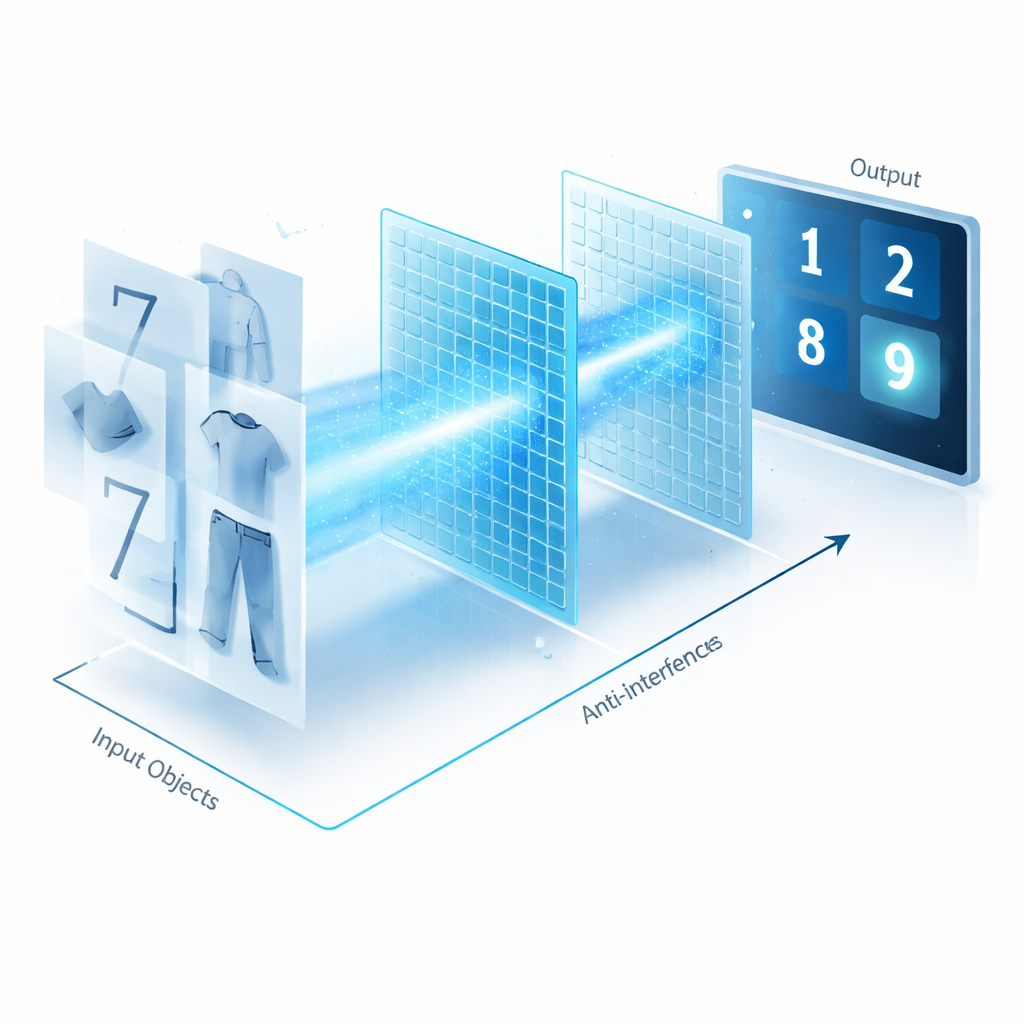
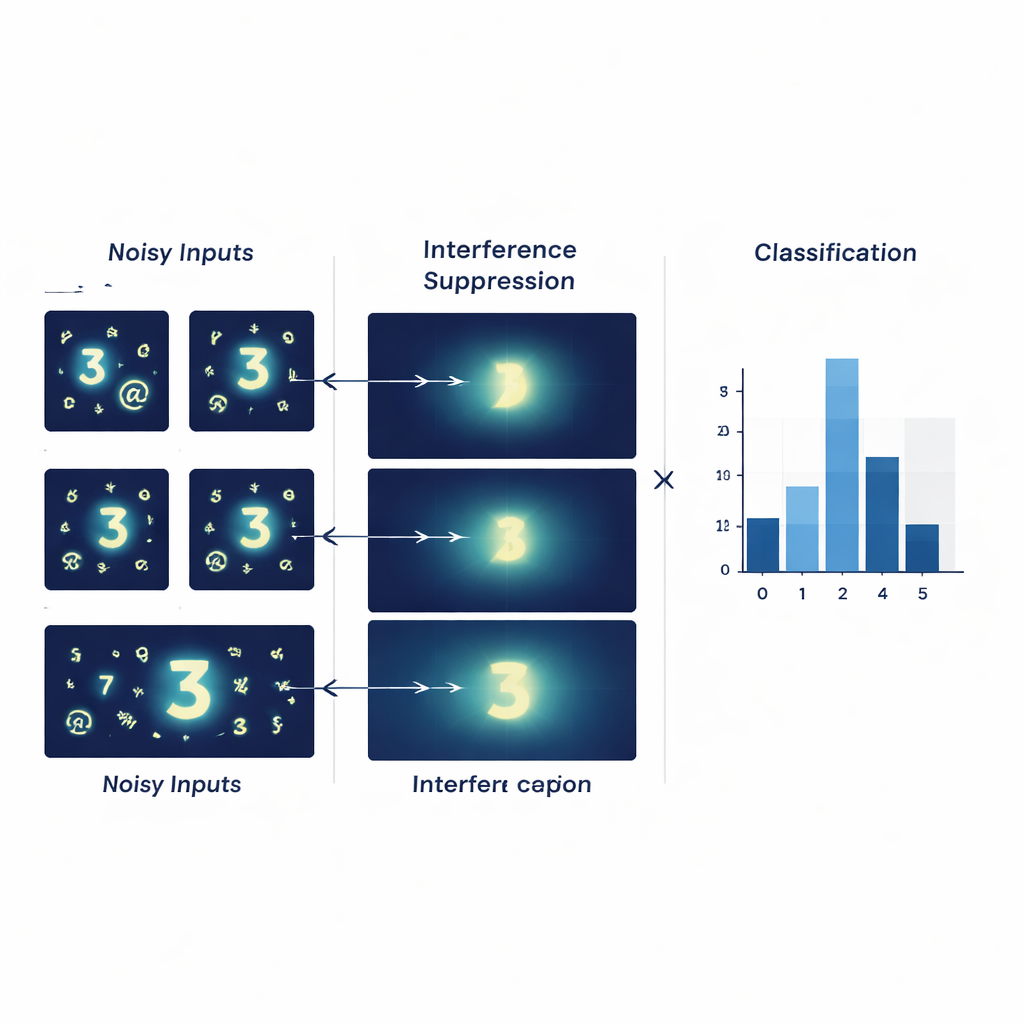
The authors introduce an “anti‑interference diffractive deep neural network,” or AI D2NN, that directly tackles busy scenes. It consists of only two ultra‑thin patterned layers – metasurfaces – that a beam of terahertz light passes through. These layers are designed by computer training so that light from target objects, here the handwritten digits 0 to 5, is steered into one of six small bright spots at the output plane, one spot per digit. At the same time, light from everything else – other digits, clothing images, letters, and random combinations of them – is intentionally scrambled into a dim, nearly uniform haze that does not trigger any output spot.
Building and Testing a Physical Light Computer
To turn the trained design into hardware, the team fabricated silicon metasurfaces made of tiny cylindrical pillars that delay passing light by precise amounts. Arranged in a 100 by 100 grid, these pillars act like optical neurons whose combined effect realizes the learned network. The researchers tested the system with terahertz beams patterned to show mixtures of target digits and 40 different kinds of interfering shapes, placed at random positions and sizes to mimic moving, cluttered scenes. In computer simulations, the optical network correctly recognized the chosen digits in about 87 percent of these challenging cases, and a real experimental setup achieved nearly the same accuracy, demonstrating that the concept works outside of a computer model.
What This Means for Future Machines
In plain terms, this work shows that it is possible to build a paper‑thin optical device that looks through clutter and still spots the object it cares about, using very little energy and operating at the speed of light. Because the design relies on general properties of diffraction, the same idea could be scaled to different colors or wavelengths of light and combined with other optical tricks to handle many more object classes at once. With further refinement, similar anti‑interference optical networks could help self‑driving cars rapidly identify key road users, assist doctors in flagging suspicious features in scans in real time, or support lightweight security cameras that detect threats without heavy electronic processing.
Citation: Huang, Z., Liu, Y., Zhang, N. et al. Anti-interference diffractive deep neural networks for multi-object recognition. Light Sci Appl 15, 101 (2026). https://doi.org/10.1038/s41377-026-02188-7
Keywords: optical neural networks, multi-object recognition, metasurfaces, terahertz imaging, all-optical computing