Clear Sky Science · en
Two-optical-cycle pulses from nanophotonic two-color soliton compression
Light Pulses on a Chip
Modern science often relies on extremely short flashes of light to watch electrons move, follow chemical reactions, or send data at blistering speeds. Until now, creating such ultrashort pulses has required room‑filling, expensive laser setups. This paper shows how to shrink that capability onto a tiny chip, using a specially engineered crystal waveguide to squeeze light pulses down to just two cycles of their underlying color—opening the door to compact, affordable ultrafast tools for science and technology.
Why Shorter Light Flashes Matter
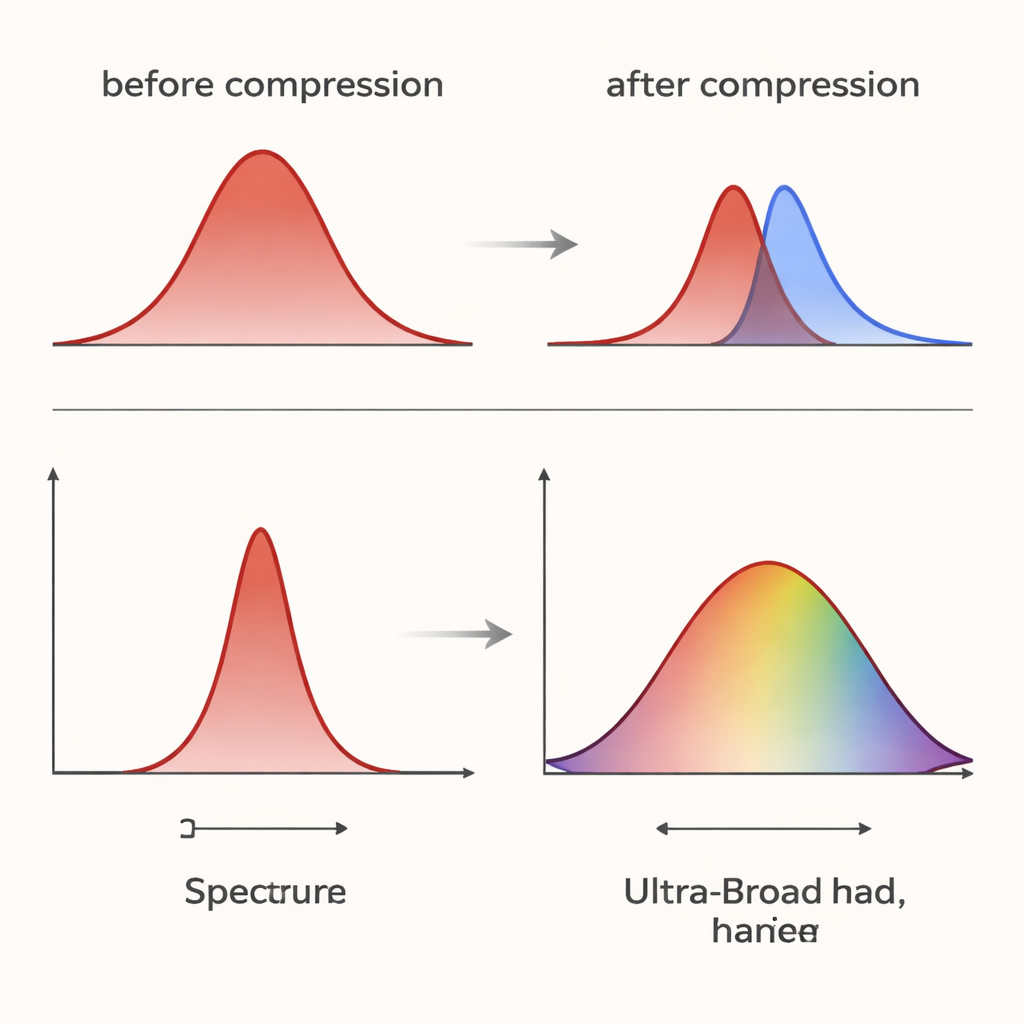
Ultrashort light pulses, lasting only femtoseconds (millionths of a billionth of a second) or even attoseconds, let researchers freeze motion at the scale of atoms and electrons. They also carry very high peak power, which can drive extreme optical effects and support ultra‑fast communications and information processing. Traditionally, generating these pulses has involved two bulky stages: first, stretching the spectrum of a laser pulse into a broad rainbow, and second, carefully correcting the phase of each color so they all line up in time. The complexity and size of this equipment have limited how widely these techniques can be used outside specialized labs.
A New Way to Squeeze Pulses
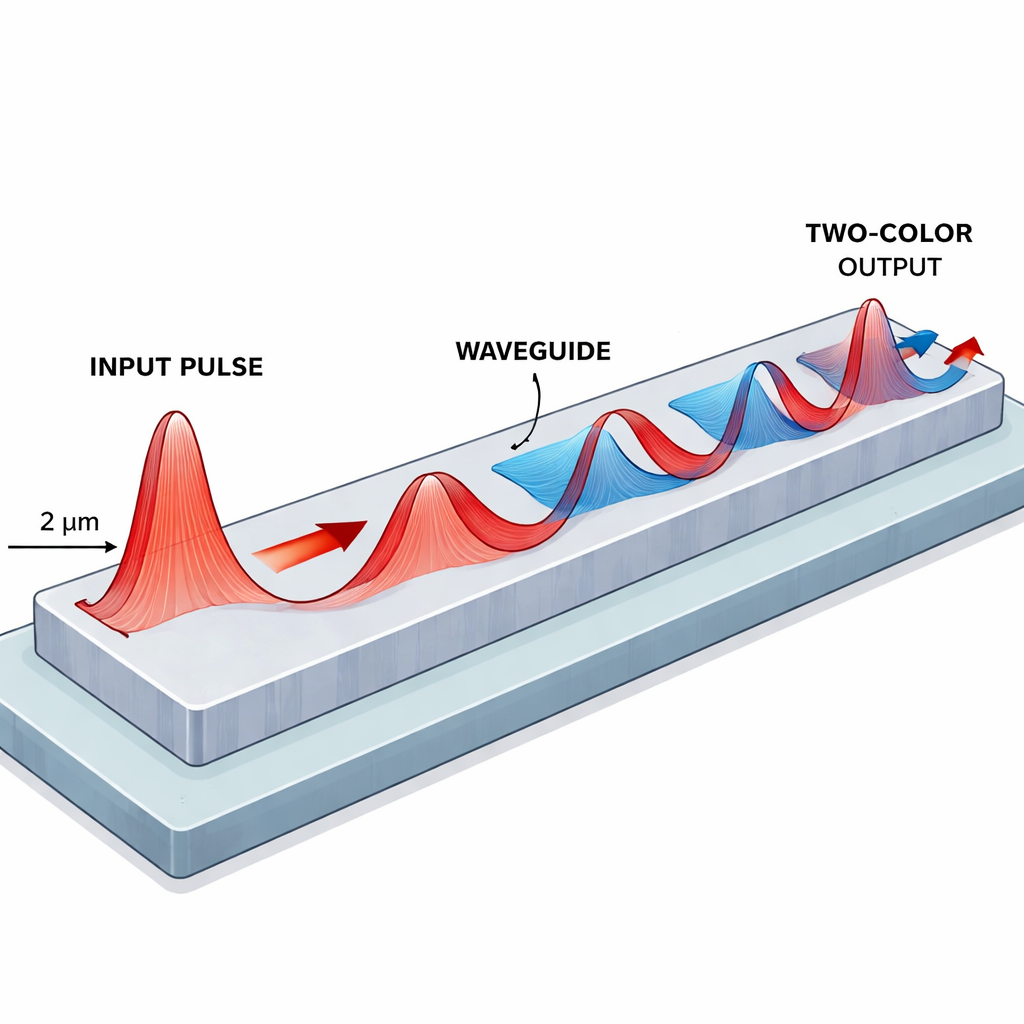
The authors build on a phenomenon known as a soliton—a self‑shaping light pulse that maintains its form as it travels because spreading from dispersion is balanced by nonlinear effects in the material. Instead of using the usual cubic (Kerr) response of glass fibers, they exploit a stronger “quadratic” response in lithium niobate, a crystal widely used in photonics. In their nanophotonic waveguide, an incoming pulse at one color (the fundamental) interacts with its own second harmonic (a bluer color at twice the frequency). Energy sloshes back and forth between these two colors as they co‑propagate, and with carefully tuned dispersion and a slight phase mismatch, this exchange naturally compresses both pulses in time while boosting their peak power.
Engineering Light on a Chip
Key to this work is precise control over how different colors and speeds of light behave inside the chip. The team designs a lithium niobate waveguide whose geometry and periodic poling pattern manage dispersion and minimize the time slip between the fundamental and its second harmonic. Using theory and numerical simulations, they map out how the compressed pulse relates to the ideal soliton solution, and derive simple design rules that connect input pulse width, material parameters, and the optimum device length. This allows them to predict not just how short the pulses can become, but also how efficiently energy stays concentrated in the main pulse and how much the peak power is enhanced.
From Theory to Two‑Cycle Pulses
With their optimized design, the researchers fabricate a 6.5‑millimeter‑long nanophotonic waveguide in thin‑film lithium niobate. They inject modest‑energy pulses of about 3 picojoules at a wavelength near 2 micrometers and characterize the output with advanced pulse‑measurement techniques. The result is striking: the fundamental pulse is compressed to about 13 femtoseconds—less than two oscillations of its carrier wave—while the second harmonic pulse shrinks to about 17 femtoseconds. The measured pulse shapes and spectra closely match the theoretical predictions, confirming that the device operates in the intended two‑color soliton regime rather than simply generating a messy supercontinuum.
Toward Single‑Cycle Waveforms
Because the fundamental and second‑harmonic pulses emerge tightly locked together in time with a well‑defined phase relationship, they form a powerful building block for synthesizing even shorter light waveforms. By slightly adjusting the relative phase—something that can be done on‑chip with a small electro‑optic modulator—different combined waveforms can be produced, including near single‑cycle pulses only a few femtoseconds long. The authors show through simulations, and using their measured pulses, that such synthesis could be achieved with only modest extensions of their current setup, and that higher‑energy on‑chip sources could eventually push peak powers high enough to drive extreme nonlinear optics in a fully integrated platform.
What This Means in Simple Terms
In essence, this work turns what used to be a room‑sized ultrafast laser system into a millimeter‑scale chip component. By cleverly using a crystal that converts light between two colors as the pulse travels, and by engineering the chip so those colors reinforce each other at just the right moments, the authors generate extremely short, intense flashes of light using very little energy. This approach provides a practical roadmap for compact, scalable single‑cycle pulse generators, with potential impacts ranging from faster optical communication and computing to tabletop tools for probing matter on the fastest timescales nature has to offer.
Citation: Gray, R.M., Sekine, R., Shen, M. et al. Two-optical-cycle pulses from nanophotonic two-color soliton compression. Light Sci Appl 15, 107 (2026). https://doi.org/10.1038/s41377-026-02187-8
Keywords: ultrafast pulses, nanophotonics, lithium niobate, soliton compression, two-color optics