Clear Sky Science · en
Exploring the feedback limits of quantum dot lasers for isolator-free photonic integrated circuits
Why reflections matter in tiny light chips
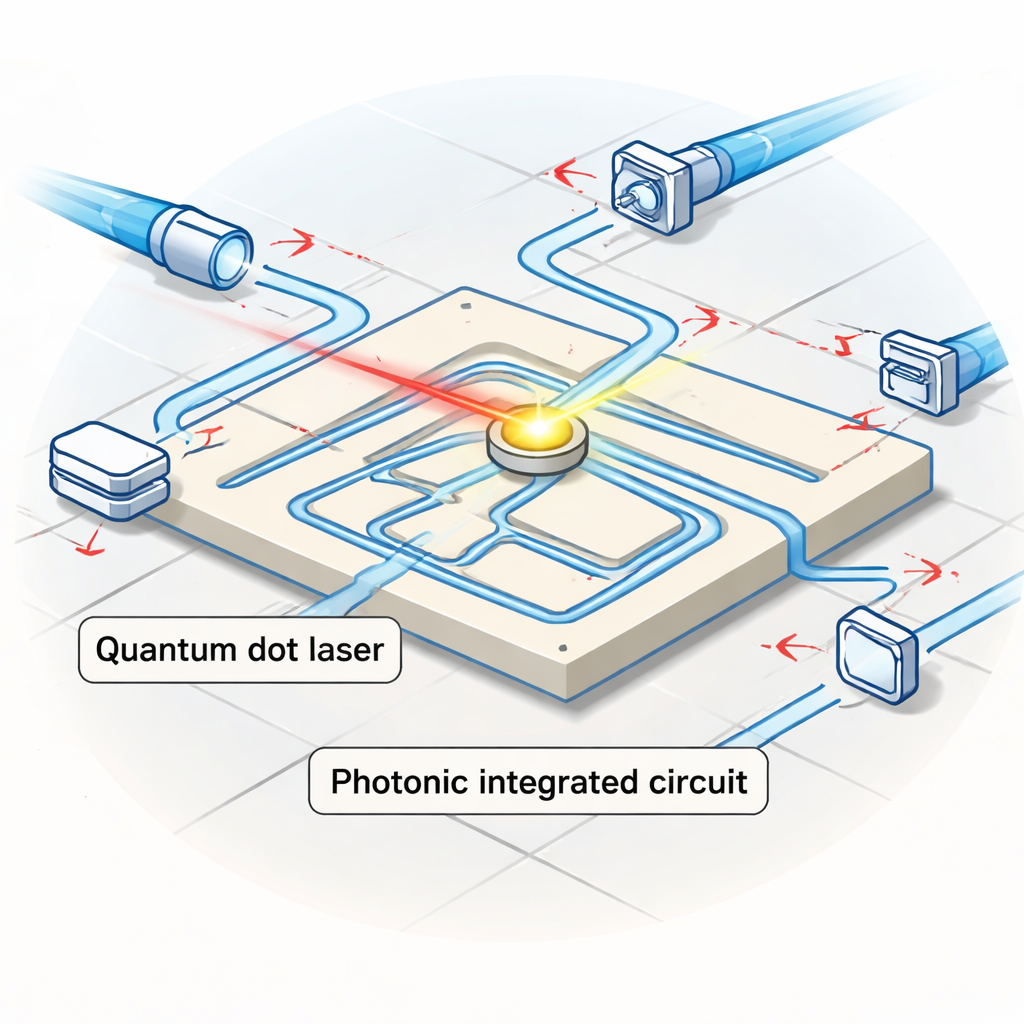
Light-based chips promise faster, more energy‑efficient data centers, sensors, and communication networks. But the tiny lasers that feed these photonic circuits are easily disturbed by reflections bouncing back from on‑chip components, like mirrors in the wrong place inside a camera. Too much reflected light can push a laser into a chaotic state where its output is noisy and useless. This article explores whether a new type of laser, based on quantum dots, can remain stable even without bulky, expensive isolator components that are normally used to block reflections.
A new kind of laser for crowded optical chips
Today’s optical networks mostly rely on lasers made from quantum wells, a technology that works well but is very sensitive to light fed back into the device. Even weak reflections can spoil their performance, forcing designers to add optical isolators and extra circuitry. Quantum dot lasers work differently: they confine electrons in all three dimensions, more like tiny boxes than thin layers. This structure naturally damps unwanted oscillations and reduces how strongly changes in brightness affect the color of the emitted light. Earlier tests hinted that quantum dot lasers were unusually tolerant to feedback, but measurements had never pushed them to true failure. That left a basic practical question unanswered: in real photonic chips, which can generate strong reflections, will these lasers still operate safely without isolators?
Building tougher lasers and pushing them to the edge
The researchers first refined how they grow and process quantum dot structures on gallium arsenide wafers. They engineered lasers with low starting currents, high power, and very low noise, and carefully shaped the ridge that guides light so that electrons stay away from etched surfaces where defects form. These design choices, combined with control over how different internal energy levels switch on, made the devices naturally resistant to disturbances. With this platform in hand, they built a specialized test setup that could return light to the laser with almost no overall loss. By adding a small optical amplifier in the feedback loop, they were able to gradually increase the fraction of light sent back, from very weak levels up to and beyond the point where the laser finally lost coherence.
Finding the real breaking point of feedback
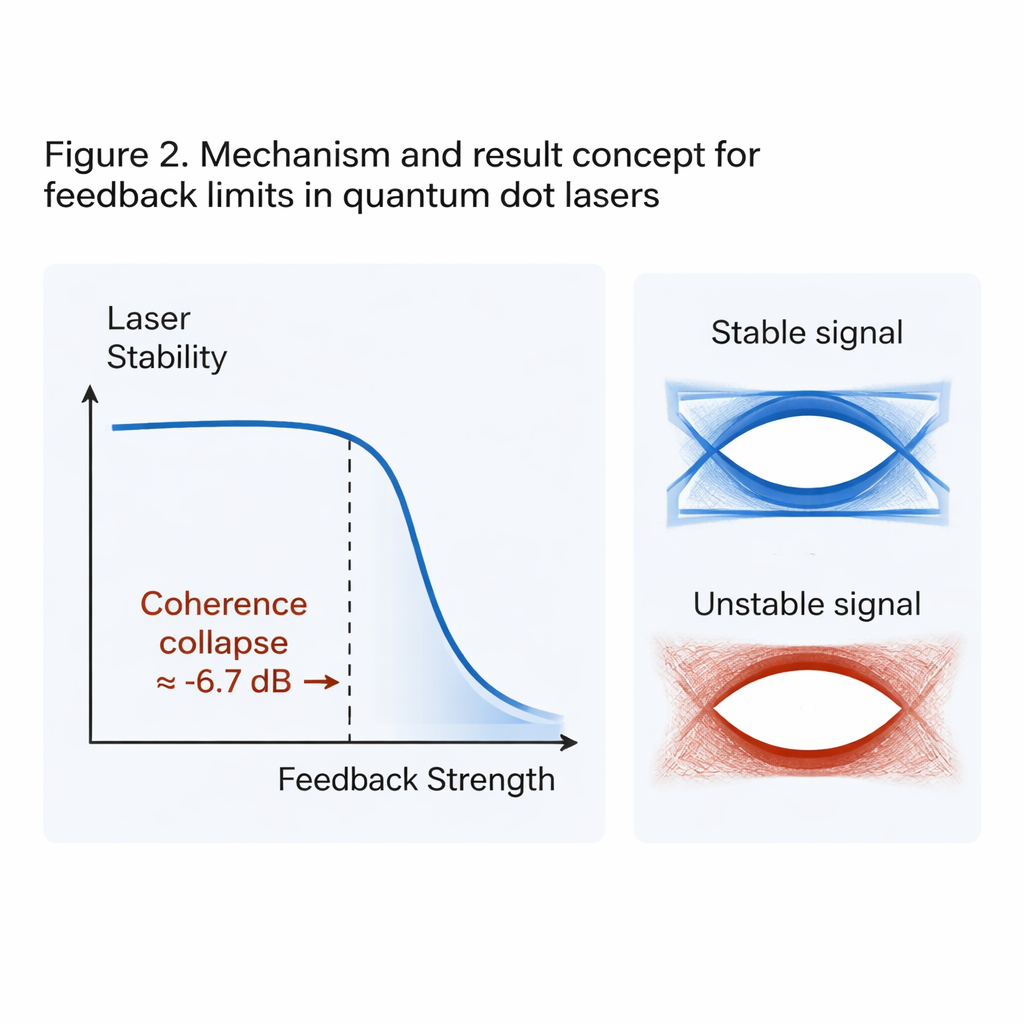
As the feedback was increased, the team watched both the spectrum of the laser light and the electrical noise it produced. For a long range of conditions, the laser’s internal modes stayed sharp and its intensity noise remained low. Only when about one‑fifth of the output power was returned (a feedback level of roughly –6.7 decibels) did the device cross into a state called coherence collapse, where the emission spreads out and the output becomes chaotic. This failure point is far beyond what typical quantum‑well lasers can tolerate, often by tens of decibels. Importantly, under weaker feedback that might be found in working circuits, the laser power and color barely changed, and extra noise stayed modest. Tests also showed that this robustness held over temperatures from 15 to 45 °C, over more than 100 hours of continuous running, and across multiple devices with only small variation.
Keeping data flowing even near the limit
To connect these physical measurements to real‑world use, the authors sent a 10‑gigabit‑per‑second data stream through the quantum dot laser while adjusting the feedback. They examined eye diagrams—plots that visualize how clearly ones and zeros can be distinguished—and measured error rates both directly and after the signal traveled through two kilometers of optical fiber. Even when feedback was set just beyond the point where regular oscillations appeared, the eyes stayed open and the added error was almost negligible. Most of the signal penalty at long distance came from ordinary fiber dispersion, not from feedback. Only when the feedback reached very close to 0 decibels, meaning almost as much light was coming back as leaving, did the data signal become unusable.
What this means for future light‑based chips
For non‑experts, the main message is that these quantum dot lasers can shrug off reflections that would quickly destabilize conventional devices. The study shows that they remain stable up to a well‑defined and unusually high feedback level, continue to send clean data at telecom speeds, and are consistent across temperature, time, and different samples. Simple modeling further suggests that in realistic chip layouts—where external paths are only centimeters long and typical reflectors are much weaker—the safe operating margin is even larger. This points toward a future where many photonic integrated circuits can skip bulky isolators altogether, making optical systems smaller, cheaper, and more energy efficient while still delivering reliable high‑speed communication.
Citation: Shi, Y., Dong, B., Ou, X. et al. Exploring the feedback limits of quantum dot lasers for isolator-free photonic integrated circuits. Light Sci Appl 15, 96 (2026). https://doi.org/10.1038/s41377-026-02185-w
Keywords: quantum dot lasers, optical feedback, photonic integrated circuits, coherence collapse, isolator-free lasers