Clear Sky Science · en
Quantum-enhanced reconfigurable in-memory stochastic computing
Why this new kind of computer matters
Modern life runs on data, from streaming video to training artificial intelligence. Yet today’s computers waste time and energy shuttling information back and forth between processor and memory. This paper reports a radically different approach: a tiny tube of warm atoms that can both store information and perform calculations using the strange rules of quantum physics. The result is a new kind of “in-memory” computer that is naturally suited to massively parallel tasks, can speed up certain operations, and even keeps the calculation itself partly hidden from prying eyes.
A different way to think about numbers
Instead of representing numbers as fixed digits in electronic circuits, the authors use chance itself as the raw material of computation. Their system relies on “stochastic computing,” where numbers are encoded in the probability of random events. In this case, the events are individual particles of light—photons—emitted from a quantum memory. The quantum memory is a glass cell filled with billions of cesium atoms at room temperature, wrapped in magnetic shielding. Carefully shaped laser pulses interact with these atoms, causing them to emit photons in a controlled but random way. By counting how often photons appear, the device can carry out basic mathematical operations. 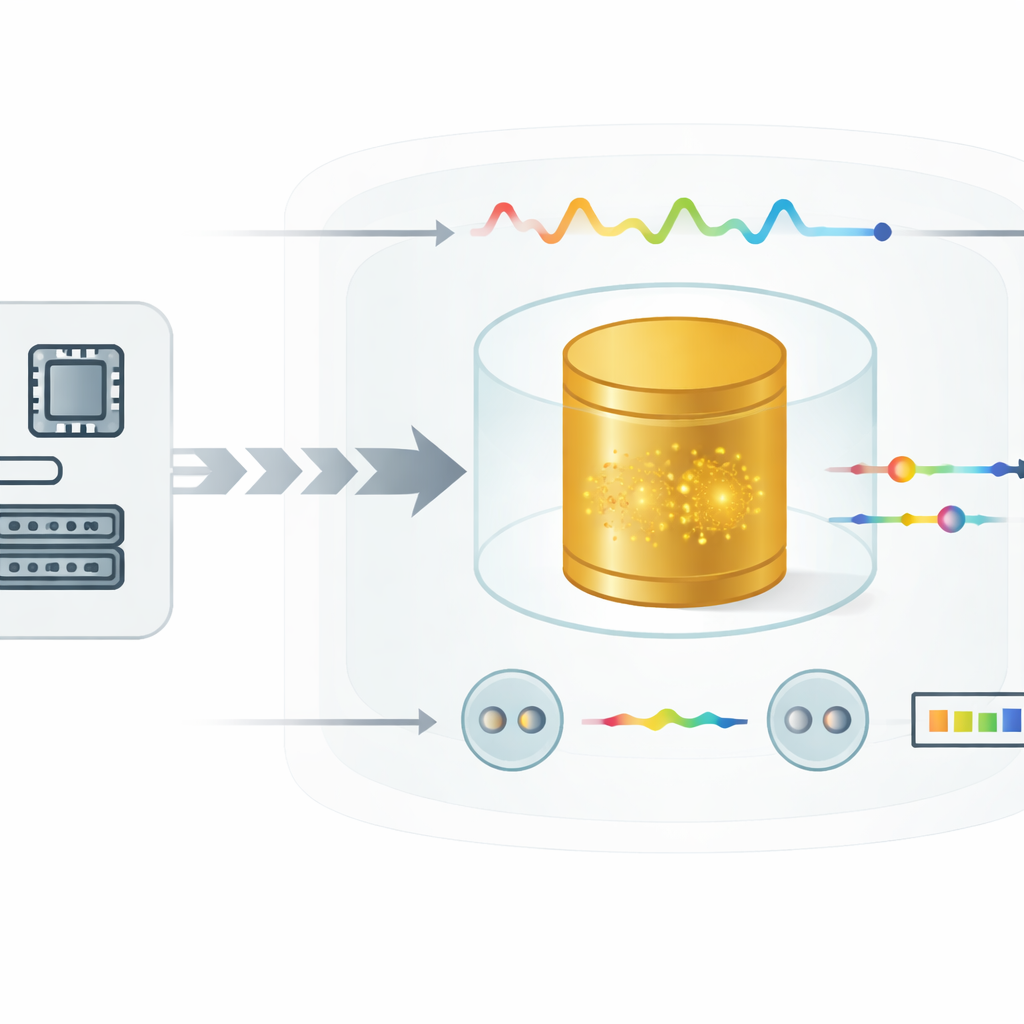
How a cloud of atoms becomes a calculator
The setup is divided into an interface unit, an in-memory unit, and an accumulator. The interface unit first translates a user’s task—like adding or multiplying numbers—into a specific pattern of laser pulses. These “addressing pulses” enter the atomic cell, where they either prepare the atoms, write information into them, or read information back out. In the process, the atoms emit two types of photons, known as Stokes and anti-Stokes photons, along with hidden spin excitations inside the atomic cloud. The probability that a photon appears in each time slot is directly linked to the numbers being processed. After leaving the memory, the photons hit single-photon detectors, and their counts are tallied by the accumulator according to simple rules chosen for each task.
Turning random flashes into addition and multiplication
Addition is implemented by repeatedly sending in “write” pulses that can generate Stokes photons with a certain probability. Each successful detection adds one unit to the running total. Over many trials, the average number of photons counted reflects the sum of the encoded inputs. Multiplication takes advantage of quantum correlations: a write pulse can create a Stokes photon together with a stored atomic excitation, and a later “read” pulse can convert that excitation into an anti-Stokes photon. When both photons are detected in coincidence, their joint appearance probability corresponds to the product of two numbers. The first number is encoded in how likely the Stokes photon is to appear, and the second in how efficiently the stored excitation is converted into the anti-Stokes photon. By designing pulse trains, the system can handle not only single additions and multiplications but also parallel operations such as vector multiplication. 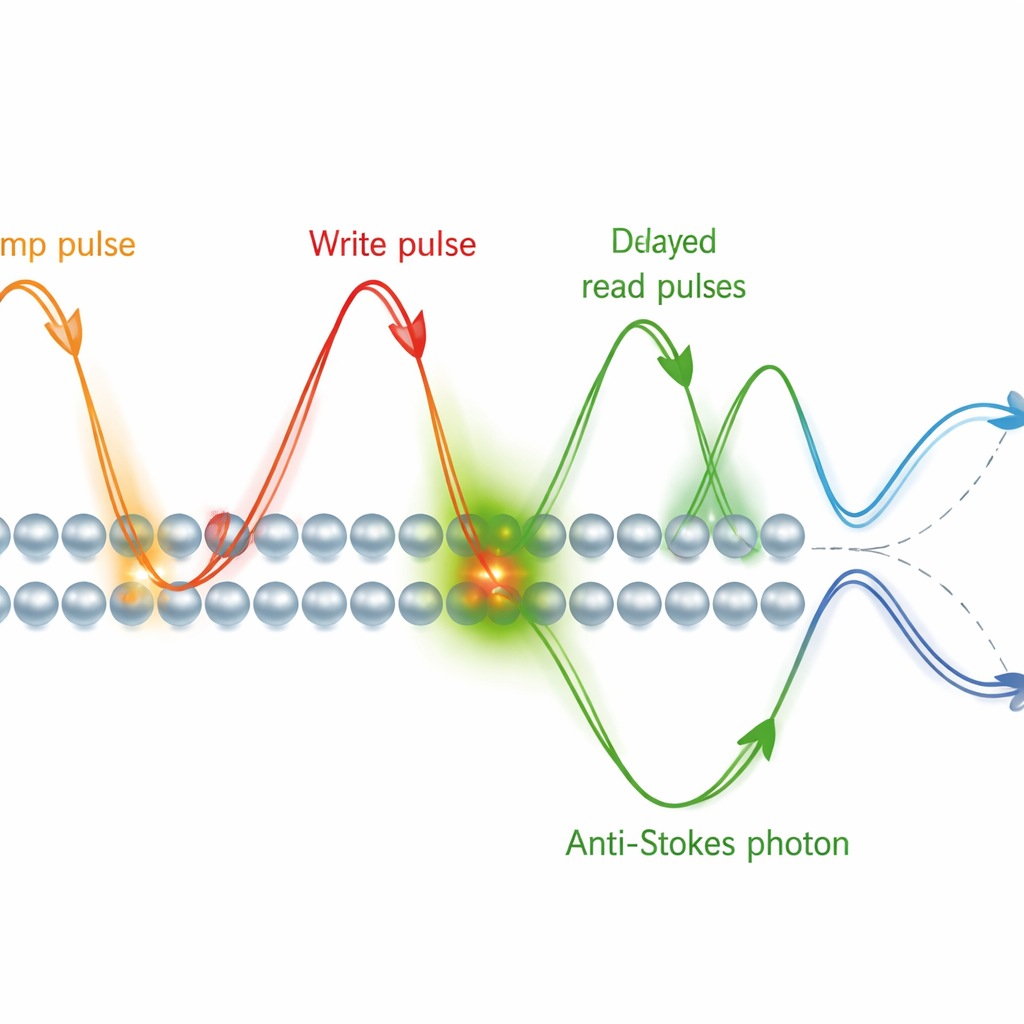
Speeding up with quantum links and hiding the answer
A central advantage of this approach comes from nonclassical correlations between the photons. When Stokes and anti-Stokes photons are genuinely linked through the shared atomic excitation, their coincidence rate can be several times higher than what would be expected from uncorrelated random photons. This effectively boosts the speed of multiplication without increasing pulse energy, because the system reaches a target number of coincidence events in fewer trials. At the same time, the randomness of photon generation provides an unusual form of security. If an eavesdropper can observe only a small fraction of the detection events, the broad statistical spread of trial counts prevents them from reliably inferring the final numerical result. In this way, the computation itself—not just the communication channel—remains concealed during processing.
Imperfect quantum memory put to good use
The quantum memory used here is far from ideal by the standards of long-distance quantum networks: only a small fraction of stored excitations are successfully read out. Nonetheless, the authors show that this “imperfect” device is more than adequate for quantum-enhanced in-memory stochastic computing, as long as correlated photon pairs occur more often than accidental ones. They argue that such memories, which are already feasible with current technology, could underpin secure, massively parallel computing modules integrated with photonic chips. In simple terms, the work demonstrates that even a noisy, low-efficiency quantum memory can act as a powerful calculator that works by counting flashes of light—offering a fresh path toward future computing hardware that is faster, more energy-efficient, and naturally private.
Citation: Yang, HZ., Dou, JP., Lu, F. et al. Quantum-enhanced reconfigurable in-memory stochastic computing. Light Sci Appl 15, 178 (2026). https://doi.org/10.1038/s41377-025-02181-6
Keywords: quantum memory computing, stochastic computing, single-photon processing, in-memory architecture, secure quantum computation