Clear Sky Science · en
Three-dimensional nanophotonics with spatially modulated optical properties
Shrinking Sculptures of Light
Imagine being able to sculpt how light moves in three dimensions the way a watchmaker arranges tiny gears. This research introduces a new way to “print” intricate, nanoscale light-guiding structures inside soft gels and then shrink them down, like a high-tech version of shrink art. The method, called Implosion Fabrication, could lead to smaller, more powerful devices for sensing, imaging, communications, and even future light-based computers.
Building Tiny Structures Inside a Soft Gel
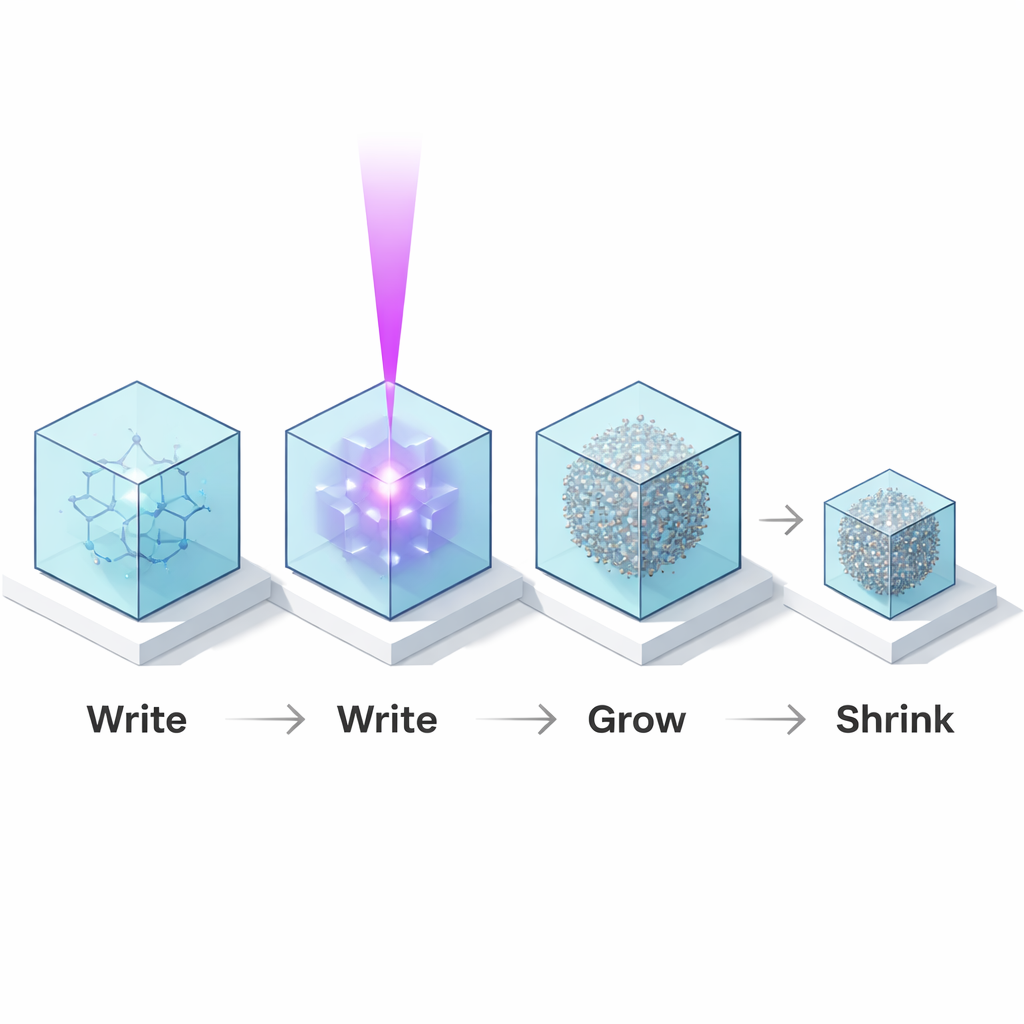
The heart of the work is a soft, transparent hydrogel that acts like a three-dimensional canvas. The researchers first prepare this gel so that it can later shrink uniformly in all directions, making every feature much smaller and sharper. They soak the gel in special fluorescent dye molecules and then use a focused laser to “write” patterns inside it: wherever the laser is brightest, the dye molecules are locked to the gel, tracing out a hidden 3D blueprint. After unbound dye is washed away, only the laser-written pattern remains, marking exactly where future material will grow.
Turning Invisible Patterns into Metal Lattices
Next, the team turns those invisible dye patterns into real material. They attach tiny gold-containing particles specifically to the written regions, using well-known biochemical linkers that act like molecular Velcro. Then they perform a chemical reaction that deposits silver onto these gold seeds, growing a dense forest of metallic nanoparticles exactly where the laser drew. Finally, they bathe the gel in salt solutions that make it shrink uniformly by a factor of about 1000 in volume. The result is a compact, three-dimensional metallic structure with features as small as tens of nanometers, far below what conventional 3D printers can easily reach.
Dialing In How Light Behaves
Because the amount of silver can be tuned by changing the laser power and writing speed, the researchers can continuously adjust how strongly the printed regions interact with light. Brighter laser exposure leads to more dye, more metal, and higher reflectivity; weaker exposure gives sparser metal and more transparency. By measuring how much light is reflected and transmitted, they estimate an “effective” optical index for the printed silver, and show that they can move from highly reflective films to relatively gentle, low-loss layers. This control over local brightness and loss is crucial for future devices that deliberately balance light amplification and absorption rather than simply trying to avoid loss.
Crystals, Twists, and Quasicrystal Patterns
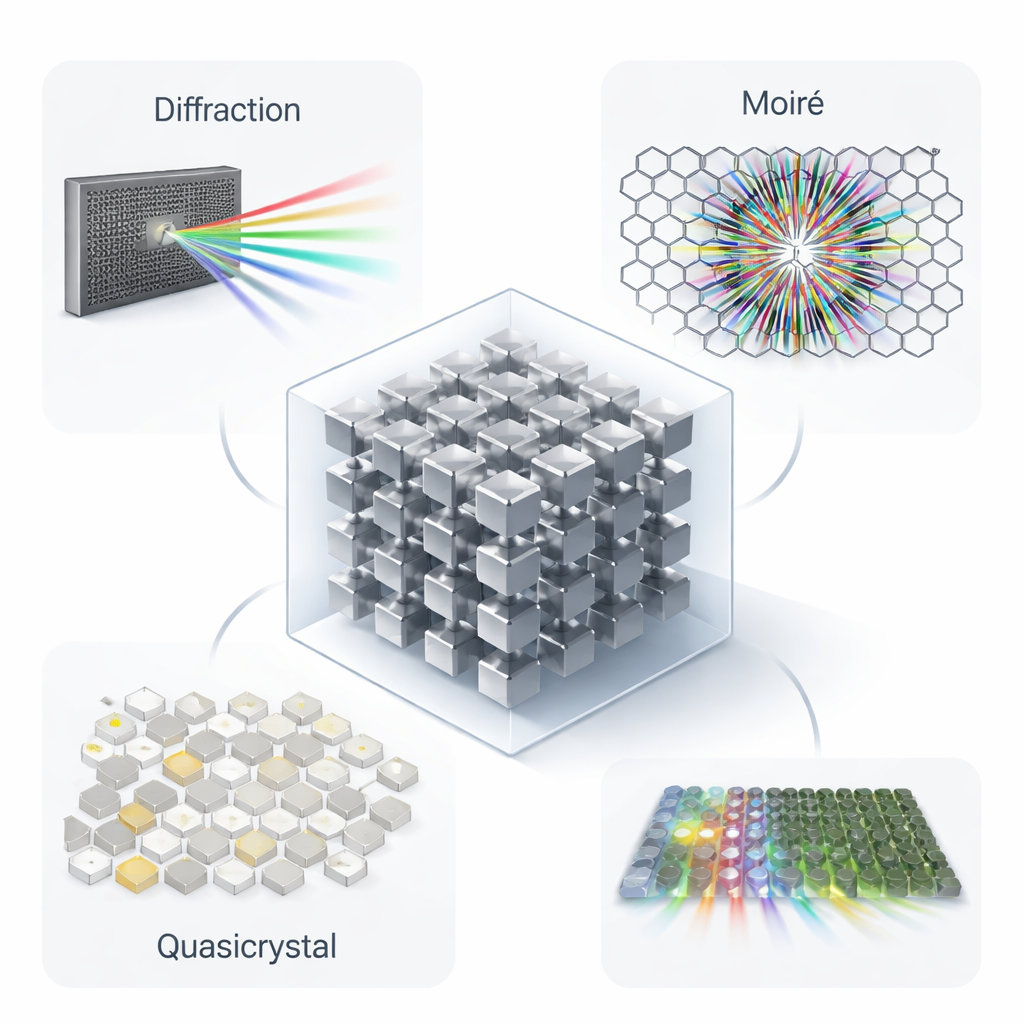
With this toolbox in hand, the team fabricates a zoo of light-guiding architectures. They build regular two- and three-dimensional photonic crystals: ordered arrays of tiny metallic “atoms” that diffract light much like atomic lattices diffract X-rays. Square, hexagonal, and body-centered cubic patterns all produce clean, symmetric diffraction patterns that match theory. They then go beyond simple order by stacking hexagonal layers with a twist, creating moiré patterns whose diffraction shows a striking 12-fold symmetry, similar to quasicrystals that lack simple repetition yet still display long-range order. Finally, they pattern Penrose tilings and 3D icosahedral quasicrystals, even assigning different material densities to different tiles, hinting at structures where gain and loss could be sculpted at the level of each unit cell.
Why Shrinkable Light Sculptures Matter
By combining the precision of laser writing with the chemistry of nanoparticle growth and controlled shrinking, Implosion Fabrication offers a flexible way to build complex 3D optical materials from the bottom up. Unlike many existing methods, it can vary not just shape but also local optical strength within the same structure. That combination is especially promising for emerging “non-Hermitian” photonics, where carefully arranged amplification and loss can produce new behaviors such as ultra-sensitive sensors, unusual laser modes, and robust light paths. In simple terms, this work shows how to sculpt tiny, three-dimensional landscapes that tell light exactly where to go, opening the door to a new generation of miniature devices that use light in ways that today’s technologies cannot.
Citation: Salamin, Y., Yang, G., Mills, B. et al. Three-dimensional nanophotonics with spatially modulated optical properties. Light Sci Appl 15, 145 (2026). https://doi.org/10.1038/s41377-025-02166-5
Keywords: nanophotonics, photonic crystals, quasicrystals, 3D nanofabrication, implosion fabrication