Clear Sky Science · en
Double-phase metasurface operators for all-optical image processing
Why tiny light chips matter for our digital world
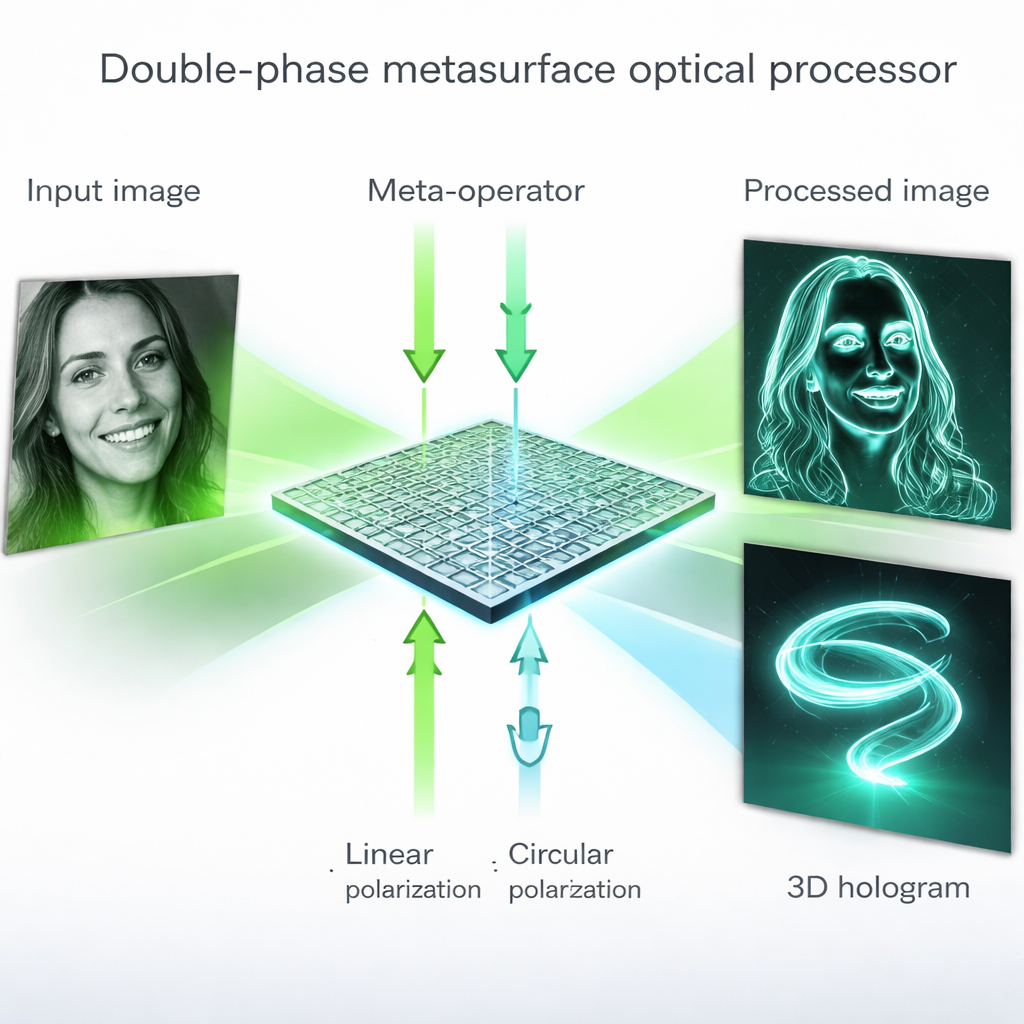
Every photo we snap, video we stream, or medical scan we analyze must be processed—usually by power-hungry electronic chips. As our appetite for image-heavy tasks grows, from phone cameras to self-driving cars and AI vision, traditional electronics are hitting limits in speed and energy use. This paper shows how an ultrathin optical “chip,” called a metasurface, can process images using light alone, performing tasks like edge detection and pattern recognition almost instantly, without heavy digital computation.
Turning light into a calculator
Conventional computers handle images by converting light into electronic signals, then crunching numbers pixel by pixel. That process wastes time and energy, especially when images must be analyzed in real time. In contrast, light waves naturally carry rich spatial information, and lenses can rearrange that information in ways that resemble mathematical operations. The challenge has been that optical systems able to do serious image processing are typically bulky—think benches covered with lenses and mirrors—and often tailored to a single task. The authors tackle this by shrinking the entire processor down to a flat, millimeter-scale surface made of nanoscale structures that can bend light with exquisite precision.
A flat chip that reshapes images
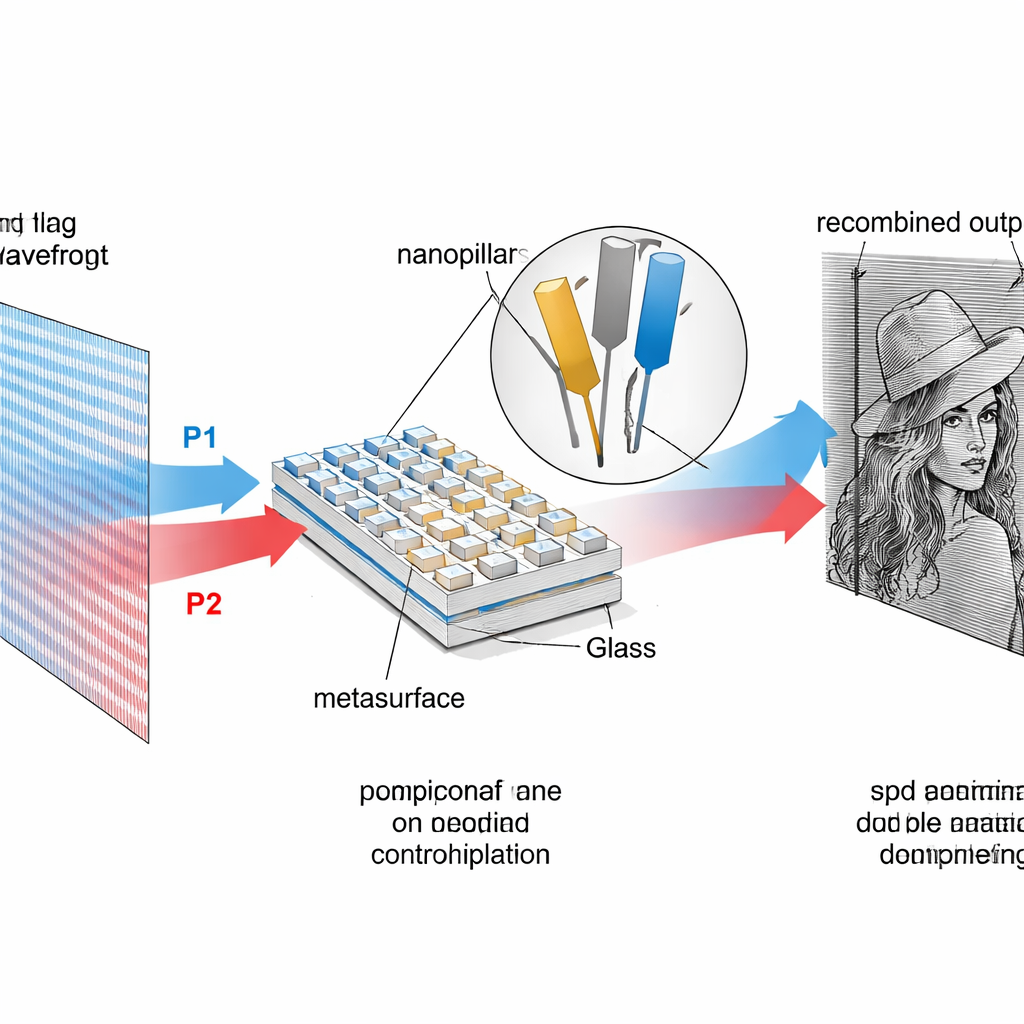
The core of the work is a “meta-operator”: a single-layer metasurface patterned with millions of titanium dioxide nanopillars, each smaller than the wavelength of visible light. By carefully choosing the size and orientation of these tiny pillars, the team controls how different polarization states of light—essentially, different ways the electric field vibrates—pick up specific phase delays as they pass through. They use a clever strategy called double-phase encoding, in which a desired transformation of an image is broken into two phase-only patterns assigned to two polarization channels. When these channels are recombined, they recreate the full, complex transformation that would normally require bulky optics or digital processing.
Finding edges, corners, and hidden patterns with light
With this platform, the researchers experimentally demonstrate a family of core image-processing operations that are normally carried out in software. Using one polarization scheme, the metasurface performs first-order differentiation, which highlights edges in one direction or in all directions, making boundaries in bar and spoke patterns stand out sharply. With more advanced designs, it performs second-order operations that pick out corners and subtle curvature changes, sharpening details in patterns such as a Chinese character. The same approach is extended to cross-correlation, a tool for pattern recognition: metasurfaces designed for the letters T, A, and U can scan an input image containing the word “TAU” and cause only the matching letter to light up as bright spots, effectively recognizing the target pattern at the speed of light.
From flat chips to 3D holograms
Beyond image filtering, the same metasurface principles can sculpt light in three dimensions to create complex holograms. The authors build a “meta-hologram” that reconstructs a spiral of bright dots spread over nearly a millimeter in depth, with layers only a few micrometers apart. By encoding different polarization states with carefully calculated phase patterns, the thin device controls not just where light appears in a plane but how it is distributed throughout a small volume of space. The experiments show close agreement with numerical designs, confirming that these flat optical chips can deliver high-fidelity volumetric holograms at visible wavelengths.
What this means for everyday technology
The study demonstrates that a single, passive, ultrathin optical element can carry out multiple image-processing tasks and generate intricate 3D holograms, all using light itself as the computing medium. For a lay reader, the takeaway is that future cameras, microscopes, and displays could include such metasurfaces to pre-process images, detect features, or create depth-rich visuals before the data ever reaches an electronic chip. That could enable faster, more energy-efficient devices for applications ranging from medical imaging and autonomous navigation to holographic displays and dense optical data storage—paving the way toward smarter, light-powered processors that complement or offload work from traditional electronics.
Citation: Yu, L., Singh, H.J., Pietila, J. et al. Double-phase metasurface operators for all-optical image processing. Light Sci Appl 15, 119 (2026). https://doi.org/10.1038/s41377-025-02153-w
Keywords: optical image processing, metasurfaces, analog computing, holography, edge detection