Clear Sky Science · en
Coherent control of electron-ion entanglement in multiphoton ionization
Watching Atoms Share Quantum Secrets
When light rips an electron out of an atom, the two leftovers – the free electron and the charged ion – don’t simply go their separate ways. Quantum mechanics says they can remain mysteriously linked, or entangled, even as they fly apart. This study shows how to deliberately control and measure that hidden connection using ultrashort flashes of ultraviolet light, opening a path toward harnessing entanglement in future quantum devices and ultrafast measurements.
Two Laser Pulses as a Quantum Steering Wheel
The researchers focus on argon, a simple noble gas atom often used in laser experiments. They use a two-step light sequence: first, a femtosecond ultraviolet “pump” pulse lifts one of argon’s outer electrons into an excited orbit; then, after a chosen delay, a second ultraviolet pulse kicks that electron all the way out of the atom. By changing only the time delay between the pulses, they can steer which quantum pathways the electron is most likely to follow as it leaves, and how its motion lines up with the remaining ion. This timing knob lets them tweak the strength of the entanglement between the two without ever touching the atom directly. 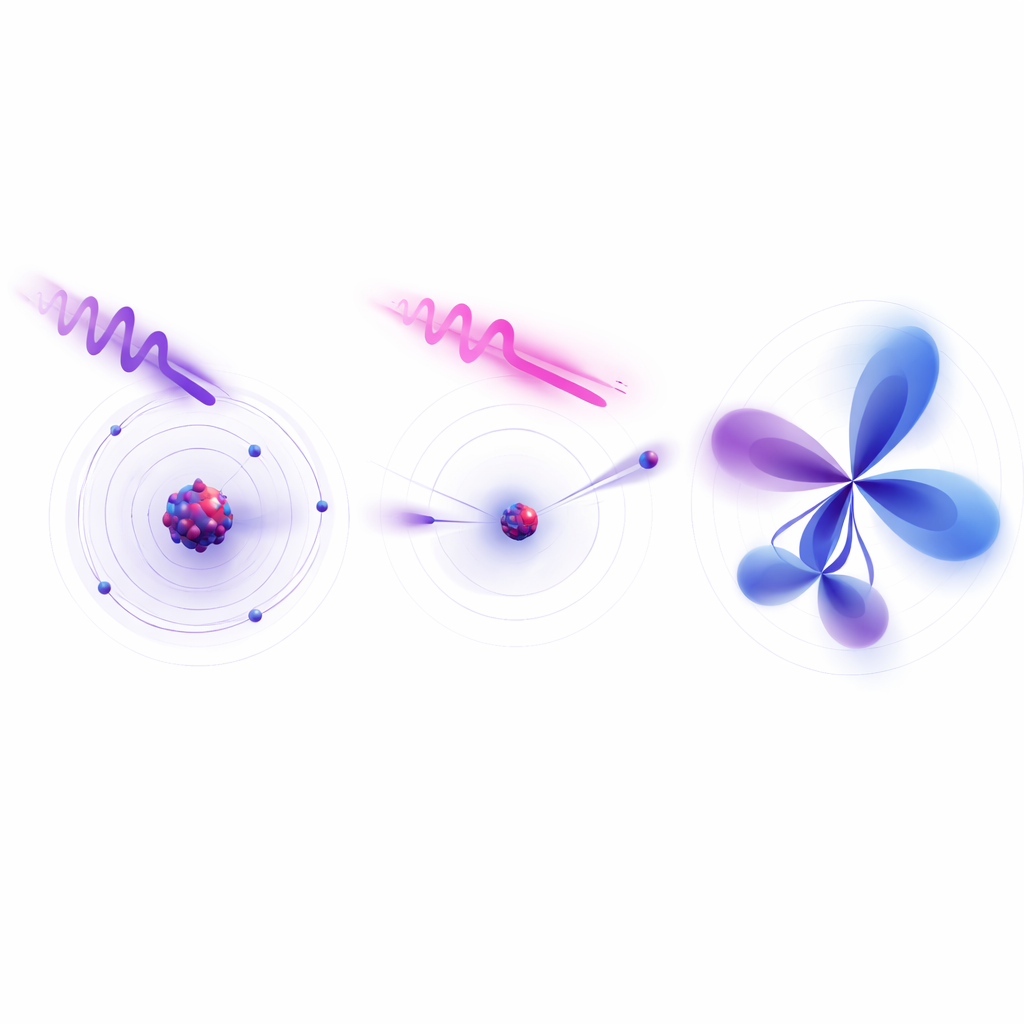
Reading Patterns in the Spray of Electrons
Once the second pulse knocks the electron free, it does not emerge in a simple straight beam. Instead, the electrons are emitted in a characteristic angular pattern around the laser axis, much like a spray pattern from a rotating nozzle. This “photoelectron angular distribution” encodes which quantum states the electron and ion occupy. In argon, several different exit routes are available, each leaving the ion in a different internal state and sending the electron out with a distinct wave shape. Because the electron and ion are entangled, the final pattern seen in the detector is an intricate mixture of these routes. The team shows that as they scan the delay between pulses, the angular pattern oscillates in time, reflecting a quantum beat between two closely spaced excited states inside the atom.
From Complex Ripples to a Simple Measure of Mixedness
In quantum terms, a perfectly well-defined state is called “pure,” whereas a state that hides information because it is tied up with a partner is “mixed.” Here, the more strongly the electron is entangled with the ion, the more mixed its own state becomes. The authors develop a practical recipe to recover this “purity” of the electron’s state directly from the measured angular patterns, without having to access the ion or perform full-blown quantum tomography. Using advanced multi-electron simulations, they show that the purity swings in time as the delay is varied: at some delays, one emission route dominates and the electron is almost unentangled; at others, several routes contribute equally, producing a highly mixed, strongly entangled electron state. 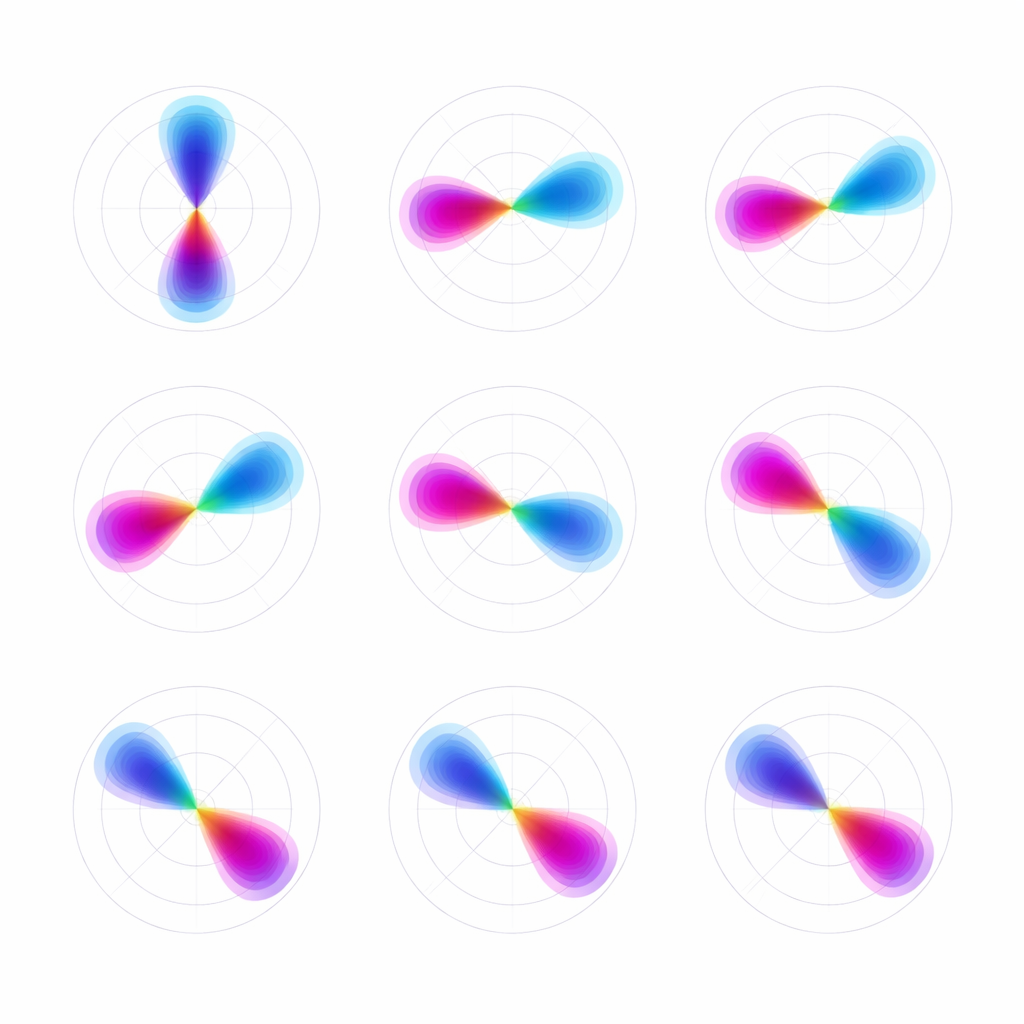
Why Simple Models Miss the Quantum Link
A common shortcut in strong-laser physics is to treat only one electron as active and ignore the detailed structure of the remaining ion. In that single-electron picture, the angular pattern from this two-pulse scheme would barely change with delay, and the electron would appear to stay nearly pure. By performing full multi-electron calculations and comparing them with this simplified model, the authors show that such shortcuts entirely miss the rich, delay-dependent modulations in both the angular patterns and the electron’s purity. These differences arise precisely because of the subtle coupling between the electron and the many-electron ion – in other words, because of entanglement.
New Tools for Ultrafast Quantum Control
At its core, the study demonstrates that the shape of an electron spray from an ionized atom is not just a static fingerprint but a tunable probe of quantum links between particles. With light sources such as tabletop lasers and free-electron lasers now reaching the ultrashort ultraviolet regime used here, the proposed method is experimentally realistic. It offers a way to both control and quantify entanglement in atoms – and, in the future, molecules and solids – using measurements that are already standard in ultrafast laboratories. This brings the dream of engineering entangled states on attosecond time scales closer to practical reality.
Citation: Mao, YJ., Zhang, ZH., Li, Y. et al. Coherent control of electron-ion entanglement in multiphoton ionization. Light Sci Appl 15, 156 (2026). https://doi.org/10.1038/s41377-025-02151-y
Keywords: quantum entanglement, ultrafast lasers, photoionization, electron dynamics, attosecond physics