Clear Sky Science · en
Dynamics of driven dissipative temporal solitons in an intracavity phase trap
Light Pulses That Behave Like Particles
Ultrashort flashes of laser light that endlessly circulate inside tiny loops of glass can act a bit like particles on a track. These so‑called cavity solitons are the building blocks of ultra‑precise optical clocks, sensors, and communications links. Yet their very stability makes them hard to steer or tune. This paper shows how adding a controlled "phase trap" inside the loop lets scientists grab hold of these light pulses, shift their color, and tune their timing far more than was previously possible, opening doors to more flexible and robust photonic technologies.
Why Trapping Light Inside a Loop Matters
Cavity solitons form when a continuous laser feeds an optical resonator made of material whose refractive index depends on light intensity. Under the right conditions, a stable, self‑reinforcing pulse of light appears and keeps circulating while the laser continues to drive it. The comb of equally spaced colors this pulse generates is a key tool for measuring frequencies, distances, and time with extraordinary accuracy. However, the pulse is strongly locked to the driving laser and the resonator, so its color (central frequency) and pulse‑to‑pulse spacing (repetition rate) are usually difficult to adjust without destroying the soliton.
Creating a Phase Trap for Solitons
The authors introduce an "intracavity phase modulation"—a controllable change of the light’s phase applied inside the resonator rather than to the incoming laser. This modulation creates a kind of landscape or potential along the pulse’s path, with valleys where the soliton prefers to sit. By slightly detuning the speed of this landscape relative to the resonator round‑trip time, the pulse can be trapped at positions where it experiences a steady phase slope. Because phase that changes in time acts like a frequency shift, this slope makes the soliton’s color shift toward bluer or redder wavelengths. Through detailed theory and computer simulations, the team shows that for deep enough traps the range of safe frequency shifts is ultimately limited by either energy depletion from the driving laser or a dynamical instability called a Hopf bifurcation, rather than by the trap’s steepness alone. 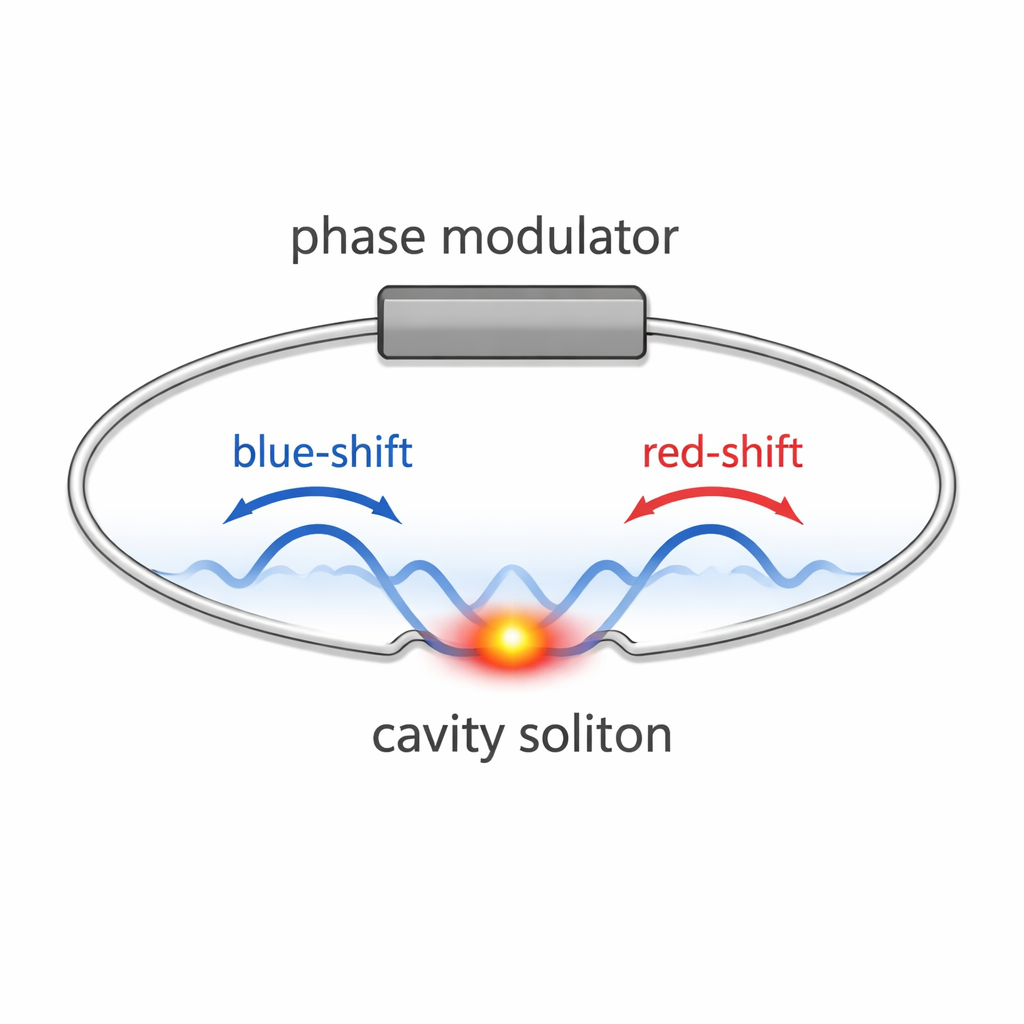
Demonstrating Control in a Fiber Ring
To test these ideas, the researchers built a 64‑meter‑long fiber‑optic ring cavity that includes an electro‑optic phase modulator. A stable continuous‑wave laser injects light into the loop, and short addressing pulses are used to create individual cavity solitons. By driving the modulator with a strong radio‑frequency signal and slowly changing its frequency, they cause the phase landscape to drift with respect to the cavity. As predicted, the trapped soliton’s spectrum shifts smoothly to higher (blue) or lower (red) frequencies while its pulse width changes in a way that matches their analytical model. They achieve shifts up to about 40% of the soliton’s own spectral width—more than an order of magnitude larger than what had been reached using external phase modulation of the input laser—and this directly translates into a wide tunability of the comb’s repetition rate.
Balancing an Unwanted Red Shift
In many glass‑based resonators, another effect, stimulated Raman scattering, tends to push the soliton’s spectrum toward longer wavelengths as the driving conditions are changed, ultimately setting a hard limit on how short and broadband the pulse can be. The team shows that a properly designed intracavity phase trap can counteract this Raman‑induced red shift. With the trap held stationary, the soliton automatically settles at a point in the phase landscape where the trap’s blue shift exactly balances the Raman red shift. Experiments confirm that this compensation keeps the soliton spectrum centered on the driving laser even as the pulse becomes shorter, allowing stable pulses that would otherwise disappear. The authors further analyze how far this balance can be pushed and derive a simple expression for the shortest achievable pulse when Raman effects are present.
Richer Spectral Structure and Synthetic Dimensions
The periodic phase modulation also acts as a regular disturbance each time the soliton circulates, leading to characteristic side features in the spectrum known as Kelly sidebands. With the intracavity modulator, these sidebands broaden and develop oscillatory patterns. By examining the time–frequency structure of the field, the authors interpret these features as a form of Bloch oscillations—repeated, bounded motion of linear waves—in a "synthetic frequency dimension" built from the resonator modes. This reveals that not only the soliton itself but also the weaker waves it sheds are shaped by the phase trap, potentially influencing how multiple solitons interact over long distances within the cavity. 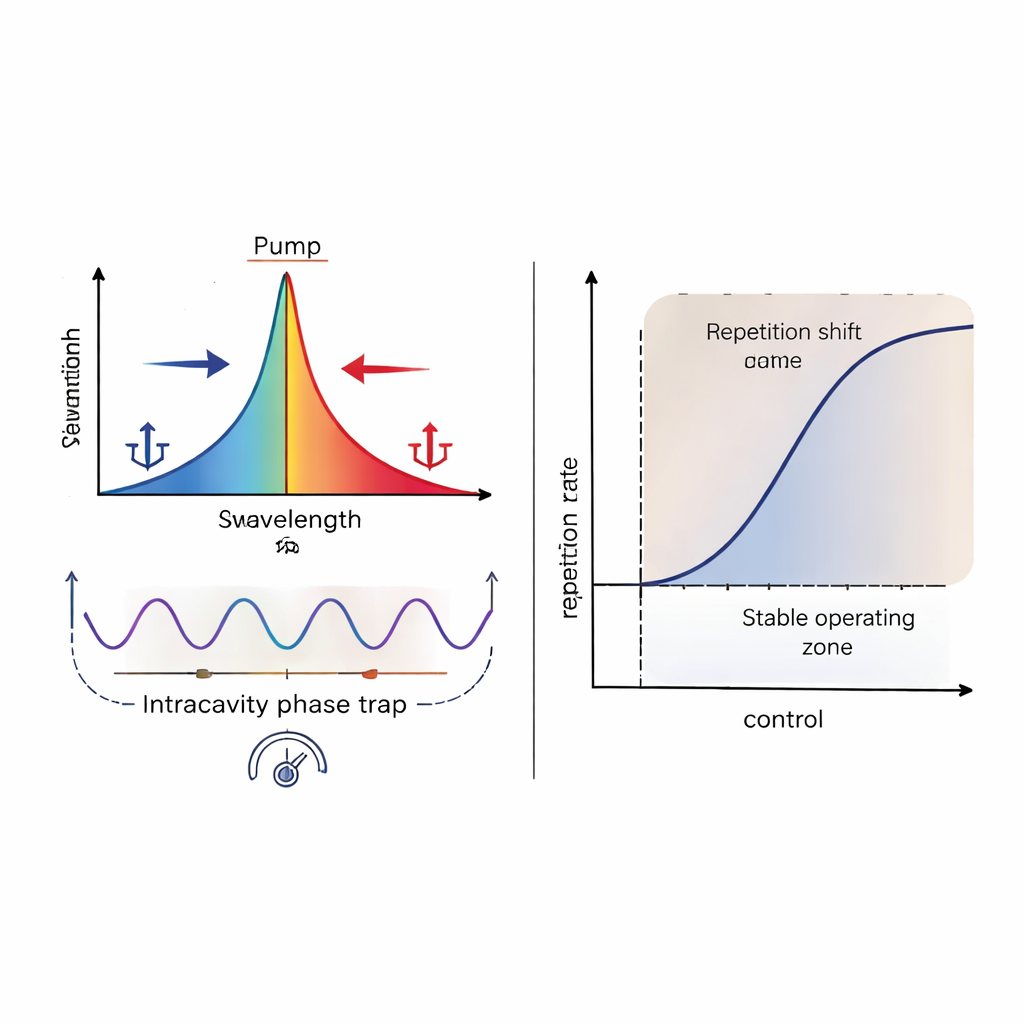
Implications for Future Photonic Tools
By combining a coherent drive laser with an intracavity phase trap, this work provides a powerful handle on the color and timing of cavity solitons. Compared to methods that modulate only the incoming light, the internal approach amplifies the effect of a given phase pattern, enabling much larger and faster tuning of the pulse train’s repetition rate and compensating for otherwise limiting material effects. These capabilities are especially promising for chip‑scale “microcomb” devices that integrate high‑speed modulators, and could lead to more agile frequency combs for LiDAR, precision sensing, low‑noise microwave generation, and other technologies that depend on exquisitely controlled trains of light pulses.
Citation: Englebert, N., Simon, C., Mas Arabí, C. et al. Dynamics of driven dissipative temporal solitons in an intracavity phase trap. Light Sci Appl 15, 117 (2026). https://doi.org/10.1038/s41377-025-02147-8
Keywords: cavity solitons, Kerr frequency combs, phase modulation, Raman scattering, fiber ring resonator