Clear Sky Science · en
Optically programmable dual-band perovskite single-pixel detector for color image encryption
Hiding Secrets in Ordinary Pictures
Every day we send photos and videos across the internet, often assuming that encryption keeps snoops at bay. But what if someone could quietly read images just by tapping into stray light along a fiber or in the air? This research shows a new way to protect visual information by making the detector itself part of the lock and key, using a special light-sensitive material that only reveals a hidden message when it is illuminated in just the right way.
A New Kind of Light Sensor
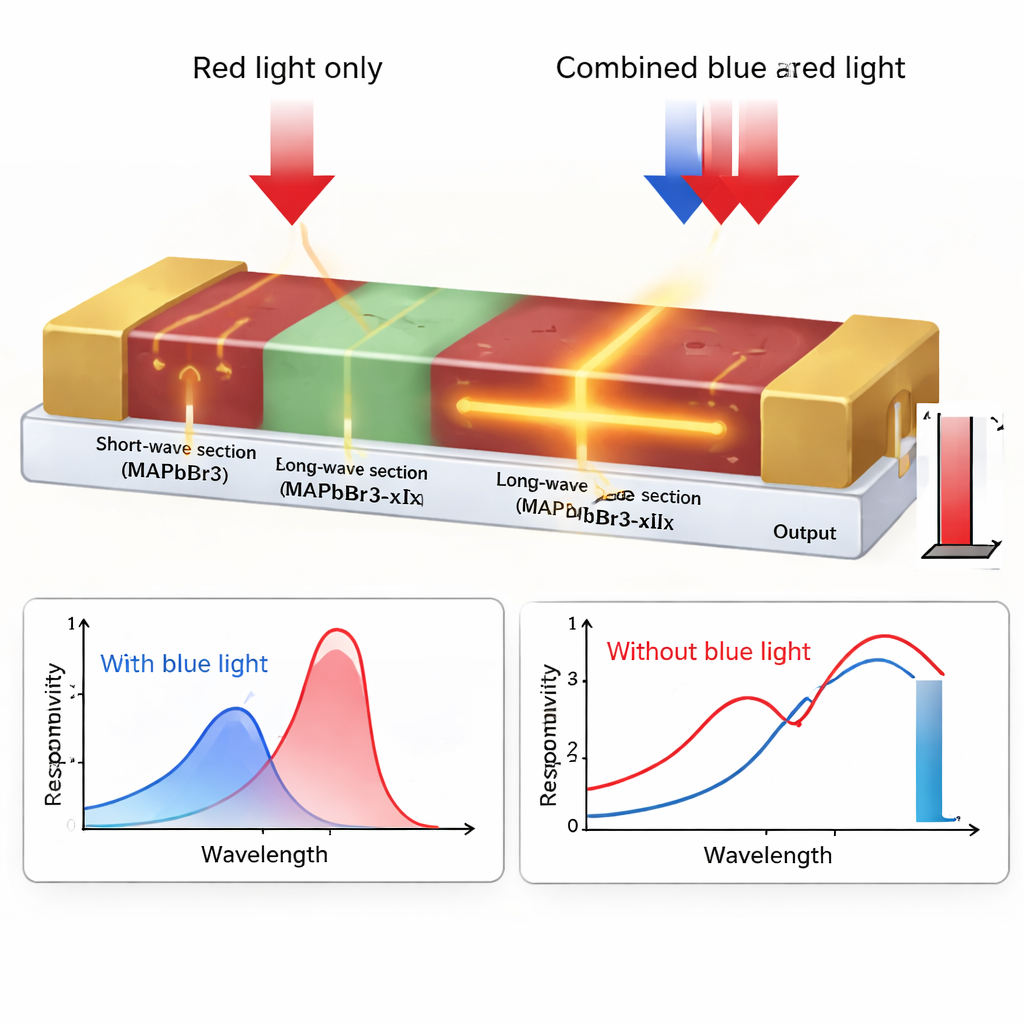
Instead of using the familiar grid of millions of pixels inside a phone camera, the team built what is called a single-pixel detector: one highly sensitive “bucket” that measures only how bright the incoming light is overall. Spatial information is encoded by projecting many patterns onto the object and mathematically reconstructing the scene. The key innovation here is the detector material itself. The researchers use a class of crystals known as halide perovskites, arranged as microscopic wires that form a lateral junction between two slightly different compositions. One side responds mainly to shorter wavelengths (bluer light), while the other side responds to both blue and longer-wavelength red light.
Light That Reprograms the Detector
On its own, the red-sensitive side of the device is partly blocked: charges generated by red light cannot easily cross the low-conductivity region, so the detector barely “sees” red. When the device is illuminated with blue light, however, that barrier turns conductive. Suddenly the path opens and red-generated charges can flow freely. In electrical terms, blue light switches the device from a nearly off state for red to a strongly on state, boosting the red response by up to a thousand times. The researchers show that this switching is fast, stable, and tunable by changing the brightness of the light and the applied voltage, making the detector optically programmable: its color sensitivity can be turned up or down using another color of light.
Turning Color Tricks into Security
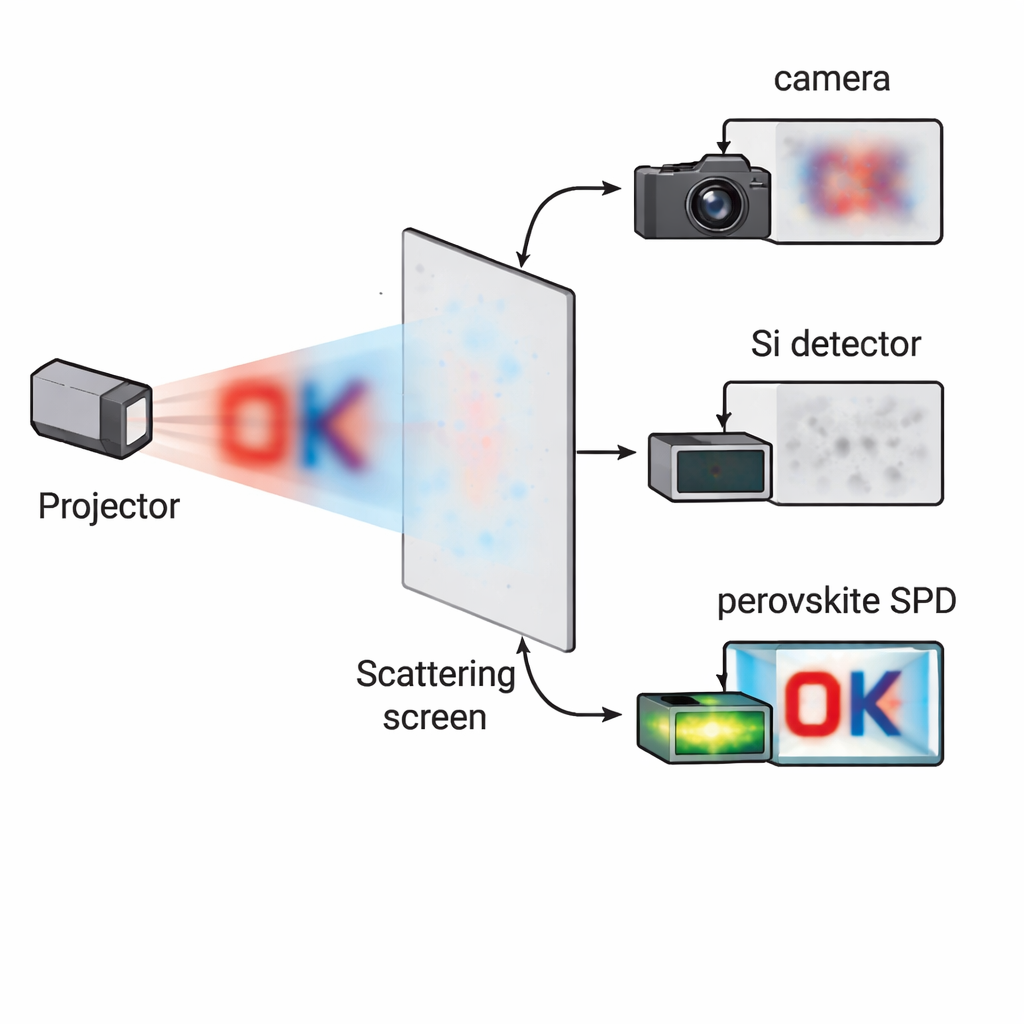
This odd behavior becomes powerful when combined with single-pixel imaging. In their setup, a projector sends a color pattern toward a digital micromirror device, which flickers through thousands of black-and-white patterns that encode the scene. The light then passes through a scattering layer that imitates foggy or milky glass before reaching the detectors. Because the perovskite device uses blue light both as a signal and as a control that unlocks its red sensitivity, blue and red regions of the image interact in a non-intuitive way at the detector. Under patterned illumination, the same color scene produces very different reconstructions depending on whether the team uses their programmable detector or a standard silicon detector, and whether they scan point by point or use single-pixel imaging.
Hiding Numbers Inside Numbers
To show how this can protect information, the authors design color images in which the true message (such as the letters “OK” or the number string “3025”) is drawn in red, while blue digits or shapes are sprinkled around as distractions and as control elements. Using their programmable detector with single-pixel imaging, they can reconstruct one version of the scene. Using a different scanning approach, which suppresses the color interaction at the detector, they obtain another version where only the blue elements appear. Subtracting these two images reveals the hidden red message. A commercial camera, or a normal silicon single-pixel detector, sees only a scrambled mix—especially once the team adds realistic complications like unequal brightness, mixed red–blue colors, and scattering layers. Even if an eavesdropper tries to use color filters and clever image processing, the detector-specific color response keeps the true message out of reach.
Why This Matters for Everyday Security
Most image encryption schemes rely on heavy software or complex optical components at the sending side, while assuming any ordinary camera can safely view the decrypted picture. This work flips that idea: it builds the security into the detector so that only a specially designed device produces the correct image, even when the light field itself is accessible to others. By exploiting the tunable color response of perovskite materials, the authors demonstrate a single-pixel detector that acts as both sensor and decryption key. In practice, such device-dependent schemes could add a new hardware layer to optical security systems, making it far harder for an eavesdropper with a standard camera or detector to recover sensitive visual information hidden in seemingly ordinary color images.
Citation: Fu, A., Zhang, ZH., Xiong, J. et al. Optically programmable dual-band perovskite single-pixel detector for color image encryption. Light Sci Appl 15, 138 (2026). https://doi.org/10.1038/s41377-025-02126-z
Keywords: optical encryption, single-pixel imaging, perovskite photodetector, image security, color coding