Clear Sky Science · en
Microfiber knot resonator with 107 Q-factor record
Light Trapped in a Tiny Knot
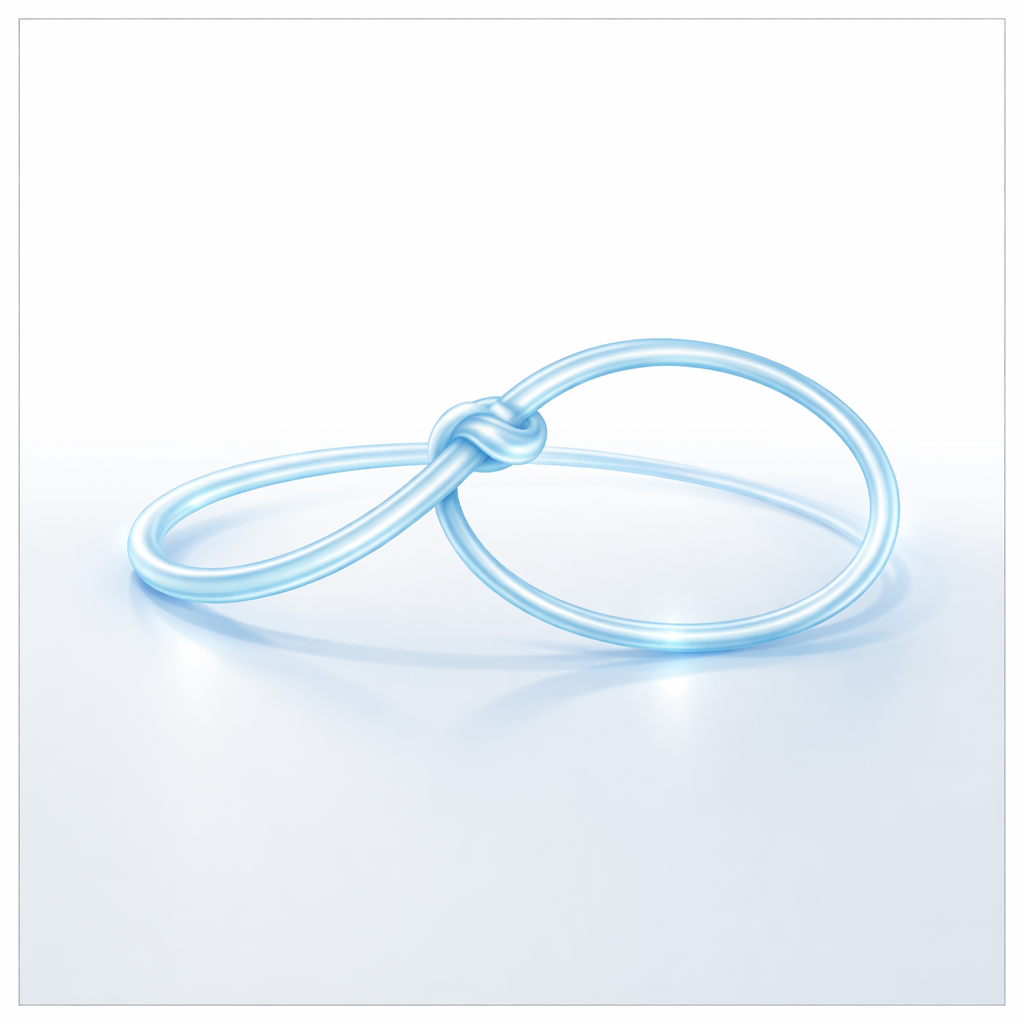
Imagine tying a knot in a strand of glass thinner than a human hair and using it to trap light so efficiently that it circles millions of times before fading. This study shows how researchers have learned to do exactly that, building a record‑setting “microfiber knot resonator” that could lead to more precise sensors, ultra‑pure lasers, and flexible, thread‑like photonic devices that integrate seamlessly with ordinary optical fibers.
Why Quality of the Knot Matters
Modern photonics often relies on tiny optical resonators—structures that store light and let it build up in intensity. Their performance is measured by a number called the Q‑factor: the higher the Q, the longer light circulates and the more strongly it interacts with matter. Existing microresonators carved on chips or made as glass spheres can reach extremely high Q, but they are hard to package and do not naturally connect to standard optical fibers. Microfiber resonators made from tapered fiber are mechanically simple and fiber‑compatible, yet for years their Q‑factors languished around one‑thousandth of the best devices, leading many to believe that this platform was fundamentally limited.
Taming Glass with Air, Heat, and Humidity
The authors show that the main obstacle was not the basic idea but the way these glass threads were made. They start with ordinary silica fiber and heat it using an oxyhydrogen flame while gently pulling to thin it down to about three micrometers in diameter—roughly one‑thirtieth the width of a human hair. By carefully controlling room temperature and humidity during this process, they reduce hidden internal stresses in the glass. Under non‑ideal conditions, the finished fiber twists and kinks, and when it eventually breaks, it tends to snap at thicker sections—signs of uneven stress. Under carefully stabilized conditions, the fiber hangs in a smooth, uniform arc and breaks only at its thinnest waist, indicating a balanced internal structure. Resonators built from these higher‑quality microfibers are more symmetric, with a nearly circular loop and a compact, well‑defined knot region. These subtle mechanical improvements translate directly into optical performance, enabling Q‑factors from five million up to an unprecedented 39 million.

Finding the Sweet Spot for Light Coupling
The knot itself acts as a built‑in coupler: two nearby segments of the microfiber allow light to “leak” back and forth through their overlapping fields. The team systematically tunes this coupling by pulling the fiber with motorized stages while monitoring how the resonance sharpens or broadens. Too weak a coupling and light barely enters the loop; too strong and it escapes too quickly. Using both experiments and theoretical modeling, they map out how the Q‑factor depends on the knot’s length, the loop size, and the fiber diameter. They find that a diameter around three micrometers strikes the right balance: thin enough for strong interaction between the two strands, yet forgiving enough that standard motion stages can reliably hit the narrow window where the resonator stores light most efficiently. Under these optimized conditions, the device maintains its ultra‑high Q over a broad range of wavelengths and remains stable for days, even though the knot is held purely by mechanical tension.
Turning a Glass Knot into a Laser Tool
To demonstrate practical value, the researchers place a single microfiber knot resonator into an all‑fiber laser cavity. Because its resonances are so sharp—tens of megahertz wide compared with gigahertz‑spaced laser modes—the knot acts as a powerful filter, allowing only one color of light to oscillate. The result is a single‑frequency laser with a linewidth of about 20 kilohertz, more than narrow enough for demanding tasks such as precision sensing or coherent communications. Radio‑frequency measurements show a clean spectrum with no extra beating signals, confirming that only one longitudinal mode survives when the knot is in place, whereas a similar cavity without the knot produces many competing modes.
What This Means for Future Technologies
In everyday terms, this work shows how a simple, knot‑shaped glass fiber can be turned into an exceptionally “echo‑friendly” home for light, rivaling more elaborate microchips while remaining flexible, robust, and directly compatible with ordinary fibers. By identifying the twin keys—high‑quality microfiber fabrication under controlled environmental conditions and precise tuning of the knot’s coupling region—the authors open the door to mass‑produced, ultra‑high‑Q fiber devices. Such resonators could underpin wearable optical sensors, underwater acoustic detectors, tunable narrow‑linewidth lasers, and even future quantum technologies that rely on light stored and manipulated in tiny, reconfigurable loops of glass.
Citation: Zhou, X., Ding, Z. & Xu, F. Microfiber knot resonator with 107 Q-factor record. Light Sci Appl 15, 155 (2026). https://doi.org/10.1038/s41377-025-02124-1
Keywords: microfiber knot resonator, ultra high Q optical cavity, fiber laser, optical sensing, photonic microcavity