Clear Sky Science · en
Ultraprecision, high-capacity, and wide-gamut structural colors enabled by a mixture probability sampling network
Turning Tiny Structures into Vivid Color
What if you could print brilliant, fade‑resistant colors without any dyes or pigments at all—just by sculpting matter on the nanoscale? This paper introduces a new artificial‑intelligence method that makes it far easier to design such "structural colors," opening the door to ultrasharp color printing, durable displays, and anti‑counterfeiting patterns built purely from nanostructures.
Color from Shape, Not from Ink
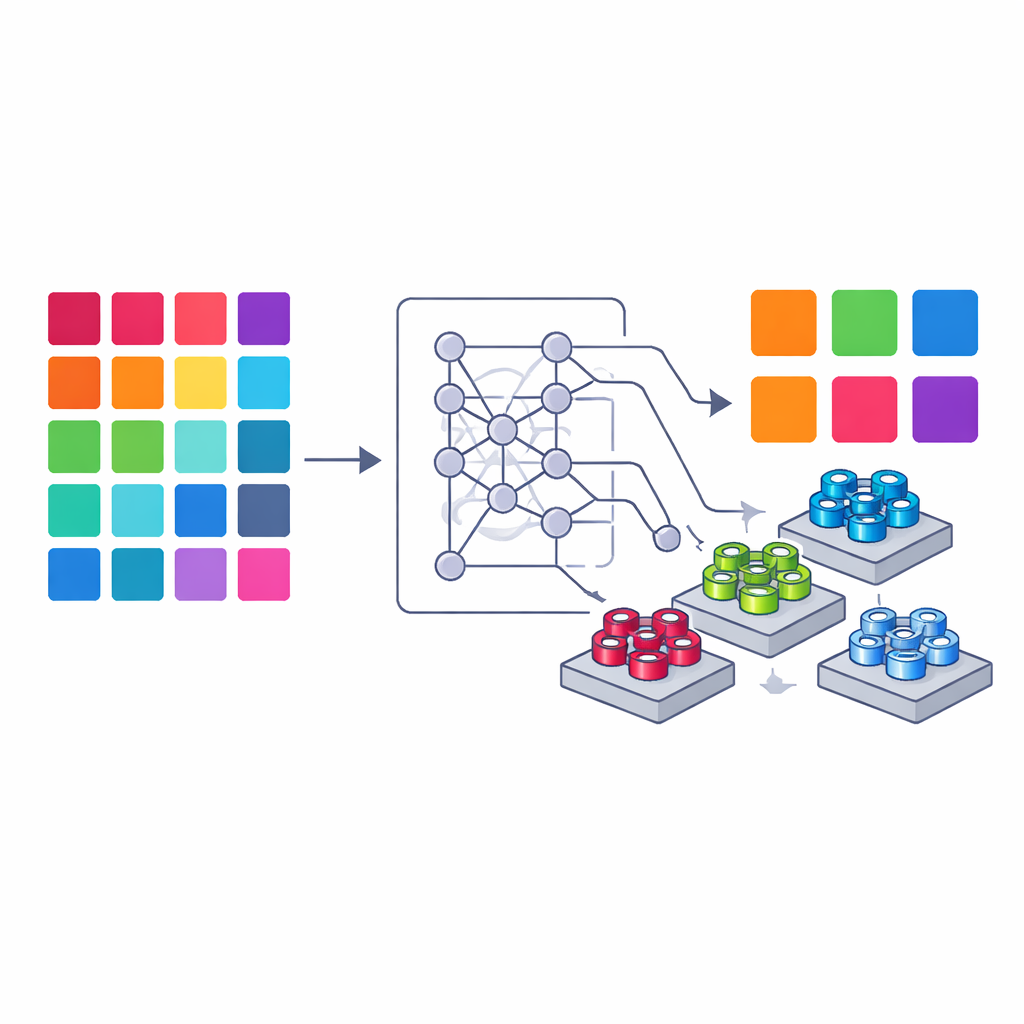
Structural colors arise when light bounces, scatters, and interferes within tiny patterns carved into materials, much like the shimmering hues on butterfly wings or peacock feathers. Instead of mixing chemical dyes, engineers adjust the size and shape of nanoscopic features—here, a repeating pattern made of a square ring surrounding a central square pillar on a glass‑like substrate. By tuning just four dimensions of this building block, they can generate a wide range of reflected colors across the visible spectrum. The challenge is to determine which exact geometry will yield a desired color, without running millions of slow physics simulations.
Why One Color Can Hide Many Structures
Designing structural color is not a simple reverse lookup. The same perceived color can often be produced by many different nanostructures because the human eye cannot distinguish between certain spectral differences. This "one color, many structures" situation makes it hard for standard neural networks to learn a reliable mapping from color back to geometry. Traditional deep‑learning approaches either struggle to converge, produce only one candidate design, or rely on random noise in ways that introduce uncertainty and reduce accuracy, especially when the nanostructure design involves several adjustable parameters.
A Smarter Way to Sample Many Possibilities
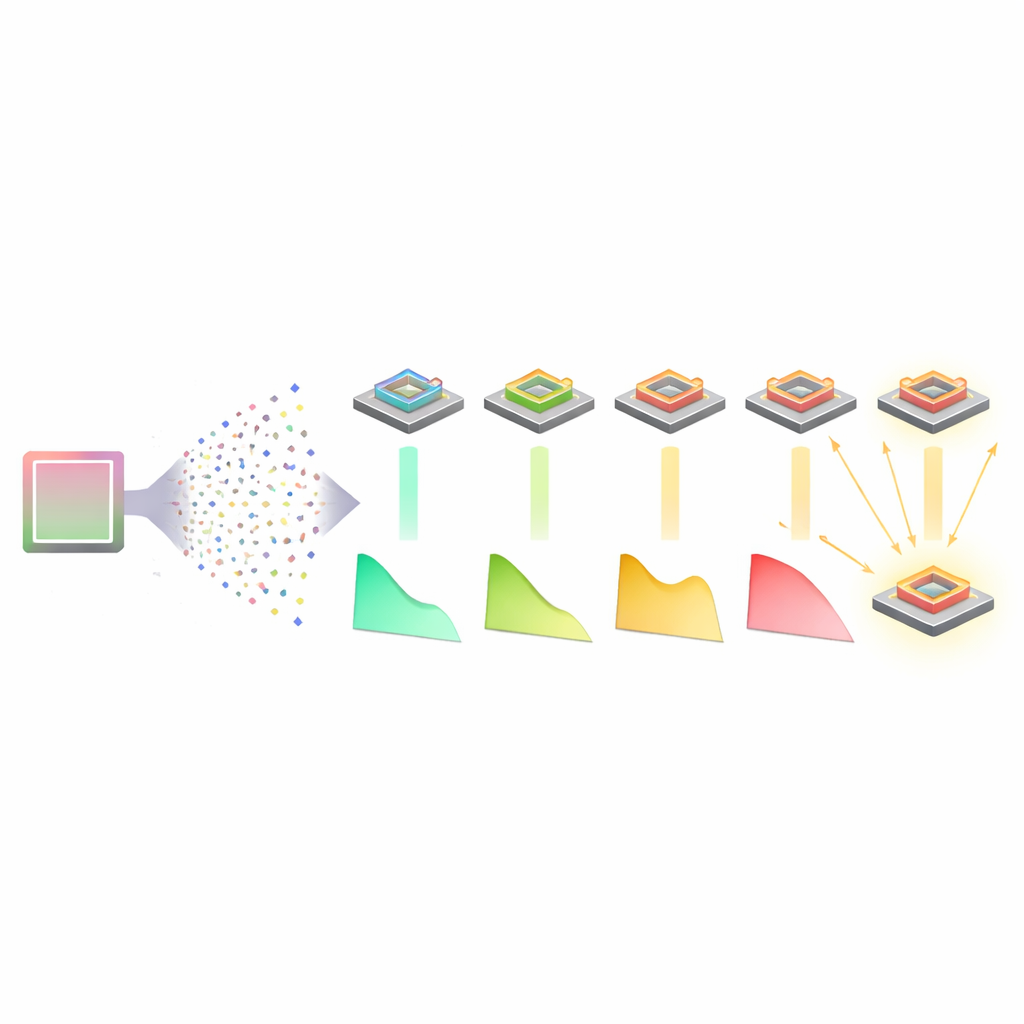
The authors propose a new framework called a mixture probability sampling network (MPSN) that embraces this non‑uniqueness rather than fighting it. First, they train a forward neural network that quickly predicts color from structure, replacing time‑consuming electromagnetic simulations. On top of this, they build an inverse network that, for any target color, outputs not a single answer but a whole probability distribution over possible structural parameters. By repeatedly sampling from this distribution, sending each candidate structure through the fast forward network, and keeping only the sample that best matches the target color, the system learns which regions of parameter space are truly promising. This loop is run end‑to‑end during training so that the probability distributions gradually sharpen around high‑quality design families.
Sharper Colors, More Choices, Less Computation
To test their approach, the team tackled the demanding problem of designing wide‑gamut structural colors. Using their MPSN, they created nanoscale ring‑and‑pillar patterns that reproduce primary red, green, and blue as well as a dense palette of other hues. Compared with other advanced neural‑network schemes, MPSN achieved extremely high agreement—up to 99.9%—between predicted and target colors, with errors far below what the eye can see. Crucially, it also returned many different viable structures for each color, giving designers flexibility to choose options that are easier to fabricate or more robust in practice. Fabricated samples matched the designs closely and covered about two‑thirds of the standard color space used in displays, all using a single‑cell design per color.
From Color Patches to Practical Devices
For non‑specialists, the key message is that this work turns a messy trial‑and‑error search into a guided, probabilistic exploration. Instead of asking a computer for one hard‑won answer, the MPSN quickly proposes a curated set of high‑quality nanostructures that can all produce the same desired color, and it does so orders of magnitude faster than traditional optimization. This approach is not limited to bright structural paint: the same strategy could streamline the design of lenses, sensors, and other complex optical components wherever many different microscopic shapes can yield the same macroscopic behavior.
Citation: Wei, Z., Xu, W., Dong, S. et al. Ultraprecision, high-capacity, and wide-gamut structural colors enabled by a mixture probability sampling network. Light Sci Appl 15, 164 (2026). https://doi.org/10.1038/s41377-025-02122-3
Keywords: structural color, nanophotonics, inverse design, deep learning, metasurfaces