Clear Sky Science · en
Balancing positive and negative luminescence for thermoradiative signatureless communications
Hiding Messages in Everyday Heat
Every warm object around us quietly glows in invisible infrared light, a kind of thermal “noise” that usually goes unnoticed. This paper shows how that ever‑present glow can be turned into a secret communications channel, where information is sent without leaving any obvious optical trace. For a casual observer, the scene looks perfectly normal; only someone with the right, very fast detector can tell that a hidden conversation is taking place.
From Bright Beams to Invisible Whispers
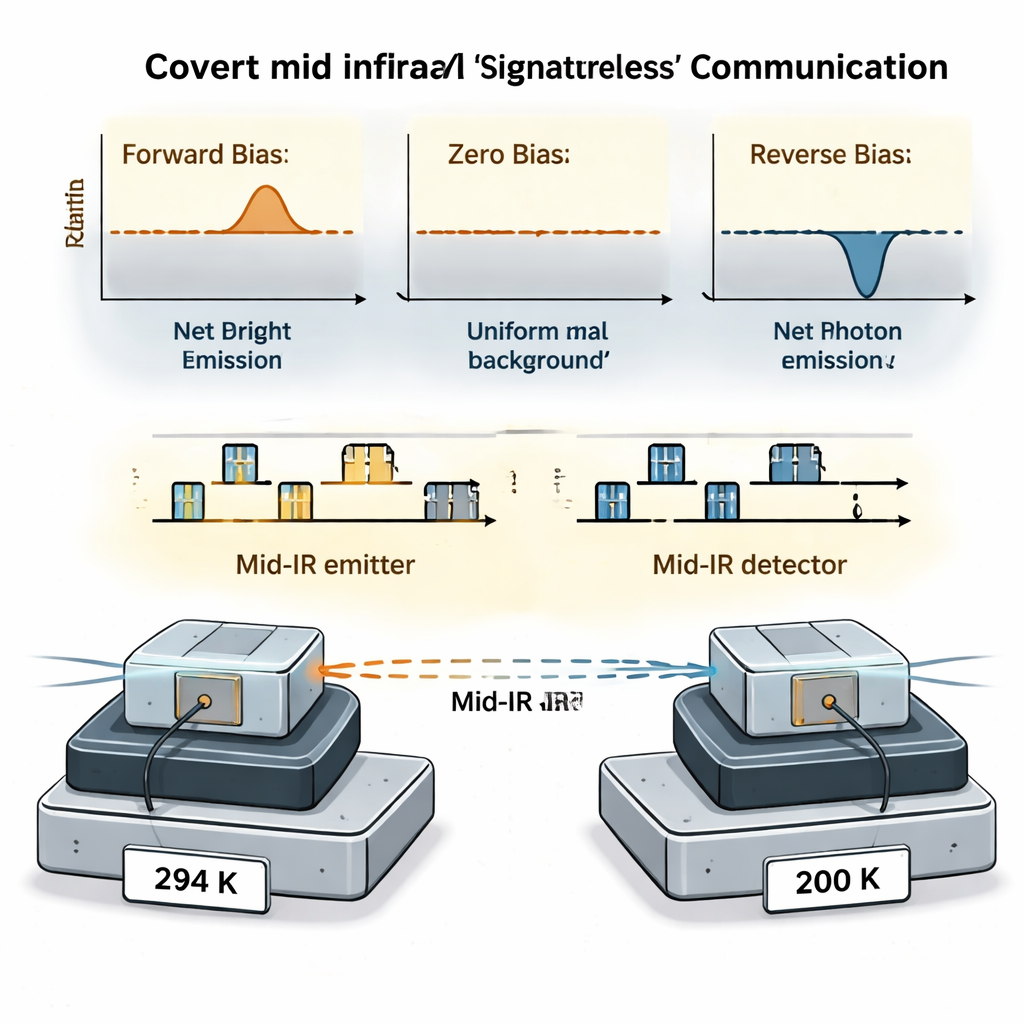
Most optical communication systems, like fiber‑optic internet links or laser pointers, work by adding extra light to the environment: a bright beam that carries information. Even if the message itself is encrypted, the beam is easy to spot. The authors explore a different idea: instead of only making things brighter, they also make them dimmer than the natural thermal background. By carefully combining these two states, the average brightness stays the same as the surroundings. To any detector that is too slow to follow the rapid changes, nothing unusual seems to happen, even though data are streaming by at high speed.
Turning Diodes into Covert Infrared Transmitters
The team builds their hidden link from mid‑infrared photodiodes made of a material called HgCdTe. These devices normally detect light, but they can also emit it when an electrical voltage is applied. With a forward voltage, the diode produces extra infrared light, a bit like a tiny LED (this is called electroluminescence). With a reverse voltage, it does the opposite: it emits less light than a simple warm object would, a phenomenon known as negative luminescence. By switching the voltage between these two states in sync with digital 1s and 0s, the authors imprint data onto the infrared glow without changing its long‑term average level.
Proving the Signal Is There—and Not There
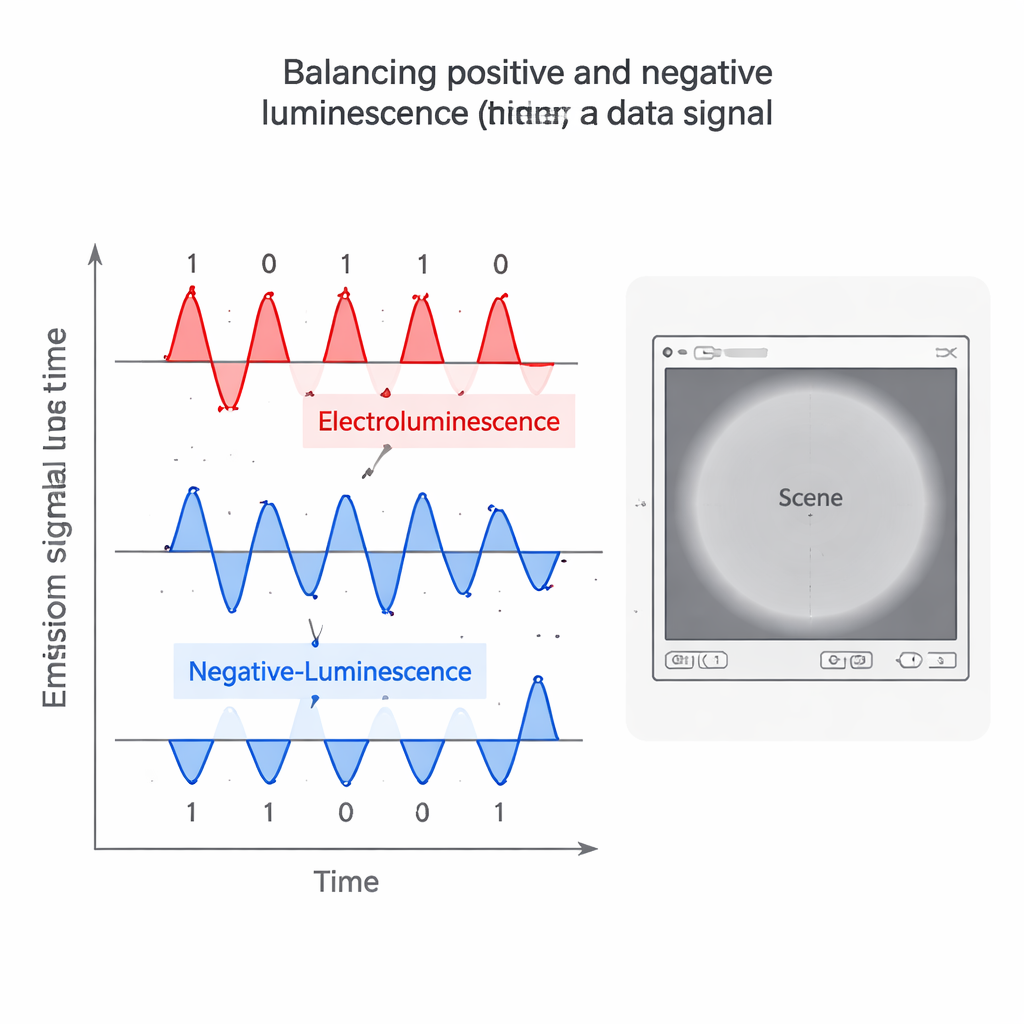
In the lab, the researchers point one such emitting diode at a second, cooled diode that acts as a sensitive receiver. They drive the emitter with square‑wave voltages and show that the received signal clearly flips between bright and dark states at up to a million times per second, corresponding to data rates of at least 100 kilobits per second. Yet when they look at the setup with a standard thermal camera, whose frame rate is much slower than the modulation, the scene appears unchanged. The emitter looks hotter under forward bias and cooler under reverse bias when each state is viewed alone, but when the bright and dark states are rapidly alternated, the camera sees an almost uniform, background‑like image. For a slow watcher, the communication is effectively invisible.
Faster, Sharper, and More Directed Beams
Looking ahead, the authors outline paths to make this hidden channel far faster and more practical. Existing commercial mid‑infrared detectors can already operate at gigahertz speeds, and emerging materials like graphene and black phosphorus promise bandwidths up to hundreds of gigahertz or even into the terahertz range. At such speeds, the system could transmit vastly more data while still remaining hidden from ordinary sensors. They also highlight the role of carefully engineered surfaces, called metasurfaces, which can shape thermal emission into narrow beams and specific colors. This would allow multiple hidden channels at different wavelengths and more efficient long‑distance links, whether through air, optical fibers, or even between satellites in space.
Everyday Heat as a Secret Channel
In simple terms, the work shows that it is possible to send information by making a device briefly a bit brighter or a bit dimmer than its natural infrared glow, in such a way that the average glow never changes. To a normal infrared camera or detector, there is no obvious “on/off” flashing; the scene blends into the thermal background. Only a receiver fast enough to follow the rapid bright‑and‑dark pattern can read the message. This balancing act between positive and negative luminescence opens the door to highly secure, covert communication systems that hide in plain, everyday heat.
Citation: Nielsen, M.P., Maier, S.A., Fuhrer, M.S. et al. Balancing positive and negative luminescence for thermoradiative signatureless communications. Light Sci Appl 15, 148 (2026). https://doi.org/10.1038/s41377-025-02119-y
Keywords: covert communication, infrared, thermal radiation, luminescence, metasurfaces