Clear Sky Science · en
Breaking the mid-infrared interconnection barrier: a robust bonding for high-power optics based on liquid-like chalcogenide glass
Why better “invisible glue” for infrared light matters
Many of the technologies that quietly power modern life—chemical sensors, medical diagnostic tools, industrial monitors, and military systems—depend on light we cannot see: mid-infrared radiation. This kind of light is excellent at probing gases, liquids, and solids, but building compact, powerful mid‑infrared devices has been held back by a surprisingly simple problem: how do you glue optical parts together without wasting most of the light or having them fall apart under heat?
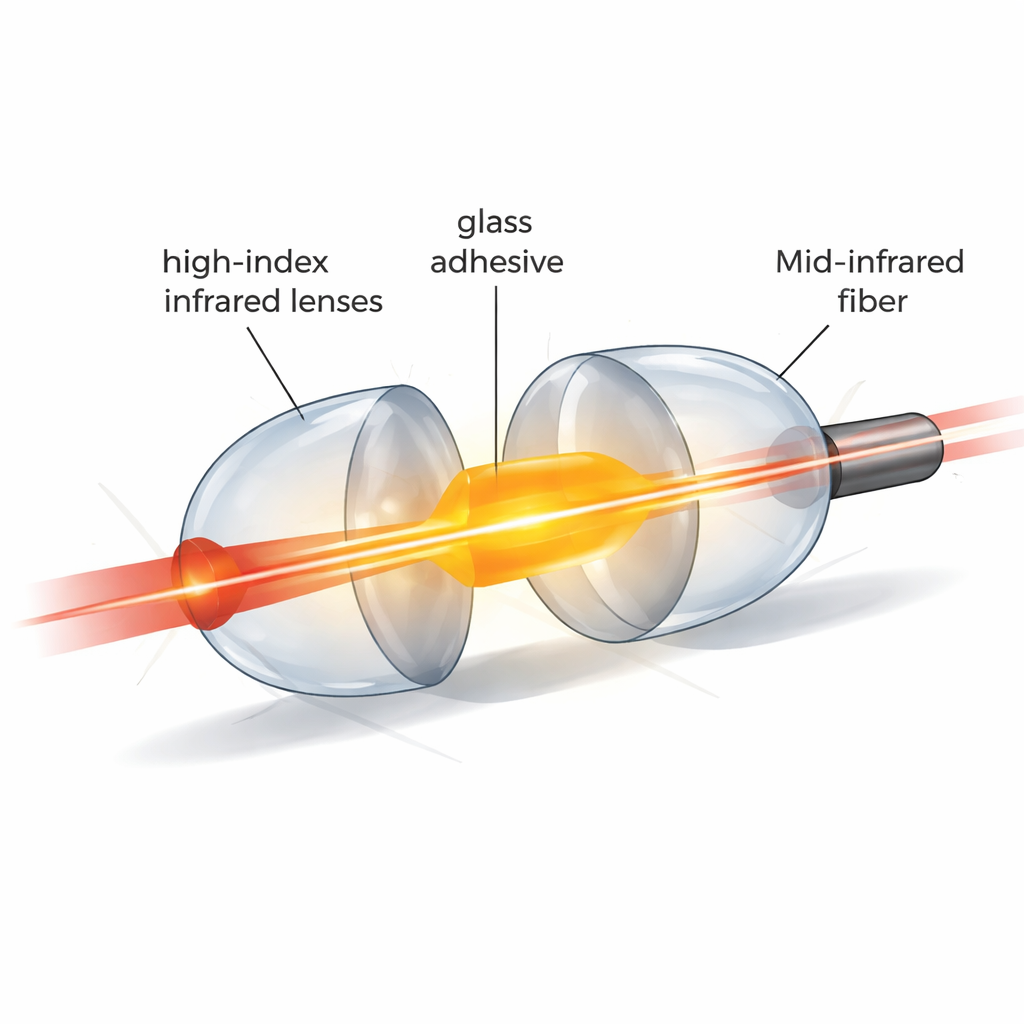
The challenge of sticking infrared optics together
Mid‑infrared components such as special glasses and crystals bend light strongly because they have a high refractive index. When light hits the boundary between one material and another—say, from air into glass—part of it is reflected away, like glare on a window. For these high‑index materials, those reflections can add up to huge losses, especially when lenses, windows, and fibers are chained together. Conventional optical glues, the kind used in visible‑light cameras and microscopes, are based on organic molecules that absorb mid‑infrared light and have much lower refractive index than these dense infrared materials. The result is both strong absorption and large reflection losses, making them unusable for high‑power mid‑infrared systems.
A liquid glass that behaves like an ideal optical glue
The authors developed a new kind of “liquid‑like” chalcogenide glass—an inorganic material made from elements like arsenic, sulfur, selenium, and iodine—that behaves more like a thick liquid at room temperature but turns into a solid, tough glass when gently heated and cooled. By carefully tuning its recipe, they created a glass that softens below room temperature, flows easily at about 120 °C, and has a refractive index around 2.1, much closer to that of common mid‑infrared optics. Importantly, this glass is highly transparent from roughly 2 to 12 micrometers, a key region for sensing molecules. Tests showed it can be stretched, bent, and drawn into shapes without cracking, and that it remains chemically stable—even after dozens of heating cycles at 120 °C and months in air.
From concept to real bonded lenses and fibers
Using this liquid‑like glass as an adhesive, the team bonded different infrared lenses and windows, then measured how much light passed through. When they filled the gaps between a high‑index glass lens and antireflection‑coated infrared lenses, the overall transmission jumped from about 36 percent to 91 percent—close to the theoretical limit set by the outermost surfaces. In another combination, using calcium fluoride and chalcogenide glass lenses, transmission rose from 62 percent to 83 percent. Power‑handling tests with mid‑infrared lasers at two wavelengths showed similar gains: bonded lens groups delivered roughly 15–25 percent more power than unbonded ones, with no damage under strong illumination. The adhesive’s mechanical strength rivaled common commercial optical glues, and bonded parts survived military‑standard environmental tests with only tiny bubble formation.
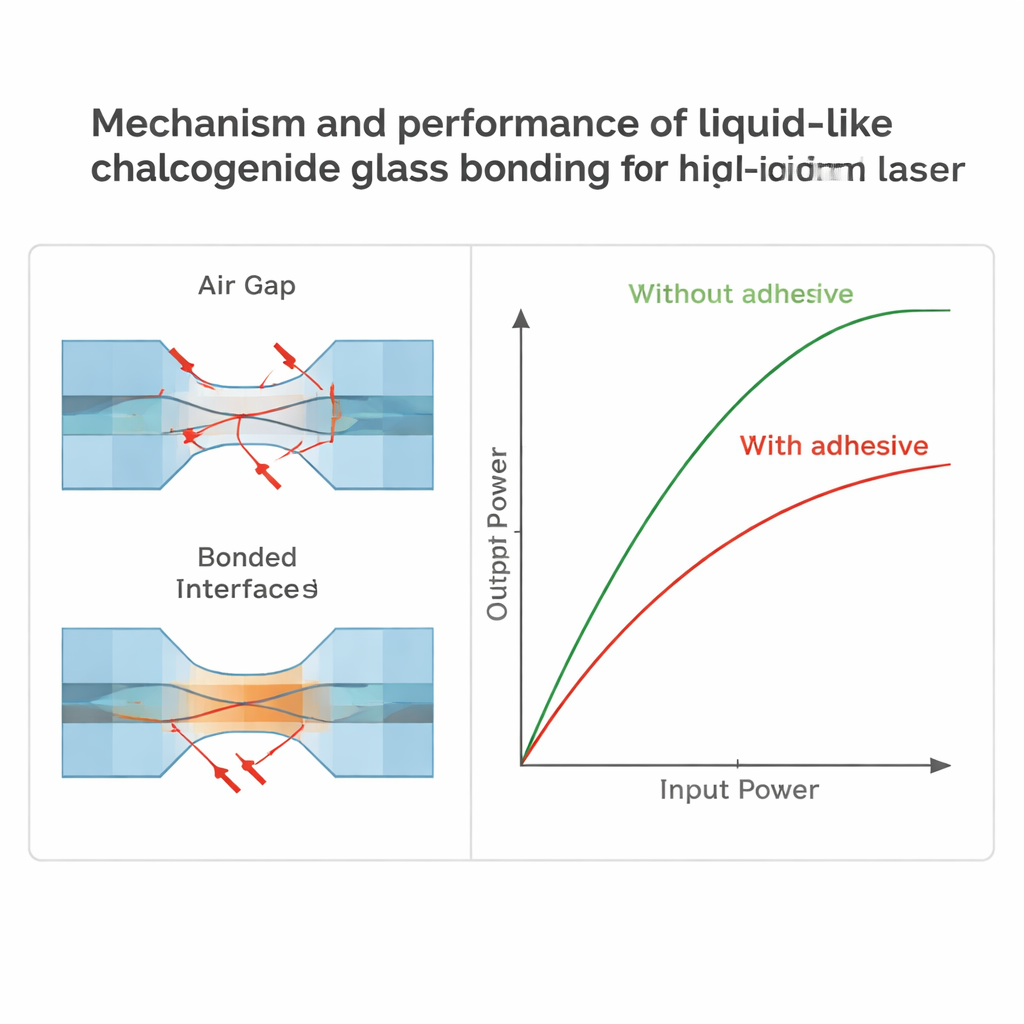
Pushing high‑power infrared fibers to new limits
To show its value in more demanding conditions, the researchers built a specialized infrared fiber system. They tapered a chalcogenide glass fiber and bonded both ends to robust calcium fluoride “endcaps” using the liquid glass. This design spreads and then re‑collects the laser beam so that no bare high‑index glass surface faces open air. At a wavelength of 4.7 micrometers, the bonded fiber delivered over 11 watts of average power with an efficiency of about 80 percent, compared with roughly 63 percent without the adhesive—a 28 percent relative boost. Over 200 heating and cooling cycles across three months, the transmission barely changed, showing that the bonded structure is not only efficient but also thermally reliable at temperatures exceeding 100 °C.
What this means for future infrared devices
In plain terms, this work introduces a glass “super‑glue” tailor‑made for mid‑infrared light. It lets designers join otherwise mismatched optical parts while slashing reflection losses, surviving high laser powers, and holding up under repeated heating and cooling. By turning a fragile optical interface into a strong, low‑loss, and durable connection, this liquid‑like glass opens the door to smaller, more powerful, and more reliable infrared instruments for chemical sensing, medical diagnostics, environmental monitoring, and defense, where every extra photon and every extra watt of delivered power can translate into better performance in the real world.
Citation: Wang, X., Xiao, F., Du, Y. et al. Breaking the mid-infrared interconnection barrier: a robust bonding for high-power optics based on liquid-like chalcogenide glass. Light Sci Appl 15, 139 (2026). https://doi.org/10.1038/s41377-025-02098-0
Keywords: mid-infrared optics, chalcogenide glass, optical adhesive, high-power fiber delivery, infrared photonics