Clear Sky Science · en
Gapless tunable intense terahertz pulse generation in strained diamond
Bridging a Missing Band of Invisible Light
Terahertz light sits between microwaves and infrared on the electromagnetic spectrum and can shake atoms and molecules in ways that reveal or control hidden properties of materials. Yet a crucial slice of this range, roughly 5–15 trillion cycles per second, has been notoriously hard to reach with powerful, clean pulses. This paper shows how a tiny but precisely squeezed diamond crystal can act as a new kind of engine to generate intense, ultrashort terahertz bursts that seamlessly cover this “missing” band, opening doors to probing superconductors, quantum materials, and complex molecules.
Why This Hidden Range Matters
Many important materials respond most strongly to vibrations in the 5–15 terahertz band. Driving a superconductor or a magnetic crystal at just the right rhythm can temporarily change its state, turning on superconductivity or reshaping its magnetic pattern. Existing terahertz sources either leave gaps in this frequency range, are too weak at specific colors, or rely on fragile, expensive crystals and complicated setups. Researchers therefore need a source that is powerful, tunable across this entire band without gaps, and straightforward enough to integrate into standard ultrafast laser laboratories.
Using Diamond as a Terahertz Engine
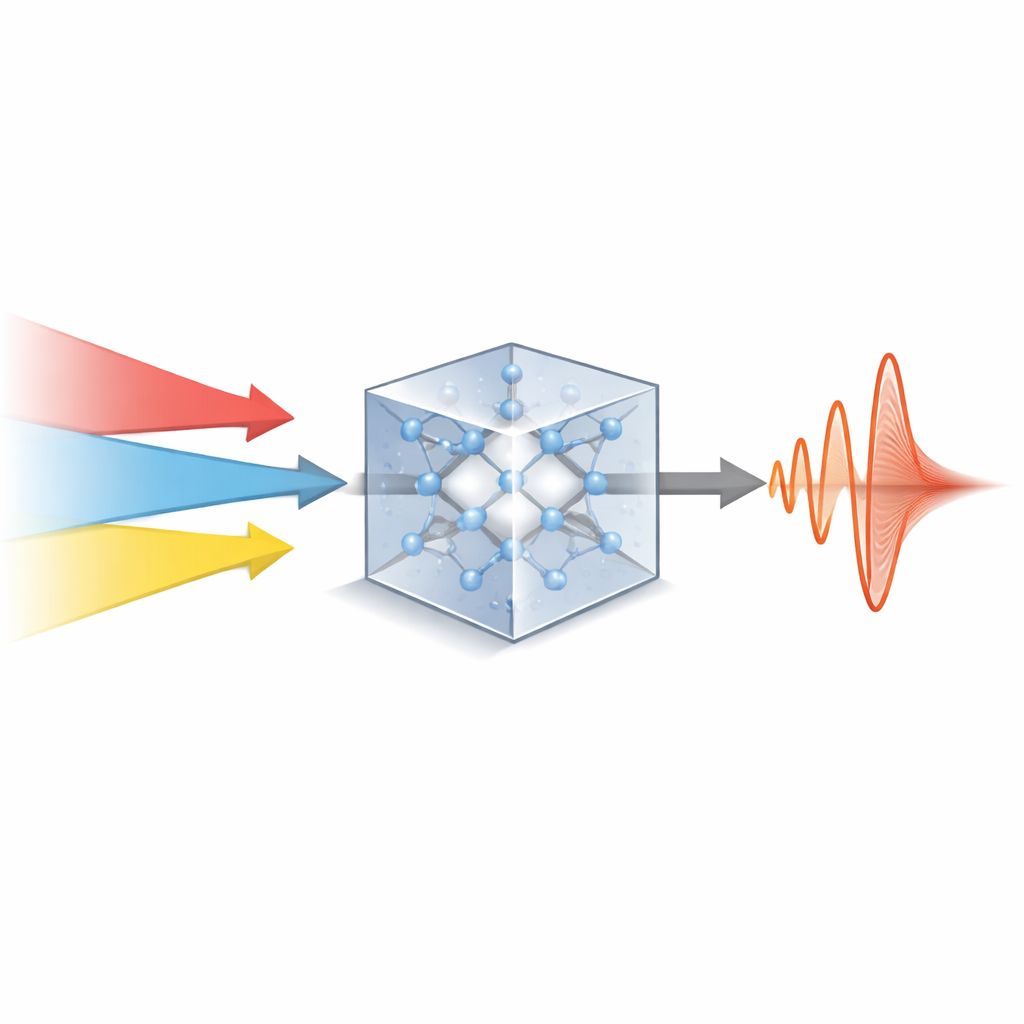
The authors build on a method where three carefully timed laser pulses work together inside diamond. Two longer pulses first tug on the crystal’s atoms in sync, exciting a well-defined vibration of the lattice. A third, very short mid-infrared pulse then passes through and “beats” against this vibration, converting some of its energy down into a terahertz pulse. The color of the terahertz light is determined by the difference in colors of the first two pulses and the color of the mid-infrared pulse, so simply tuning the lasers lets the output sweep from about 5 terahertz well beyond 15, without leaving holes in between. The key challenge, however, is ensuring that all the waves traveling through the diamond add up in phase so the generated terahertz field grows rather than cancels itself.
Straining Diamond for Perfect Timing
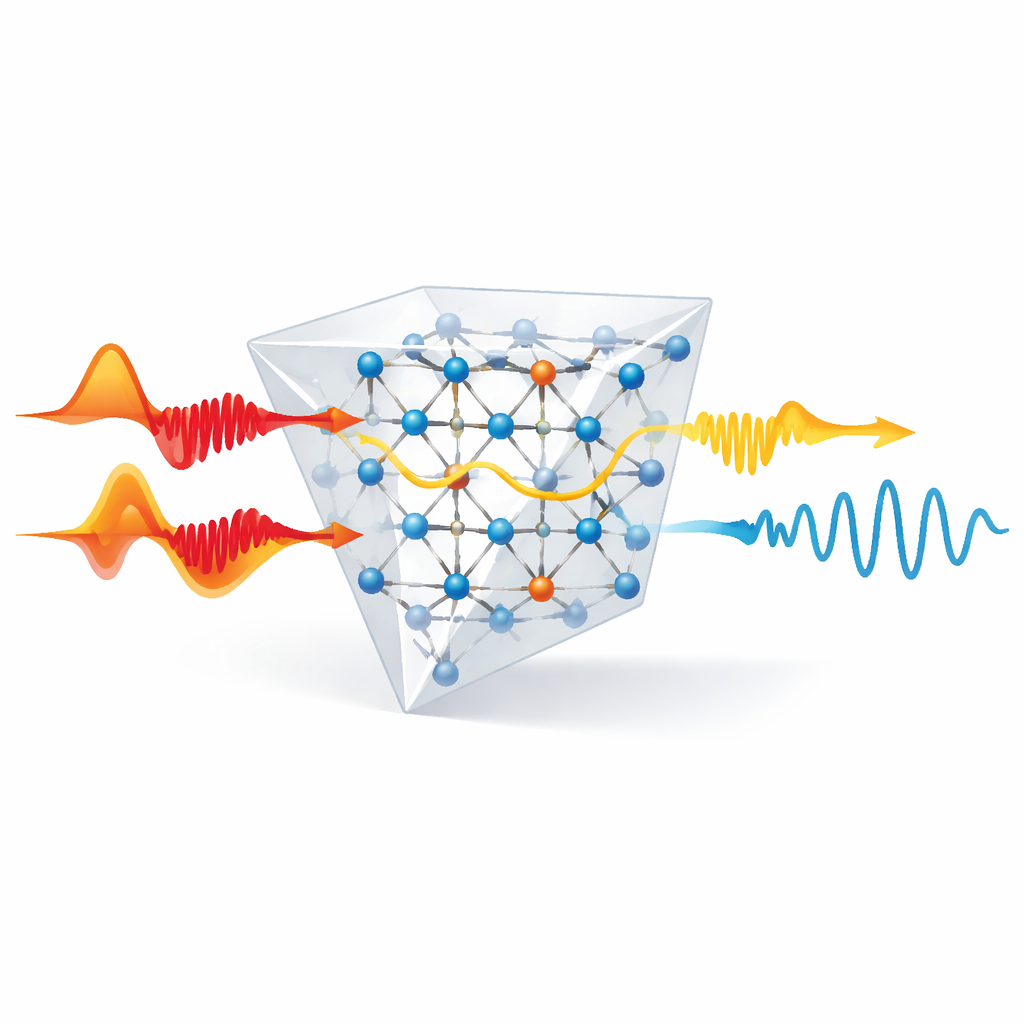
In an unstrained diamond, the waves do not naturally keep in step when all the beams travel along the same line, forcing earlier experiments to use beams crossing at angles. That non-collinear geometry shortens the interaction region, complicates alignment, and introduces distortions in the outgoing beam. Here, the team applies a controlled mechanical squeeze along one axis of a small diamond cube. This tiny strain slightly changes how fast different colors of light move through the crystal, and with the right amount of compression, the timing lines up: all interacting waves can propagate collinearly while staying in phase. Experiments show that with this approach a 2-millimeter diamond produces about three times more terahertz energy at 10 terahertz than the angled-beam setup, while preserving a clean, nearly Gaussian beam that focuses tightly.
Balancing Energy Flow Inside the Crystal
To understand and optimize performance, the authors numerically solve equations that track both the light pulses and the crystal vibrations as they travel through the diamond. They find that the strongest pump pulse is heavily depleted—most of its energy is converted into the other waves—so simple formulas assuming negligible depletion break down. The simulations reveal that what matters most is not just how hard the crystal is driven, but the shape and extent of the vibrational pattern along the diamond’s length. If the driving pulses are too strong or perfectly tuned, the vibration becomes very intense but confined to a short region; if too weak or too far detuned, the vibration spreads but never reaches a large amplitude. The sweet spot is a broad, moderately strong vibrational profile that overlaps well with the short mid-infrared pulse, maximizing the terahertz output.
Scaling Up and Looking Ahead
With their current laser system, the researchers generate 60-femtosecond terahertz pulses at 10 terahertz with 30 nanojoules of energy, reaching electric field strengths of over two million volts per centimeter when tightly focused. Their calculations suggest that modestly thicker diamonds—up to a few millimeters—could boost the energy by several times before practical limits, such as damage and beam spreading, set in. Because the beams now all travel collinearly, the source integrates naturally into common terahertz time-domain and ultrafast spectroscopy setups. In essence, by gently squeezing diamond and carefully balancing the input pulses, this work delivers a compact, tunable, and intense source that effectively closes the 5–15 terahertz gap and equips researchers with a powerful new tool to drive and explore complex material behavior.
Citation: Su, Y., Wei, Y., Lin, C. et al. Gapless tunable intense terahertz pulse generation in strained diamond. Light Sci Appl 15, 186 (2026). https://doi.org/10.1038/s41377-025-02092-6
Keywords: terahertz pulses, strained diamond, ultrafast lasers, Raman scattering, quantum materials