Clear Sky Science · en
Advancing flexible optoelectronics with III-nitride semiconductors: from materials to applications
Electronics that Bend with You
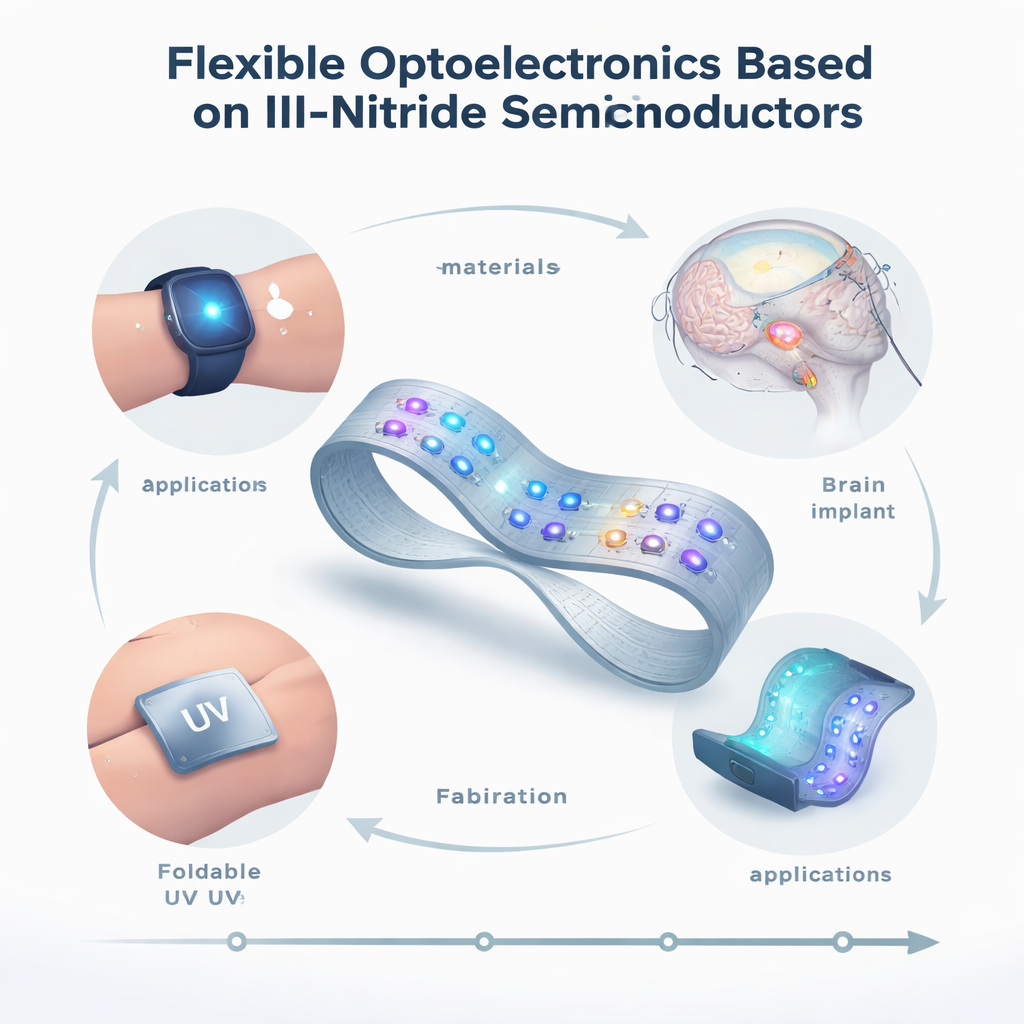
Imagine a phone screen that rolls like paper, a bandage-thin light that helps doctors treat the brain, or a skin patch that quietly counts your daily sun exposure. This review article explores how a special family of materials called III-nitride semiconductors could make such bendable, durable light-based gadgets practical in everyday life, from wearables to medical implants.
Why New Materials Are Needed
Today’s flexible electronics mostly rely on organic (carbon-based) materials. They are cheap and naturally bendy, but they age quickly, dislike moisture and heat, and respond more slowly than the chips inside your phone. III-nitride semiconductors—materials like gallium nitride (GaN) and related alloys—come from the same family used in bright blue and white LEDs. They can handle high temperatures, resist chemicals, stay stable for many years, and work across a very wide range of colors, from deep ultraviolet to infrared. Crucially, they also interact strongly with mechanical strain: bending them can subtly change how they move electrical charges and emit light, which opens a door to smarter, more sensitive flexible devices.
From Hard Wafers to Soft Surfaces
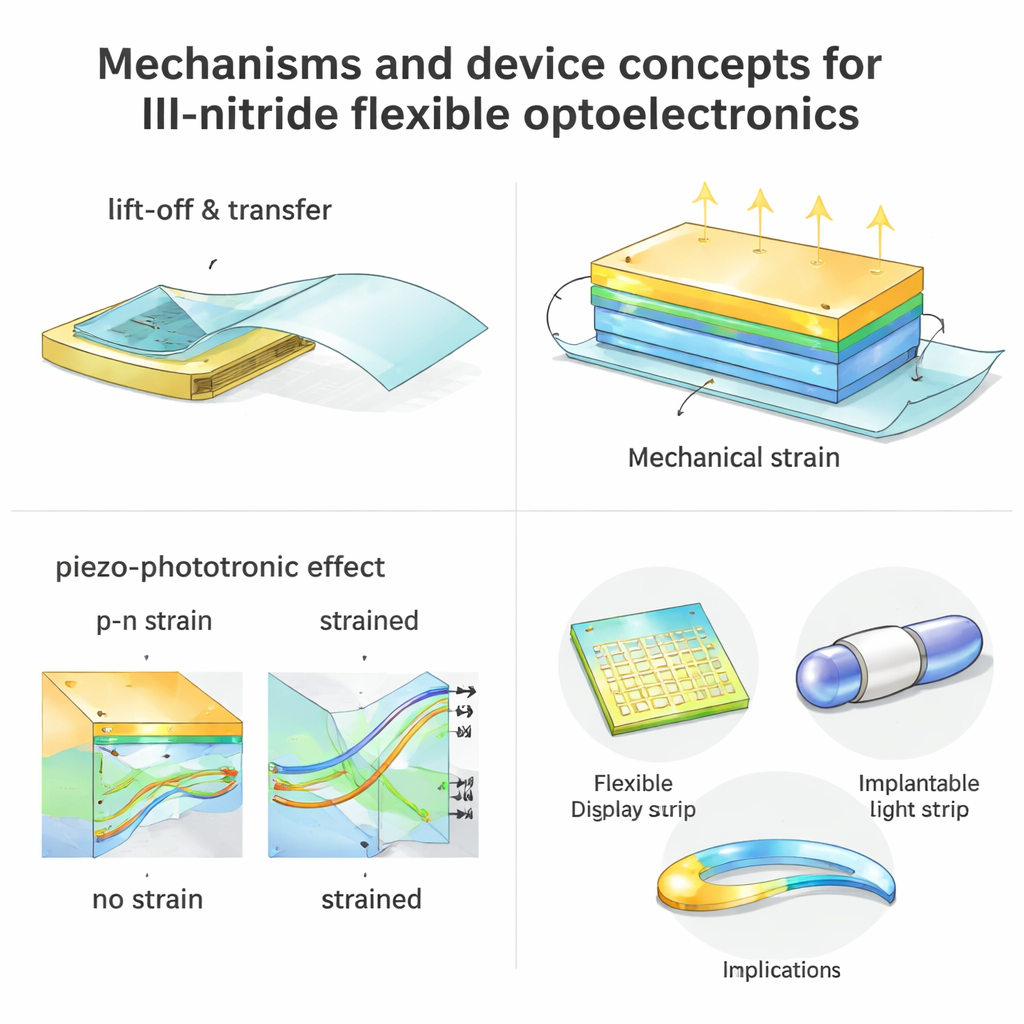
Turning a brittle crystal into something that can wrap around a wrist or a brain is mainly a manufacturing challenge. III-nitride devices are usually grown on thick, rigid wafers such as sapphire or silicon. The article surveys several clever ways to free thin, active layers from these wafers and move them onto soft plastics, metals, or even hydrogels. Some methods thin or etch away the back of the rigid wafer; others slip in a "sacrificial" layer that can be chemically dissolved so the thin film floats free. Laser techniques can also separate the film with precision. A newer strategy uses atomically thin "2D" materials like graphene as a weakly bonded buffer. The III-nitride layer grows crisply on top but can later be peeled off, and the expensive wafer underneath reused. These approaches aim to preserve high performance while making the production scalable and less costly.
Tiny Structures that Flex and Shine
Instead of relying only on flat films, researchers are increasingly sculpting III-nitrides into tiny wires, rods, and pillars. Shrinking the structures to the micro- and nanoscale makes them easier to bend and better at handling strain without cracking. Their large surface area also helps them absorb and emit light more efficiently. The review describes ways to grow such structures bottom-up, like forests of nanowires on metal foils or graphene, as well as top-down methods that etch patterns into existing films. These mini building blocks can then be "printed" onto flexible sheets, much like transferring ink with a stamp. Combined with 2D buffers, they offer a toolkit for building dense, flexible arrays of light sources and sensors with fine control over shape and function.
New Kinds of Flexible Devices
With materials and processing in place, III-nitride devices are moving into real applications. Flexible light-emitting diodes (LEDs) based on GaN now form micro-arrays that can bend around curved surfaces while keeping high brightness and contrast, promising for foldable micro-displays and thin lighting panels. In medicine, ultrathin GaN micro-LEDs built on soft polymers have been injected or implanted into animals’ brains to control nerve cells with light, a technique known as optogenetics. These implants can work wirelessly for months, showing that III-nitrides can be both powerful and biologically gentle. On the skin, III-nitride ultraviolet (UV) detectors have already reached commercial products: tiny, battery-free sensors that log UV dose in wearables like patches, nails, or earrings. Other prototypes act as pressure-sensitive light emitters or multi-axis tactile sensors, using the way these crystals respond to bending to "feel" touch and force.
What This Means for the Future
The article concludes that III-nitride semiconductors are strong candidates to push flexible optoelectronics beyond today’s short-lived, mostly organic gadgets. They combine long life, toughness, biocompatibility, and a unique ability to link light, electricity, and mechanical strain in a single platform. At the same time, major hurdles remain: keeping delicate layers intact under repeated bending, improving manufacturing yield and cost, and integrating many functions—sensing, processing, and communication—into complete flexible systems. If these challenges are met, we could see a new generation of bendable devices that safely light, sense, and communicate in ways that fit the curves of our bodies and our built environment.
Citation: Gao, X., Huang, Y., Wang, R. et al. Advancing flexible optoelectronics with III-nitride semiconductors: from materials to applications. Light Sci Appl 15, 141 (2026). https://doi.org/10.1038/s41377-025-02052-0
Keywords: flexible optoelectronics, gallium nitride, wearable sensors, micro-LEDs, optogenetics