Clear Sky Science · en
Refinement of the classification of DDX41 variants through analysis of aggregated clinical datasets
Why this matters for families and doctors
Some people inherit subtle changes in a gene called DDX41 that quietly raise their chance of developing blood cancers such as myelodysplastic syndromes and acute myeloid leukemia later in life. Until now, doctors have struggled to tell which of these changes are truly dangerous and which are harmless quirks of our DNA. This study pulls together the world’s data on DDX41 to build a clearer rulebook, helping clinicians give better advice about cancer risk, screening, and treatment choices for patients and their relatives. 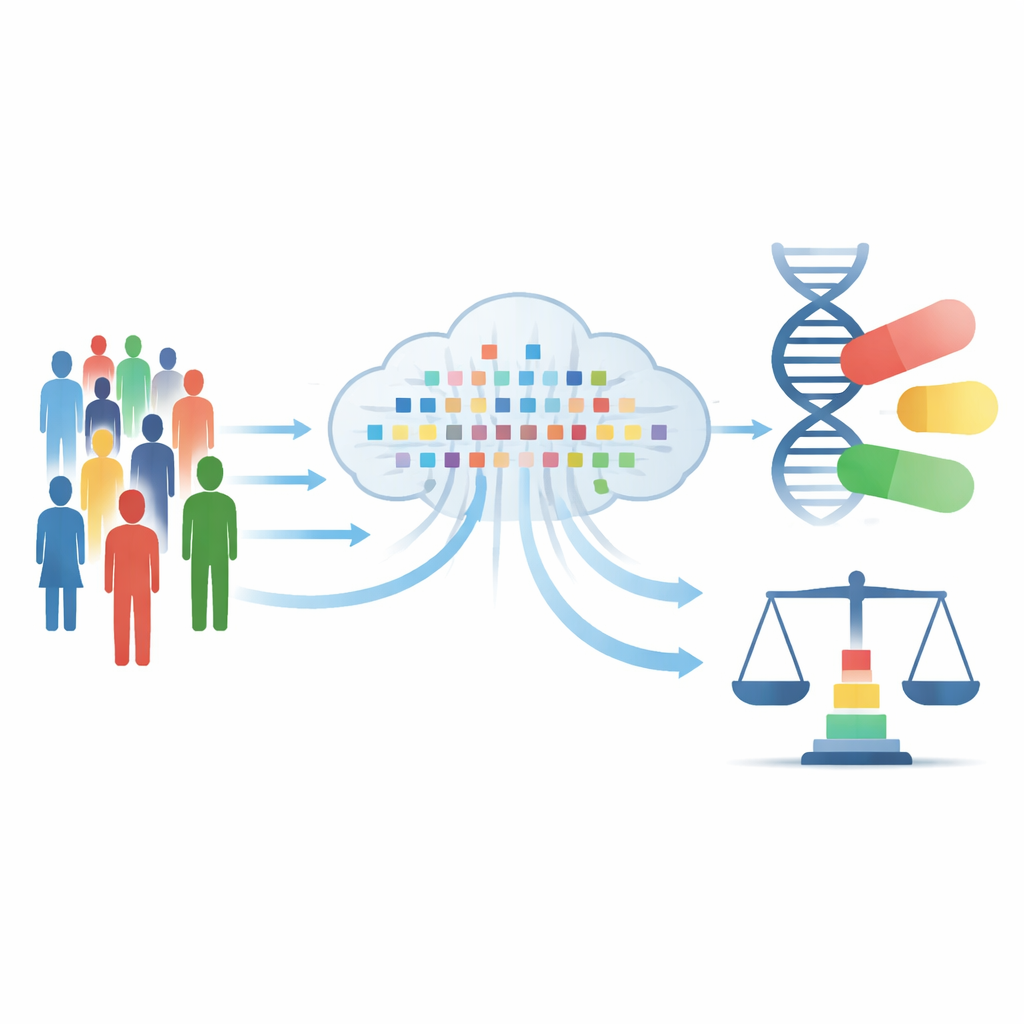
Bringing scattered clues into one big picture
The researchers combed through hundreds of scientific papers and medical reports containing information on DDX41. From 35 large patient series and many smaller reports, they assembled an "aggregated synthetic cohort" covering more than 54,000 people tested for blood disorders and 2,628 individuals carrying changes in DDX41. They focused on changes that alter the DDX41 protein, discarding clearly harmless variants and duplicates. In the end, they cataloged 450 distinct inherited variants, ranging from small deletions that break the gene to subtle single-letter substitutions whose impact is uncertain.
Where DDX41 changes show up most
With this combined dataset, the team asked in which diseases inherited DDX41 variants are most common. They found that about 4% of patients with myelodysplastic syndromes or acute myeloid leukemia carried a DDX41 variant, a higher rate than in other blood problems such as unexplained low blood counts or lymphoid cancers. Most affected patients had variants already known or now strongly suspected to disrupt the gene’s function. The authors also showed that some variants are more frequent in particular ancestry groups, and that failing to match patients and comparison populations by ancestry can exaggerate how strongly a given variant seems linked to disease.
Reading patterns of “second hits” in cancer cells
One striking feature of DDX41-related disease is that cancer cells often pick up a second, acquired mutation in the same gene on top of the inherited one. In this study, the team mapped exactly which somatic DDX41 changes appear and how often they occur together with specific inherited variants. The most common “second hit” was a missense change called R525H, but many other somatic variants were seen. By comparing thousands of patients with and without inherited DDX41 changes, the authors showed that finding a single somatic DDX41 mutation—especially one of the recurrent hotspots—strongly suggests an underlying harmful germline variant. They then used a Bayesian statistical model to translate different somatic patterns (for example, one hotspot change versus multiple rare changes) into odds that the inherited variant is truly disease-causing. 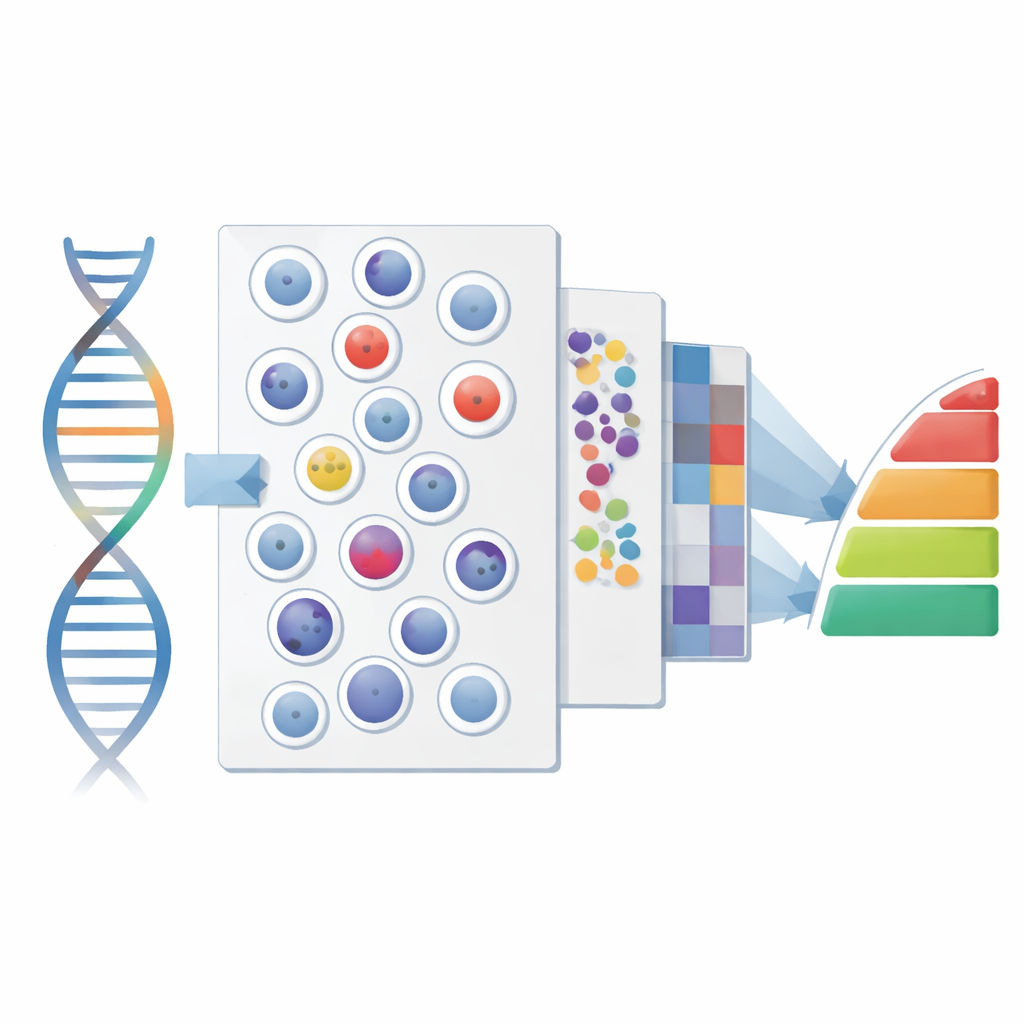
Testing computer predictions against real-world data
Many DDX41 variants only swap one amino acid for another, making their impact harder to judge in the lab. To tackle this, the researchers compared two popular computer tools that predict whether such substitutions are damaging. Using variants that clearly behaved like harmful changes—because they repeatedly appeared with characteristic somatic “second hits”—as a reference, they found that a newer deep-learning model called AlphaMissense outperformed the widely used REVEL tool in spotting likely harmful missense variants in DDX41. AlphaMissense was more sensitive, identifying more truly risky variants, while REVEL was somewhat better at recognizing clearly benign ones. Combining these predictions with the somatic patterns and disease-enrichment data allowed the team to upgrade many previously “uncertain” variants to likely or definitively disease-causing.
Turning complex evidence into a practical tool
By weaving together ancestry-aware case–control comparisons, detailed maps of germline–somatic pairings, and improved computer predictions, the authors reclassified 438 evaluable DDX41 variants. Sixty-five changes were moved to a higher risk category, including several upgraded to fully pathogenic. To make these advances usable in everyday practice, they built a freely accessible online application that lets laboratories input a DDX41 variant and automatically retrieve pooled evidence, suggested criteria, and a provisional classification. For patients and their families, the bottom line is a more reliable answer to the question, “Does this change in my DDX41 gene really increase my cancer risk?”—and for clinicians, a sharper tool to guide monitoring, transplant donor selection, and genetic counseling worldwide.
Citation: Tiong, I.S., Hunter, S., Kankanige, Y. et al. Refinement of the classification of DDX41 variants through analysis of aggregated clinical datasets. Leukemia 40, 649–660 (2026). https://doi.org/10.1038/s41375-026-02886-6
Keywords: DDX41, myeloid neoplasms, germline predisposition, variant classification, somatic mutations