Clear Sky Science · en
Bioengineered α-Hairpin peptide TKH with GKG linker: a LLPS-mediated biomimetic mineralization system for intrafibrillar remineralization and deep dentin tubule occlusion
Why tooth sensitivity matters
Anyone who has winced from a jolt of pain when drinking ice water or hot coffee has felt dentin hypersensitivity. This common problem arises when the protective mineral around tiny channels inside the tooth is lost, leaving nerve pathways exposed. The article describes a new bioengineered peptide, called TKH, that is designed to help the tooth rebuild its own mineral from the inside out, offering a more durable and biologically friendly way to calm sensitive teeth.
How teeth lose their natural shield
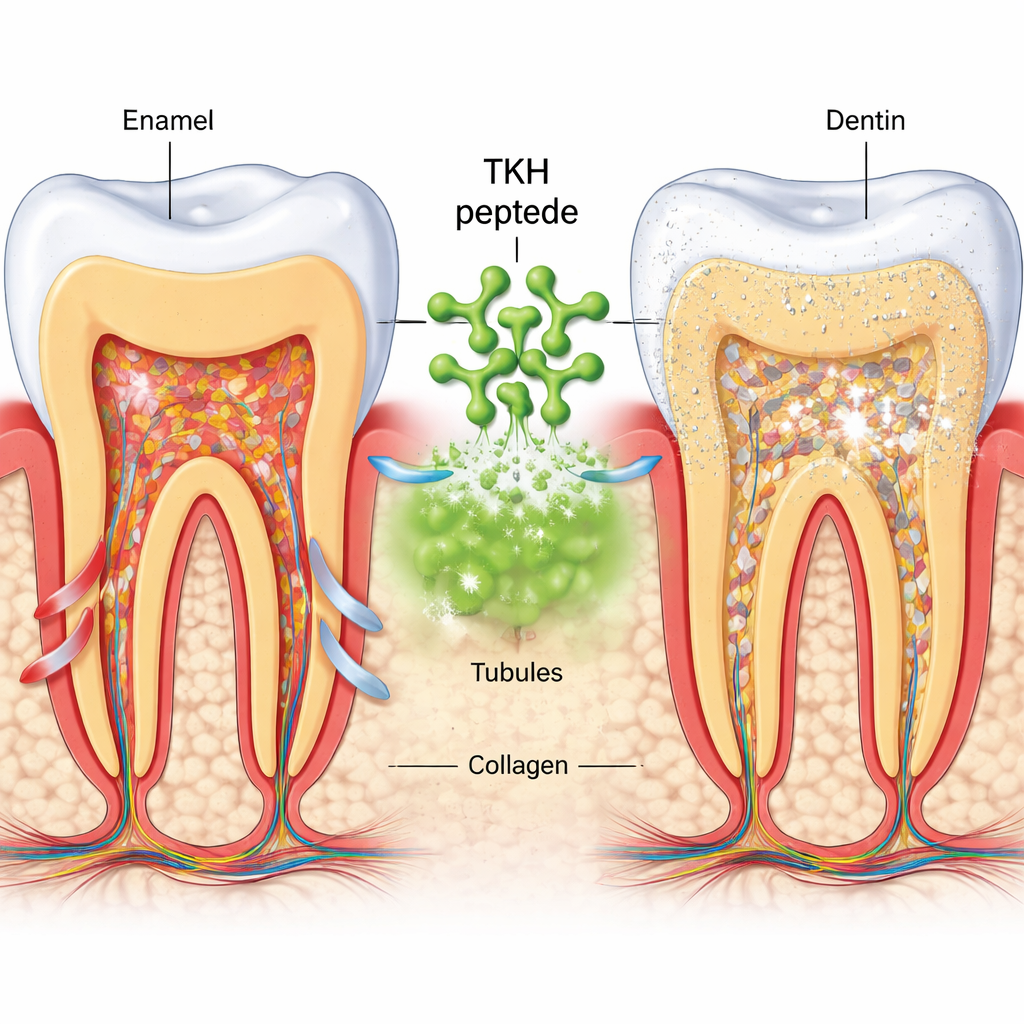
Under the hard enamel of a tooth lies dentin, a softer layer filled with microscopic tubes that run toward the nerve in the center. Everyday acid attacks from bacteria and food, or mechanical wear from brushing and grinding, can dissolve the mineral in dentin and enlarge these tubes. As mineral disappears, the collagen framework that supports dentin becomes exposed and weakened. Current treatments, such as fluoride varnishes, bioactive glasses, or resin coatings, often block only the outermost portion of the tubes and can wash away or break down over time. A longer-lasting solution must not only plug the tubes deeply but also restore mineral inside the collagen network itself.
A smart peptide inspired by nature
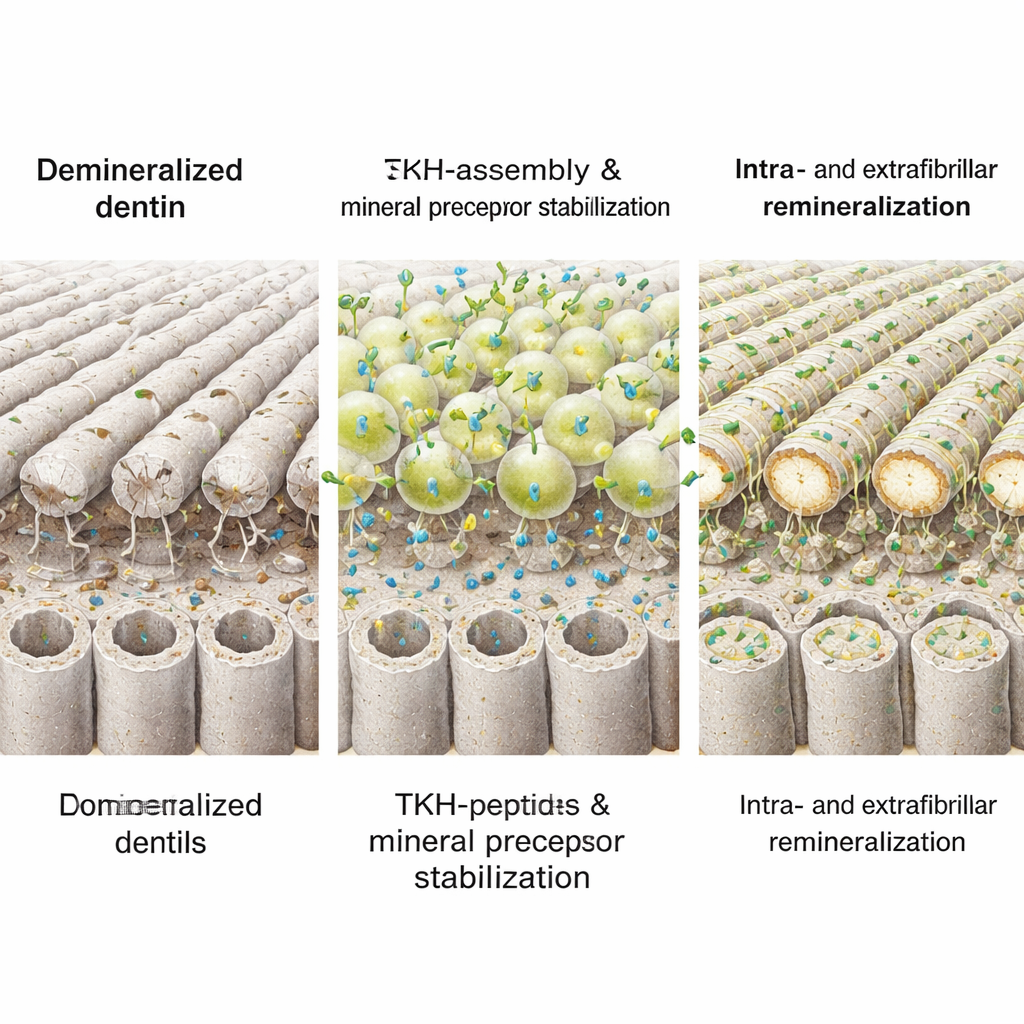
In healthy teeth, specialized proteins help control where and how minerals grow within collagen. The researchers mimicked this natural process by redesigning an existing antimicrobial peptide, TVH-19, into a new form named TKH. They inserted a short flexible sequence, called a GKG linker, to make the peptide fold into a hairpin-like shape. In salt solutions resembling those in the mouth, TKH molecules do not just float separately; they gather into tiny liquid droplets and then into uniform nanoparticles, a behavior known as liquid–liquid phase separation and self-assembly. These soft clusters can bind strongly to both collagen and hydroxyapatite, the main mineral in teeth, positioning TKH exactly where new mineral is needed.
Guiding mineral back into the tooth
In laboratory tests, TKH showed a strong ability to hold calcium and phosphate ions in a stable, amorphous form—an early, flexible mineral precursor. These TKH–mineral complexes were small enough to seep into the narrow spaces inside collagen fibers and along dentin tubules. Electron microscopy revealed that collagen treated with TKH developed orderly bands of mineral within the fibers, not just on their surface, a pattern associated with strong, healthy dentin. When applied to demineralized dentin slices, TKH promoted extensive mineral growth that both lined the surface and filled deep dentin tubules, more completely and uniformly than fluoride or the original TVH-19 peptide.
From lab dishes to living mouths
The team then tested TKH in an animal model that mimics the oral environment. Human dentin slices, etched to remove mineral, were fixed to the palates of rats and treated daily. After four weeks, samples exposed to TKH showed dense mineral layers on the surface and well-packed mineral deposits deep within the dentin tubules, effectively sealing the channels that transmit pain. The distribution of calcium and phosphorus closely matched that of sound dentin. Importantly, TKH retained useful antibacterial and anti-biofilm activity against cavity-causing bacteria, while safety checks on blood, organs, and oral tissues found no signs of toxicity or irritation.
What this could mean for sensitive teeth
To a layperson, the key message is that TKH acts like a smart, tooth-seeking scaffold: it sticks to weakened dentin, gathers mineral ingredients from saliva-like fluids, and guides them back into the tooth’s own collagen framework and tiny channels. Rather than simply painting over damage, this peptide encourages the tooth to rebuild a more natural, integrated mineral barrier that both strengthens dentin and deeply blocks fluid movement in the tubules. While further clinical studies are needed, this approach points toward future treatments that regenerate, rather than merely cover up, the causes of dentin hypersensitivity.
Citation: Ou, Y., Wang, J., Wang, L. et al. Bioengineered α-Hairpin peptide TKH with GKG linker: a LLPS-mediated biomimetic mineralization system for intrafibrillar remineralization and deep dentin tubule occlusion. Int J Oral Sci 18, 26 (2026). https://doi.org/10.1038/s41368-026-00425-8
Keywords: dentin hypersensitivity, tooth remineralization, peptide biomaterials, collagen mineralization, dental tubule occlusion