Clear Sky Science · en
DNA and RNA-based amplicon sequencing of paired supragingival and dentin lesion plaque in children with severe early childhood caries
Why Deep Tooth Decay in Toddlers Matters
Tooth decay in very young children is far more than a cosmetic issue. Severe early childhood caries (S-ECC) can destroy baby teeth, cause intense pain, disturb sleep and eating, and even require treatment under general anesthesia. This study asks a simple but crucial question: which germs are not just present, but actively damaging children’s teeth deep inside the cavities, and how are they different from the germs living on the tooth surface?
Looking Beyond the Usual Suspects
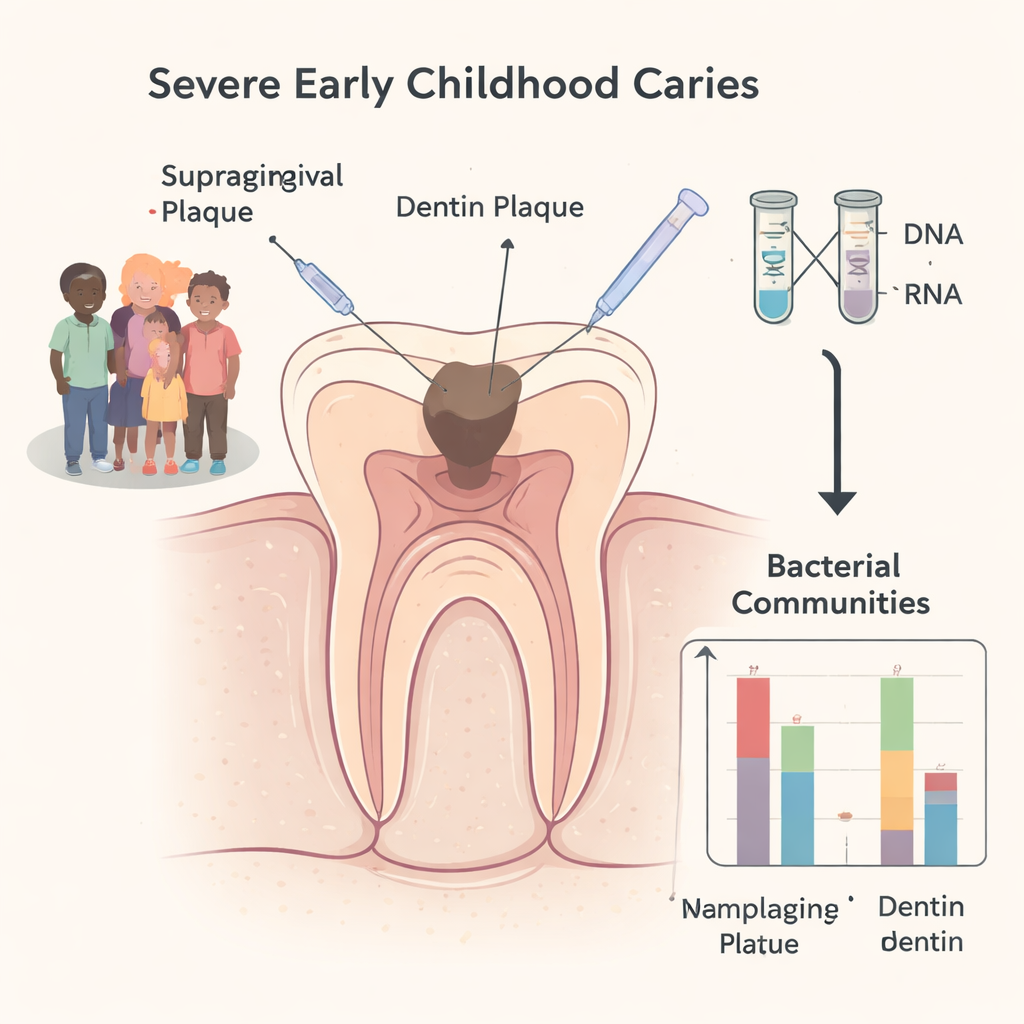
For decades, one main villain, Streptococcus mutans, has been blamed for cavities. But dentists and scientists now know that tooth decay is driven by entire communities of bacteria that feed on sugars and produce acids. In S-ECC, decay races from the outer enamel into the softer inner dentin layer, essentially hollowing the tooth out from within. The team behind this study focused on that deep zone of damage in children under six, comparing the bacteria living in the dentin of badly decayed teeth with the bacteria on the nearby tooth surface, called supragingival plaque.
Sampling Tiny Patients, Layer by Layer
The researchers worked with 13 children who needed multiple extractions for S-ECC under general anesthesia. From each child, they collected two samples from the same tooth: plaque from the outer surface and plaque scraped from deep inside the dentin after the tooth was removed. They then used modern genetic tools to read pieces of a bacterial marker gene known as 16S rRNA in two forms. One form came from DNA, which reveals which species are present, alive or dead. The other came from RNA, which breaks down quickly and is produced only by active cells, offering a window into which bacteria are currently busy and metabolically “switched on.”
A Simpler but Harsher Deep-Tooth World
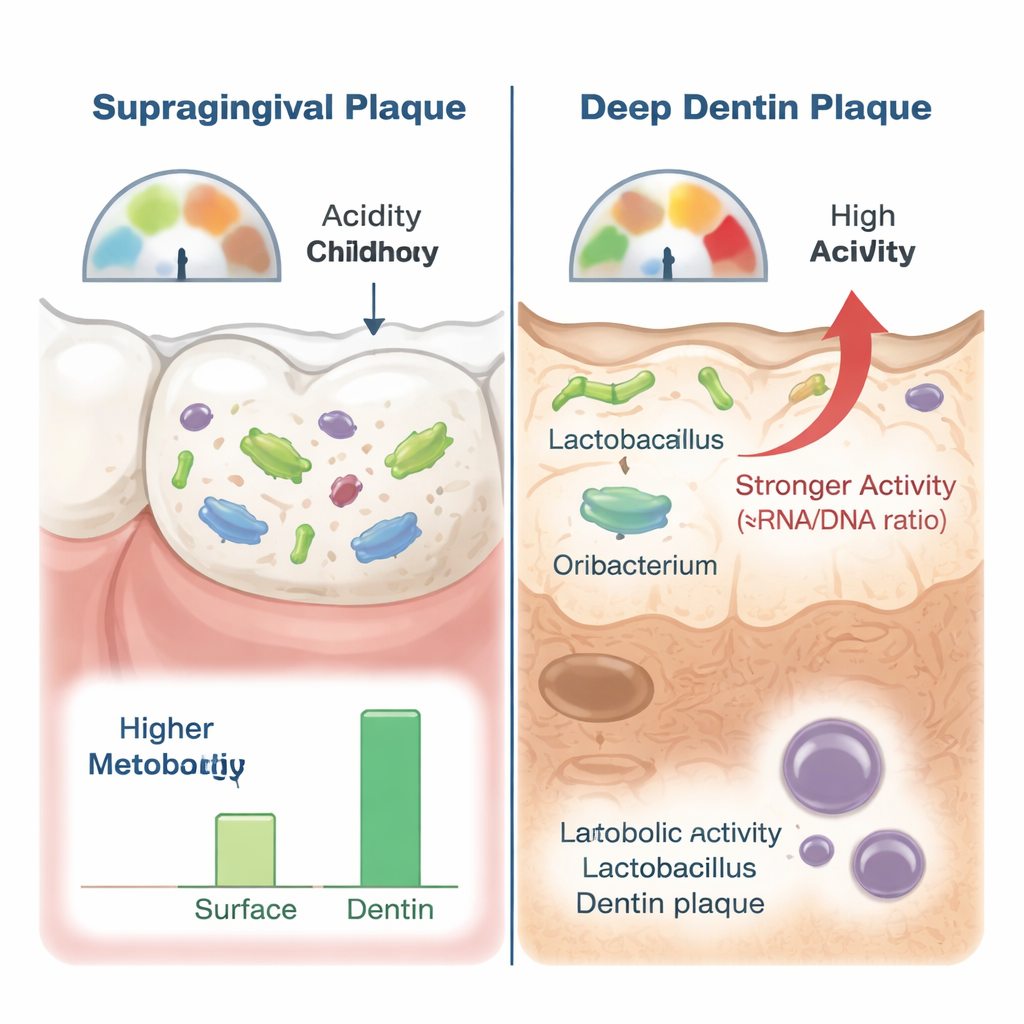
When the team compared surface and deep-dentin communities, they found that the deep lesions hosted fewer kinds of bacteria overall but looked more alike from child to child. In other words, as decay burrows inward, the community becomes less diverse and more uniform, favoring a narrower set of hardy microbes. These survivors are well adapted to life in a dark, sheltered, oxygen-poor pocket flooded with acid from constant sugar breakdown. The surface plaque, by contrast, contained a richer, more varied mix of species and differed more between children, reflecting the changing conditions in the mouth.
Which Bacteria Are Really Doing the Damage?
By comparing RNA and DNA, the researchers could distinguish bacteria that were simply present from those that were especially active. Several well-known cavity-associated groups, including Streptococcus and Prevotella, were enriched in deep dentin, but their RNA levels suggested only modest activity there. In contrast, bacteria in the Lactobacillus group—and in particular Lactobacillus casei—showed both higher abundance and a strikingly high RNA-to-DNA ratio in dentin, signaling strong metabolic activity. Another species, Oribacterium sp. HMT-078, was also consistently enriched and more active in deep lesions. Together, these findings point to L. casei and this Oribacterium type as key players in creating and sustaining extremely acidic conditions that dissolve dentin.
What This Means for Protecting Young Teeth
To a layperson, the takeaway is that the worst forms of tooth decay in toddlers seem to be driven not just by any cavity bacteria, but by a specialized group that thrives deep inside the tooth under very acidic conditions. Lactobacillus casei and related species appear to be especially active culprits, working alongside other acid-producing microbes. Understanding which bacteria are most active where the tooth is breaking down may help guide future strategies—from targeted prevention and diet counseling to new treatments aimed at disrupting these deep, acid-loving communities before they can destroy a child’s teeth.
Citation: Naumann, A.A., Elmorr, E.M., Lamont, E.I. et al. DNA and RNA-based amplicon sequencing of paired supragingival and dentin lesion plaque in children with severe early childhood caries. Int J Oral Sci 18, 19 (2026). https://doi.org/10.1038/s41368-025-00421-4
Keywords: early childhood caries, oral microbiome, dentin plaque, Lactobacillus casei, tooth decay in children