Clear Sky Science · en
Identification of key areas for soil conservation service and driving factors under ecological restoration projects in South China Karst
Why Saving Thin Mountain Soils Matters
In the rugged limestone mountains of South China, a few centimeters of soil can mean the difference between green hillsides and bare rock. Guizhou Province, sitting in the heart of the South China Karst, has long struggled with soil washing away from steep slopes, leaving behind stony “rocky deserts” and deepening rural poverty. This study asks a simple but urgent question: after two decades of large restoration programs that turned cropland into forest, grass, and reservoirs, is the land now better at holding on to its soil, and what conditions make these efforts succeed or fail?
Taking a New Look at Soil Protection
Traditionally, scientists have estimated soil loss using detailed erosion equations that require many hard-to-measure inputs. The authors instead use a simpler “surrogate” approach based on how much plant material the land produces each year—its net primary productivity—combined with rainfall, slope, soil properties, and how much bare rock is exposed. Because plant roots bind soil and leaves soften the impact of rain, places with higher, more stable plant growth usually offer stronger protection. By normalizing all inputs to a 0–1 scale, the team maps a relative soil conservation score for every 250-meter grid cell across Guizhou from 2000 to 2023. 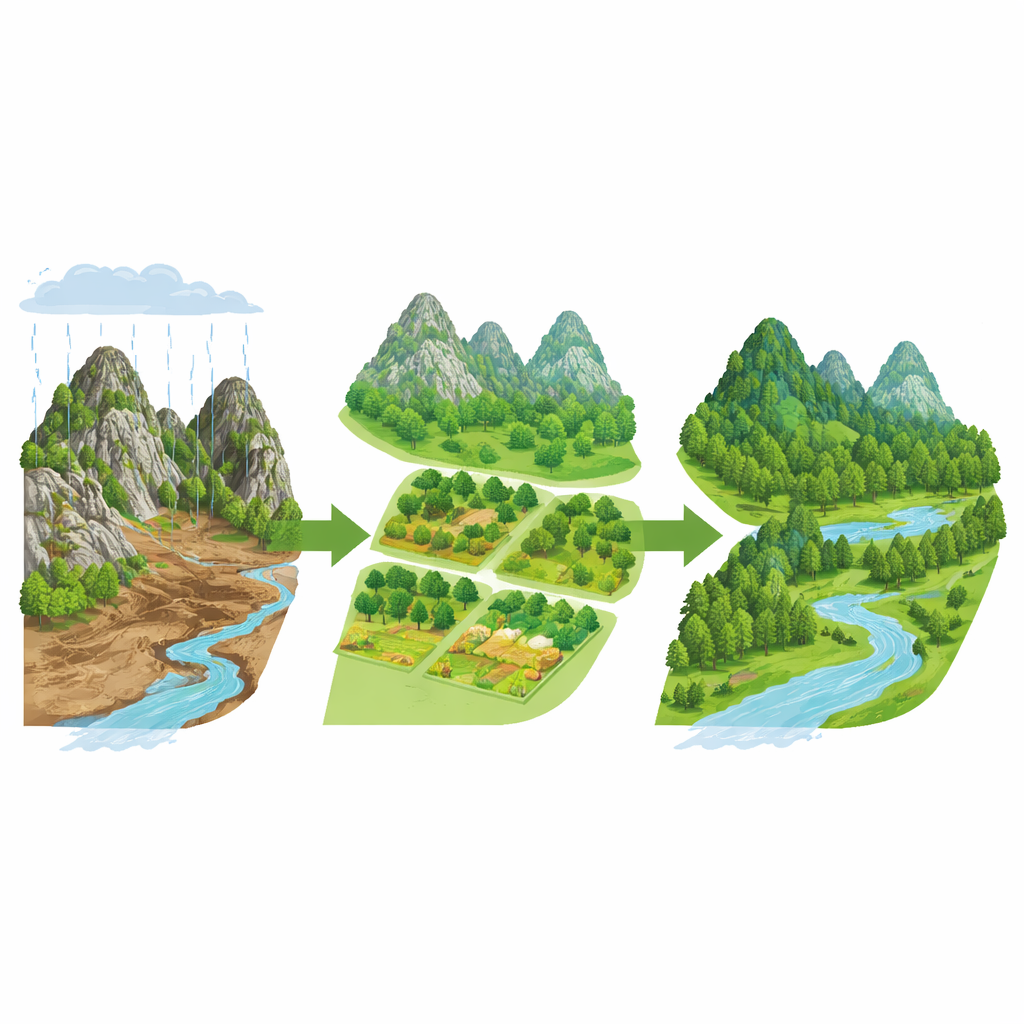
Where the Land Holds On and Where It Lets Go
The resulting maps reveal a clear pattern: soil conservation capacity has steadily improved over the past two decades, and it is consistently higher in southern Guizhou than in the north and northwest. Southern counties such as Qianxinan and Qiannan form “hotspots” where the landscape retains soil well, while northern and western areas remain “coldspots” with weaker protection. Forests and grasslands emerge as the main guardians of soil, together providing nearly three quarters of the province’s total conservation capacity. By contrast, built-up land and open water contribute very little on their own. The study also shows that moderate slopes and mid‑elevation zones perform best; extremely steep or very high areas, especially those heavily grazed or already rocky, struggle to keep soil in place.
How Land-Use Projects Change the Picture
China’s massive ecological restoration programs have reshaped Guizhou’s countryside, especially through the Grain for Green program that converts sloping farmland back to forest or grass. By tracking land-use transitions, the authors quantify how these projects affect soil protection. Converting cropland to forest is the single most powerful measure, responsible for roughly half of the overall improvement in soil conservation since 2000. Turning farmland into grassland and turning grassland into forest together account for most of the remaining gains. Interestingly, the benefits of turning farmland into water, such as reservoirs and ponds, grew sharply in the later decade, hinting that carefully placed water bodies can also buffer erosion in this karst terrain. At the same time, rapid urban expansion—farmland paved over for cities and infrastructure—locally eroded some of the gains by reducing vegetation cover and disturbing slopes.
Nature’s Limits and Human Choices
The study goes beyond mapping to ask which factors truly drive these patterns. Using a spatial statistics tool known as a geographical detector, the authors find that rainfall, slope, and soil type are the three dominant influences on where soil conservation is strong or weak, but their relative importance changes over time. Early on, rainfall differences mattered most; later, as restoration projects increased vegetation cover, slope and soil characteristics became more prominent, and indicators of human activity such as nighttime lights temporarily gained influence. Areas with moderate rocky desertification that still retain some soil and vegetation can actually show better soil protection than zones where thin, sloping farmland has been overused, suggesting that poorly managed “not yet rocky” areas deserve urgent attention. 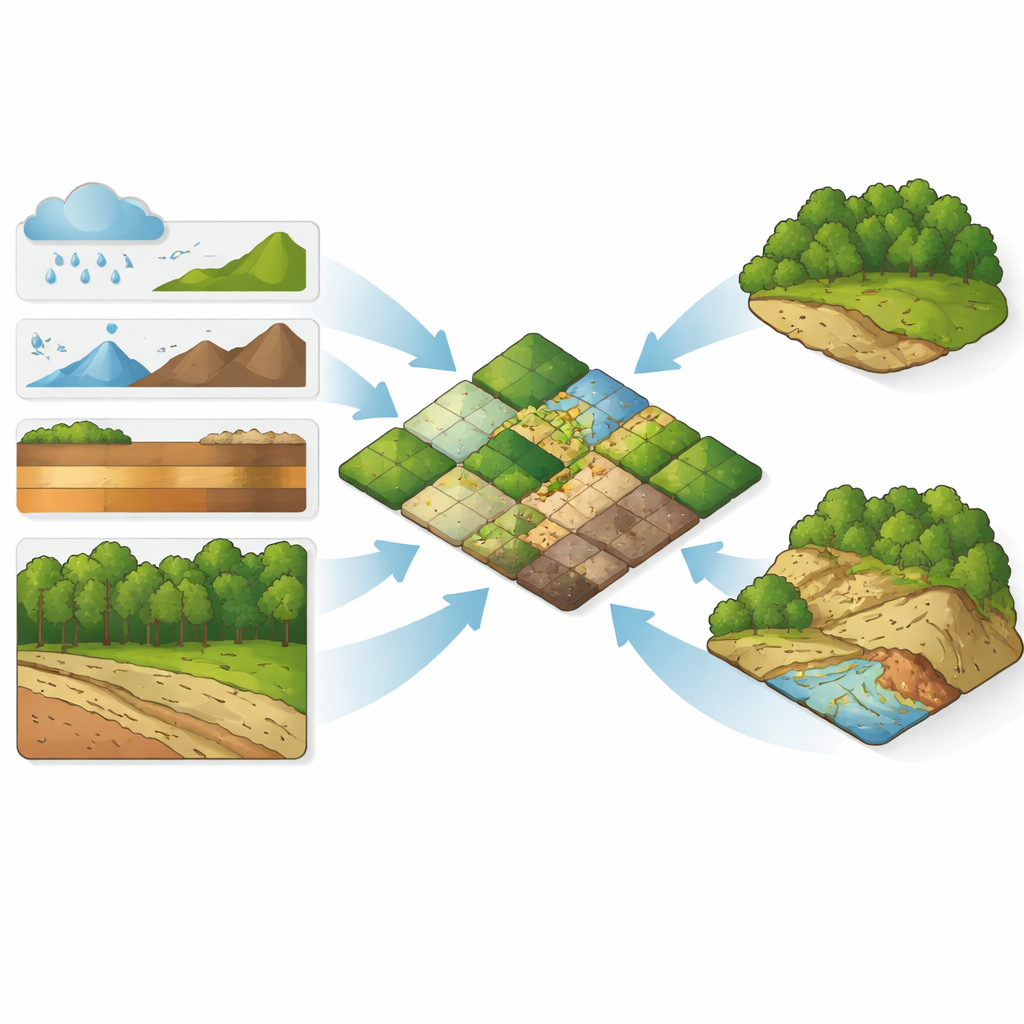
What This Means for Future Green Efforts
For non-specialists, the key message is that large-scale tree planting and grassland recovery in Guizhou have worked overall: hillsides now do a better job of holding onto their fragile soils than they did two decades ago. But the benefits are uneven, and they depend strongly on how steep the land is, what kind of soil lies beneath, how much it rains, and how people choose to use the land. The findings suggest that the most effective strategies in karst regions are to protect and expand forests and grasslands on suitable slopes, give special priority to erosion‑prone farmland in “almost rocky” zones, and, where water supply allows, consider converting some cropland to water bodies rather than more fields or buildings. By targeting restoration where nature is most ready to cooperate, policymakers can better safeguard both the region’s world‑famous karst landscapes and the communities that depend on the thin soils draped over them.
Citation: Mu, Y., Xiong, K., Yan, X. et al. Identification of key areas for soil conservation service and driving factors under ecological restoration projects in South China Karst. npj Herit. Sci. 14, 198 (2026). https://doi.org/10.1038/s40494-026-02476-w
Keywords: soil conservation, karst restoration, land use change, Guizhou Province, ecosystem services