Clear Sky Science · en
Reassessing Anne Boleyn and other Boleyn women in Holbein drawings using facial recognition
A Queen’s Face, Reconsidered
For centuries, one famous drawing by the Renaissance artist Hans Holbein has been shown in books and exhibitions as the face of Anne Boleyn, Henry VIII’s ill‑fated second wife. Yet that identification rested largely on an eighteenth‑century handwritten label rather than firm evidence. This study asks a deceptively simple question with very modern tools: have we actually been looking at the wrong woman? By blending traditional archival sleuthing with advanced facial‑recognition software, the authors revisit who appears in two Holbein drawings and what they can truly tell us about Anne Boleyn and her family.
Old Portraits and Uncertain Names
Holbein’s portrait drawings at Windsor Castle are among the most vivid images of Henry VIII’s court, but very few are securely named from documents written in their own time. Most identities rely on much later inscriptions that claim to copy earlier notes, yet no one can now verify those supposed originals. The authors show that these labels are riddled with inconsistencies: some sitters are given the wrong titles, others are mis‑spelled, and in at least one case a woman long thought to be “Mother Iak” is now firmly known to be someone else. In this light, the traditional label identifying one sketch, RCIN 912189, as Anne Boleyn looks shaky—especially because the woman shown is fair‑haired, heavyset, and double‑chinned, at odds with eyewitness accounts describing Anne as dark, slender, and notably small‑necked. 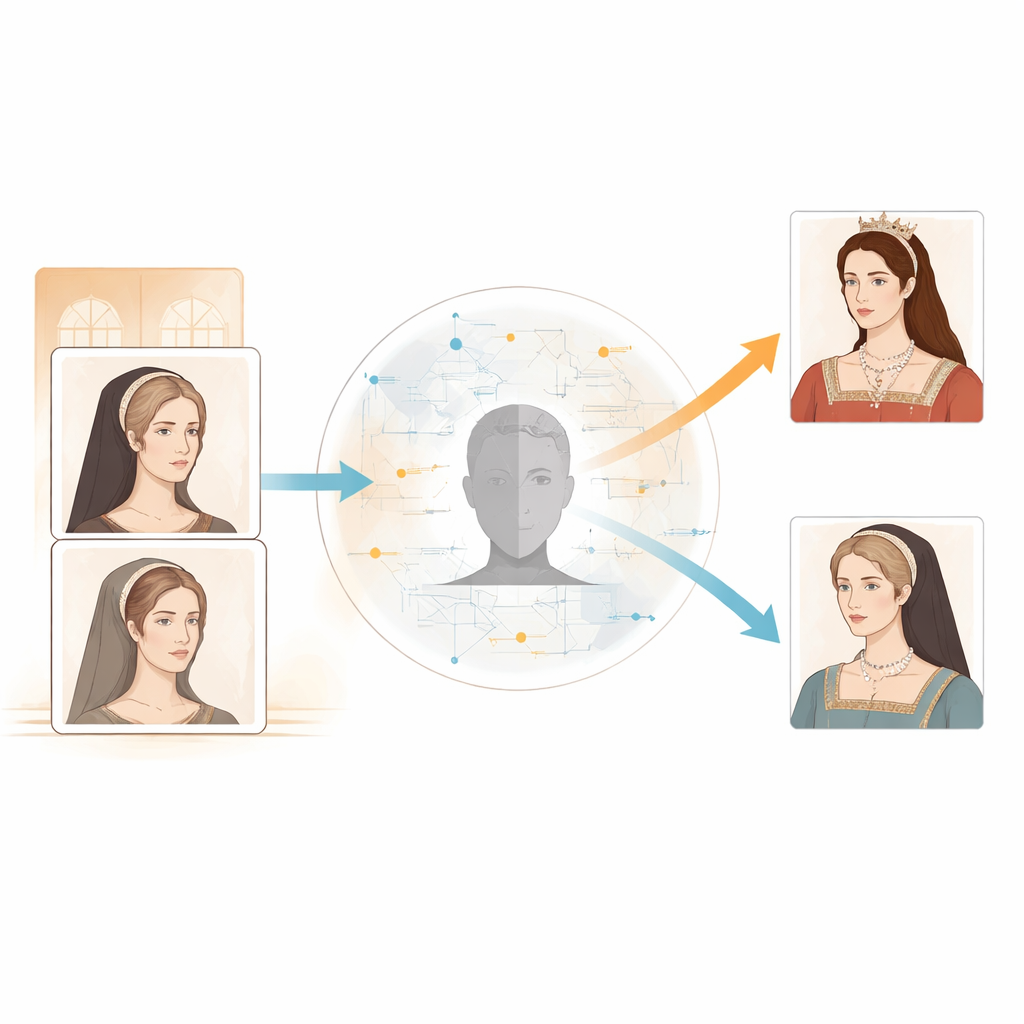
Letting Algorithms Look at Faces
To move beyond subjective visual comparison, the team adapted modern facial‑recognition methods—normally trained on millions of photographs—to the delicate chalk portraits of the sixteenth century. They focused on Holbein’s preparatory sketches drawn directly from life, which acted as working “templates” for later paintings and therefore aimed at structural accuracy rather than flattery. Using a deep‑learning model called AdaFace, they converted each face into a numerical pattern capturing bone structure and proportions while downplaying hair color and artistic style. They then measured how similar different sitters were, not by eye, but by how close their facial patterns lay in this abstract space, paying special attention to known Tudor family relationships to check that the system behaved sensibly.
Following Family Resemblance
The key test case pits two drawings against one another. RCIN 912189 is the traditional “Anne Boleyn” sketch; RCIN 912190 is catalogued simply as “An Unidentified Woman,” but visually matches written descriptions of Anne’s dark hair, slim build, and “little neck.” When compared to the best early painted likeness of Elizabeth I as a teenager, RCIN 912190 showed a level of similarity in line with what the model found between confirmed relatives elsewhere in the Tudor network. RCIN 912189 also bore some resemblance to Elizabeth, but its broader pattern of connections fit better with the previous generation, suggesting it could represent Anne’s mother, Elizabeth Howard. By mapping how both drawings clustered with known members of the extended Boleyn–Howard family, the authors saw RCIN 912190 repeatedly fall into the same “family zone,” while unrelated courtiers sat far away in this facial space.
Clues from Care, Copies, and Memory
Numbers alone did not drive the argument. The authors also followed the physical histories of the drawings and related paintings. RCIN 912190 received unusually careful treatment in the eighteenth century—its outline meticulously cut and mounted—hinting that collectors prized it even without a name. A separate portrait type, preserved in the National Portrait Gallery, was already accepted in Elizabethan times as representing Anne Boleyn, and this painted image also aligns closely with both Elizabeth I and RCIN 912190 in the facial‑recognition analysis. Meanwhile, another Holbein‑derived portrait long labelled “Lady Vaux” seems, from later family commissions and clothing details, more likely to show Anne’s sister Mary Boleyn. Together, these threads of material evidence, archival records, and computational patterns weave a coherent picture of how Anne and her relatives were depicted and remembered. 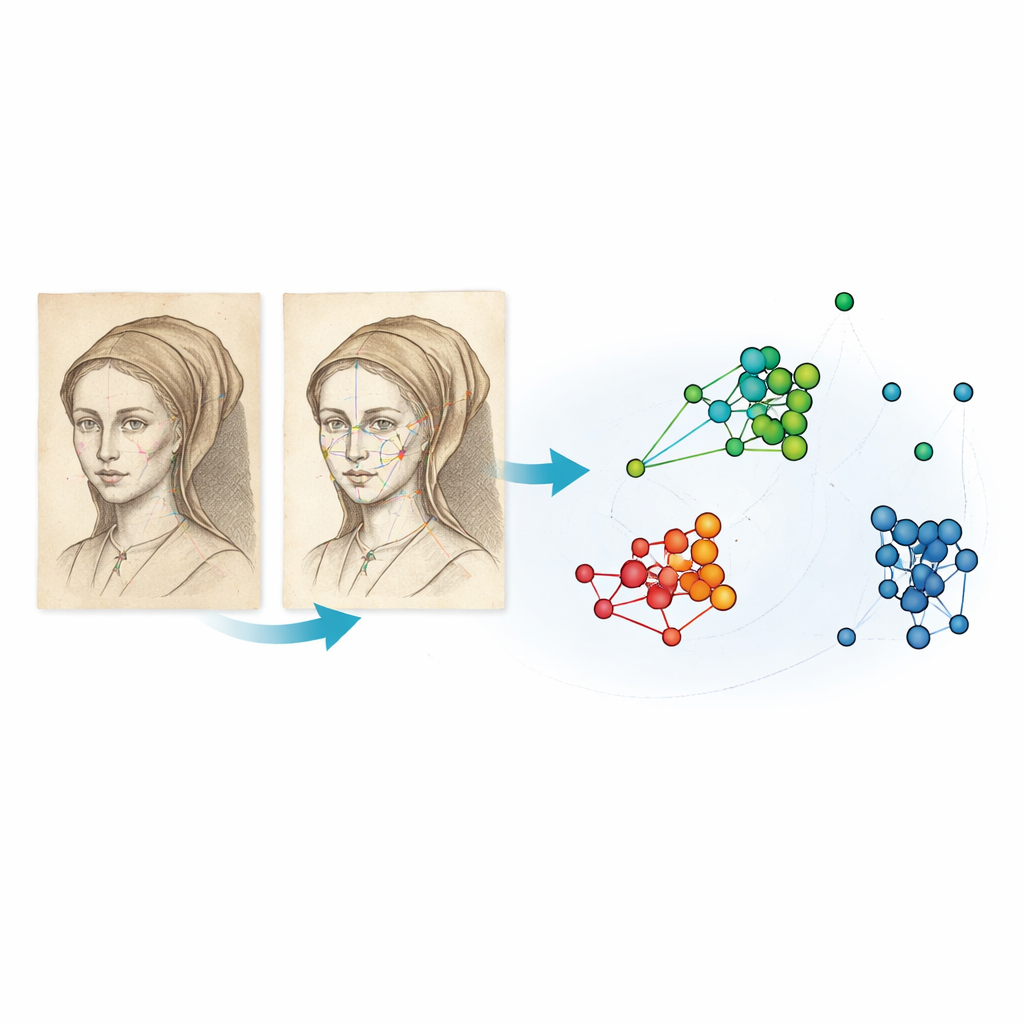
What This Means for Anne Boleyn’s Image
The study concludes that the long‑standing identification of RCIN 912189 as Anne Boleyn is probably wrong and that RCIN 912190 is a much stronger candidate for her true likeness, while RCIN 912189 more plausibly portrays her mother. The authors are careful to stress that facial‑recognition scores do not “prove” identity; instead, they provide an extra, quantifiable line of evidence that must agree with documents, stylistic study, and conservation history. In this case, all these independent approaches point in the same direction, suggesting that our mental picture of Anne Boleyn—reproduced for generations—may need to change. More broadly, the work showcases how carefully used artificial intelligence can help museums and historians re‑examine cherished assumptions about who is really looking back at us from the past.
Citation: Davies, K.L., Ugail, H. & Stork, D.G. Reassessing Anne Boleyn and other Boleyn women in Holbein drawings using facial recognition. npj Herit. Sci. 14, 175 (2026). https://doi.org/10.1038/s40494-026-02456-0
Keywords: Anne Boleyn, facial recognition, Renaissance portraits, Hans Holbein, digital art history