Clear Sky Science · en
Study on impact of scratch distribution characteristics on the audio quality of magnetic tape recordings
Why Old Tapes Still Matter
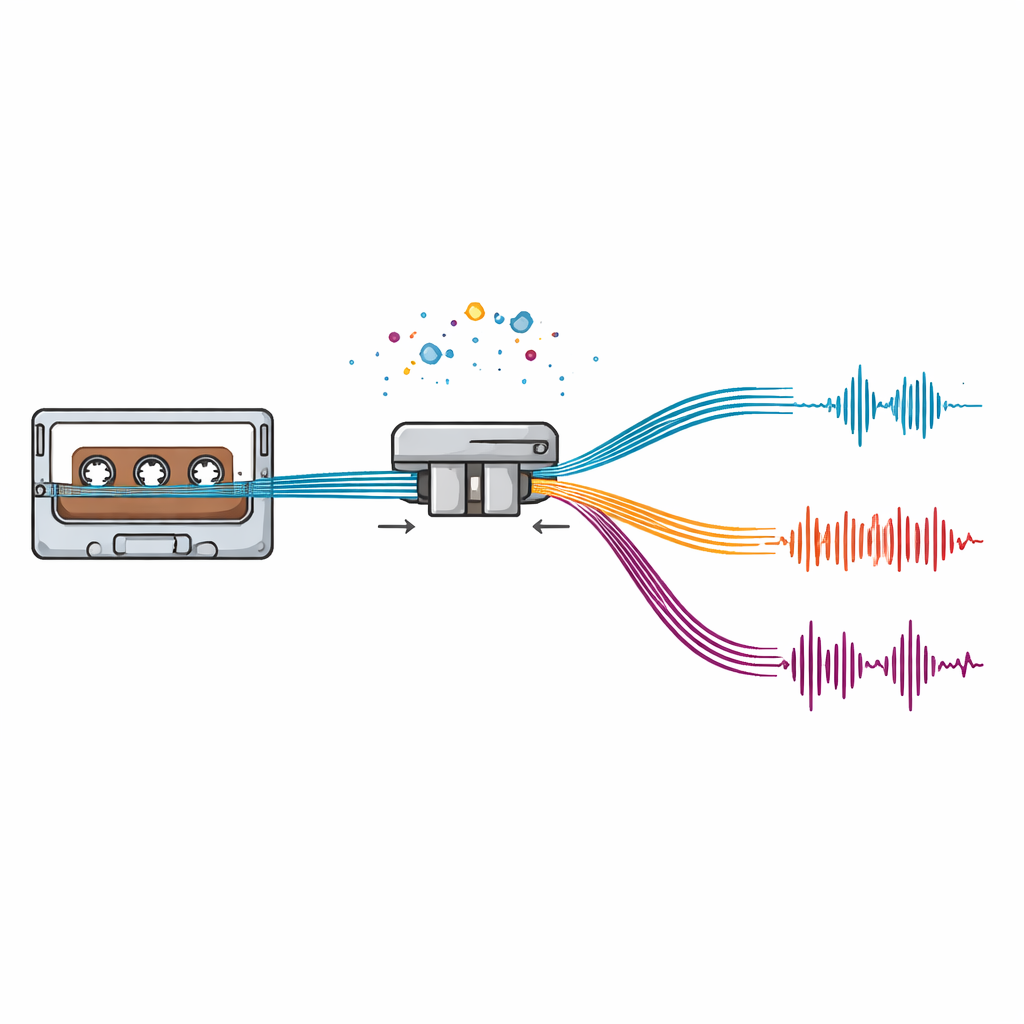
From family interviews to historic broadcasts, countless memories and records still live on magnetic cassette tapes. Yet these tapes were never meant to last forever. As they age, their delicate surfaces become scratched and worn, and the sounds they carry can fade or warp. This study asks a simple but important question: how exactly do different kinds of scratches change what we hear, and how can we measure that change in a clear, objective way?
Looking Closely at Worn Tape
The researchers focused on a very common problem in tape collections: surface scratches. Some scratches are long and even, caused by the tape rubbing in a regular way against the playback head. Others are patchy and irregular, created by dust, grit, or faulty machines scraping the tape in unpredictable ways. To study these effects safely, the team did not start with priceless archives. Instead, they used modern commercial tapes and carefully created two families of damage: neat, evenly spaced scratches and messy, blotchy ones, each at several levels from mild to severe.
From Surface Scars to Hidden Structure
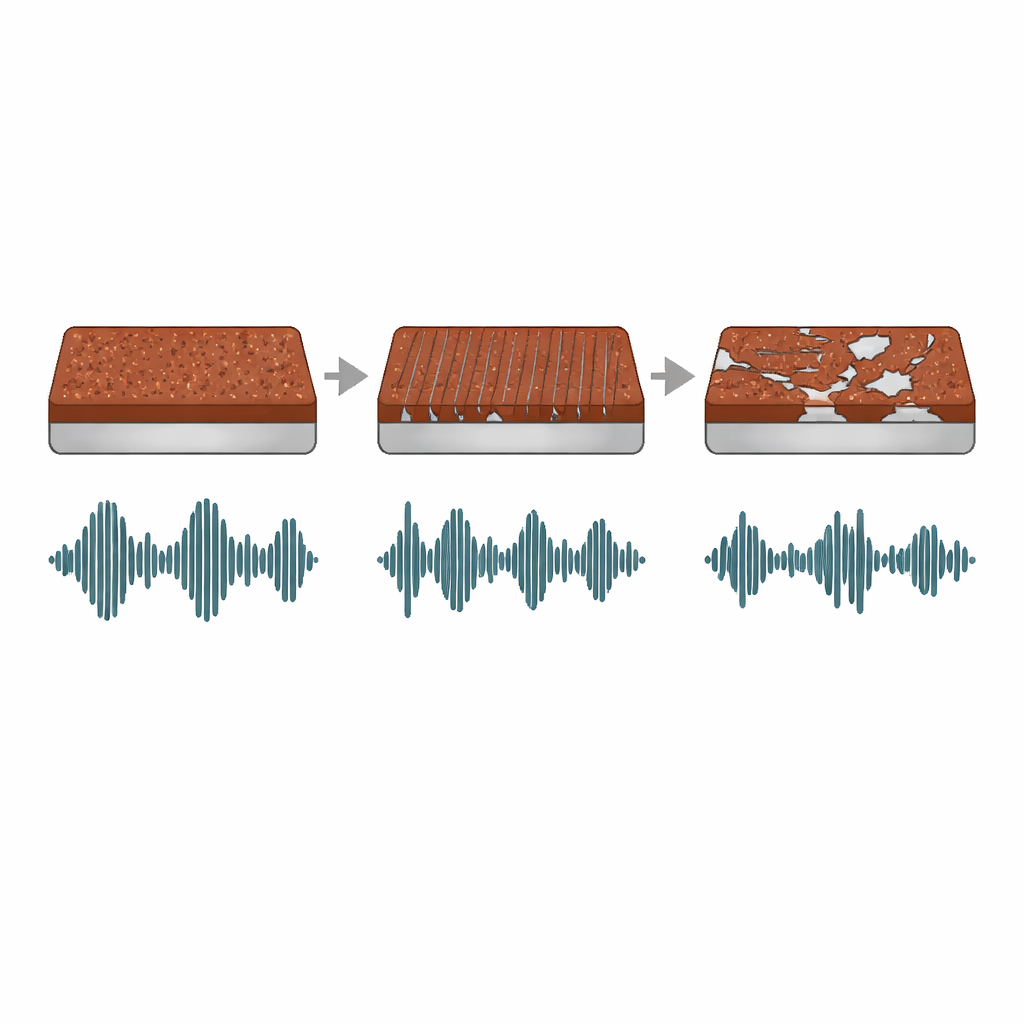
To understand what was happening on the tape itself, the team first treated the problem as a question of surfaces. Using powerful microscopes, including scanning electron microscopy and laser confocal scanning, they visualized how the tape’s thin magnetic coating—the layer that actually stores sound—was being scraped away. Gentle treatment produced fine lines and shallow grooves; harsher treatment peeled off flakes of the magnetic layer and in the worst cases exposed the plastic base underneath. By scanning the tapes like photographs and analyzing how light and dark pixels were distributed, they could quantify how much of the dark magnetic surface had been lost and replaced by brighter exposed areas.
How Scratches Rewrite the Sound
Next, the scientists turned to the sound itself. They recorded the same short musical passage before and after each level of damage, then analyzed the digital recordings using speech-analysis software. Colorful spectrograms showed where sound energy was concentrated across low and high pitches. As the magnetic coating wore away, these images became paler, signalling weaker sound, especially in the low and middle pitch ranges where most musical and spoken information lies. Even mild damage reduced the overall loudness, because fewer magnetic particles remained to carry the signal.
Different Damage, Different Distortion
A key finding was that not all scratches are equal. Uniform scratches—those neat, head-aligned lines—reduced loudness but largely preserved the original shape of the sound waves. Listeners would hear a duller, softer playback, but the melody and speech patterns stayed recognizable. Non-uniform scratches, however, caused far more trouble. As flake-like patches of the magnetic layer broke away, the recorded sound waves became distorted and, in severe cases, partly erased. The analysis revealed that certain numerical measures of the sound spectrum, such as how tightly or loosely frequencies were grouped and how skewed or spiky the distribution became, changed more strongly with irregular damage than with regular, head-induced wear.
Turning Measurements into Conservation Advice
By comparing changes in sound energy between low and high pitch ranges, the team could even infer what likely caused the scratches. Tapes with many regular scratches and a steadily growing gap between low and high pitch energy probably suffered from an uneven playback head. In such a case, archivists should stop the machine immediately and check for dirt or misalignment before further harm is done. Irregular damage, by contrast, tended to leave this energy gap nearly constant, pointing instead to random environmental wear such as dust and rough handling. These objective patterns offer conservators a new set of tools for diagnosing problems without sacrificing more of the original recording.
What This Means for Saving Our Sounds
In plain terms, this work shows that regular, gentle wear mainly turns the volume down, while random harsh scratches can actually change the tune—or erase parts of it altogether. The study provides a practical roadmap for linking what we see on the surface of a tape to what we hear during playback, and for recognizing early warning signs in the sound itself. For libraries, archives, and anyone digitizing old cassettes, these insights support better decisions about when to clean or repair a machine, when to stop playback, and how urgent it is to transfer a fragile tape before its unique voice is gone for good.
Citation: Yu, S., Wang, Y., Zhao, Y. et al. Study on impact of scratch distribution characteristics on the audio quality of magnetic tape recordings. npj Herit. Sci. 14, 180 (2026). https://doi.org/10.1038/s40494-026-02452-4
Keywords: magnetic tape, audio preservation, cassette scratches, sound quality, heritage archives