Clear Sky Science · en
Unraveling the revitalization suitability of Great Wall fortress heritage via RSI
A Hidden Story Inside the Great Wall
The Great Wall is famous for its endless stone ramparts, but scattered along its length are lesser-known forts that once supplied soldiers, guarded passes, and anchored villages. Many of these small strongholds are crumbling or even missing from official records, yet they sit at the heart of struggling rural communities. This study asks a practical question with broad appeal: which of these old fortresses are best suited to careful restoration and reuse, so that they can both protect history and help nearby villages thrive?
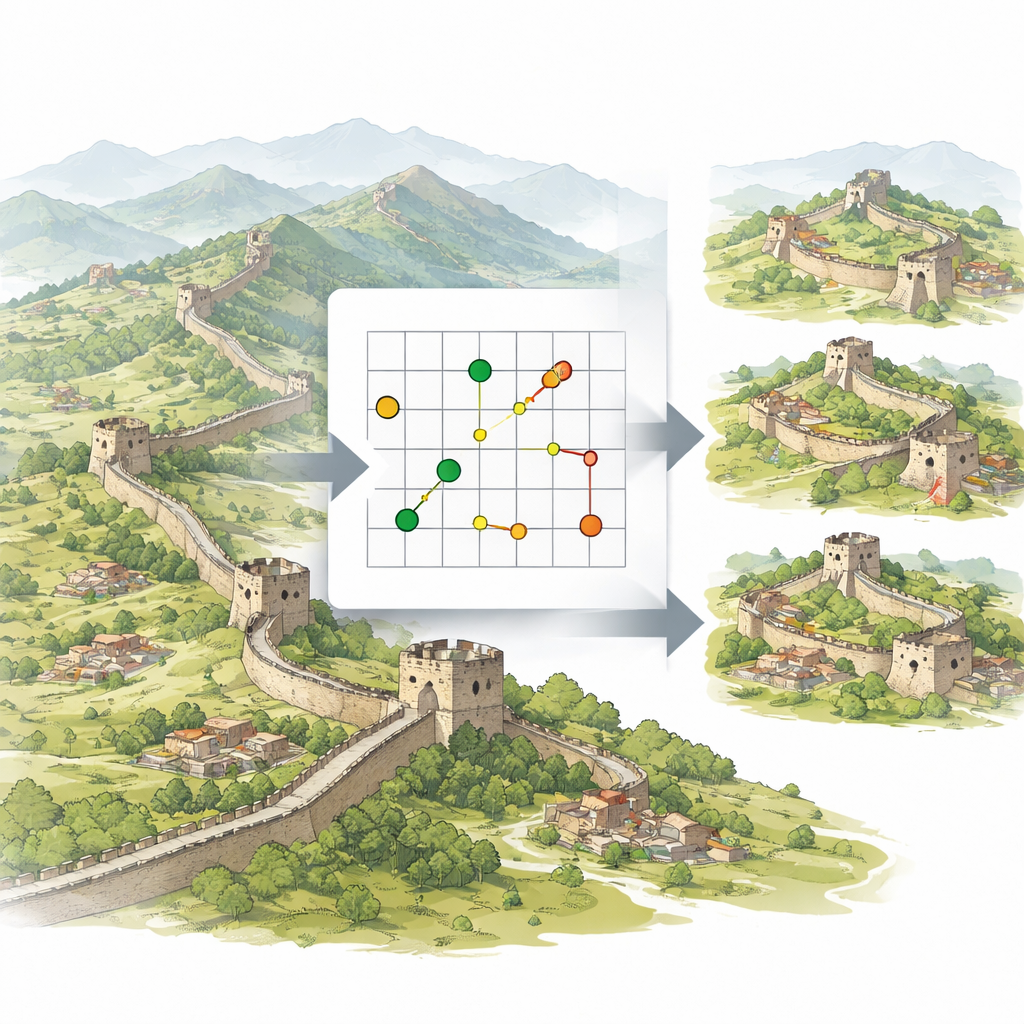
Forgotten Forts in a Living Landscape
The research focuses on Miyun District in northeastern Beijing, home to the city’s densest cluster of Great Wall fortresses. Although these sites are historically important and often surrounded by villages, they have been eroded by wind and rain, damaged by human activity, and left out of most development plans. Some forts are officially registered cultural relics, but others have slipped through the cracks of earlier national surveys. The authors argue that unless these “undocumented” forts are properly identified and evaluated, both cultural heritage and local development opportunities will continue to be lost.
How to Find a Fortress That Is Not on the Map
To track down forgotten sites, the team built a five-part detective framework. They sifted through old written records and gazetteers, compared multiple historical maps, and examined high-resolution satellite images to spot suitable terrain and traces of walls. They then checked 1960s U.S. spy satellite photos for earlier evidence of forts, walked the landscape to look for remaining structures, and interviewed elderly villagers who remembered walls that have since been dismantled. By cross-checking all these sources, they confirmed ten previously undocumented fortress sites in Miyun, some with surviving walls and others known mainly through memory and faint ground traces.
Scoring Which Forts Can Safely Come Back to Life
Finding the forts was only the first step; the harder task was deciding which ones could realistically and responsibly be brought back into use. For this, the authors created a Revitalization Suitability Index, or RSI, that scores each fortress from several angles. They grouped 18 measurable indicators into three dimensions. The heritage dimension captures how well the fortress is preserved, how many related historic features surround it, and how important it was in the old military system, including links to notable people or events. The ecological dimension considers vegetation, land use, terrain, and proximity to rivers. The socio-economic dimension looks at population density, access to roads and town centers, nearby shops and services, tourist attractions, and how mixed the local functions are. Together, these factors describe both the cultural value of a fortress and how easily it can support new uses.
A Careful Balance of Expert Judgment and Hard Data
To avoid relying only on opinion or only on raw numbers, the study blends two weighting methods. Experts in architecture, conservation, and archaeology used a structured comparison process to express which indicators they felt mattered most. At the same time, a mathematical technique based on information “entropy” examined how much each indicator actually varied across all forts. The researchers then compared the rankings from both approaches and only averaged them when they lined up, bringing in more experts and repeating the process when they did not. This iterative procedure produced a set of final weights that give greatest importance to heritage quality, followed by socio-economic context, with ecological conditions playing a smaller—though still meaningful—role in deciding where revitalization makes sense.
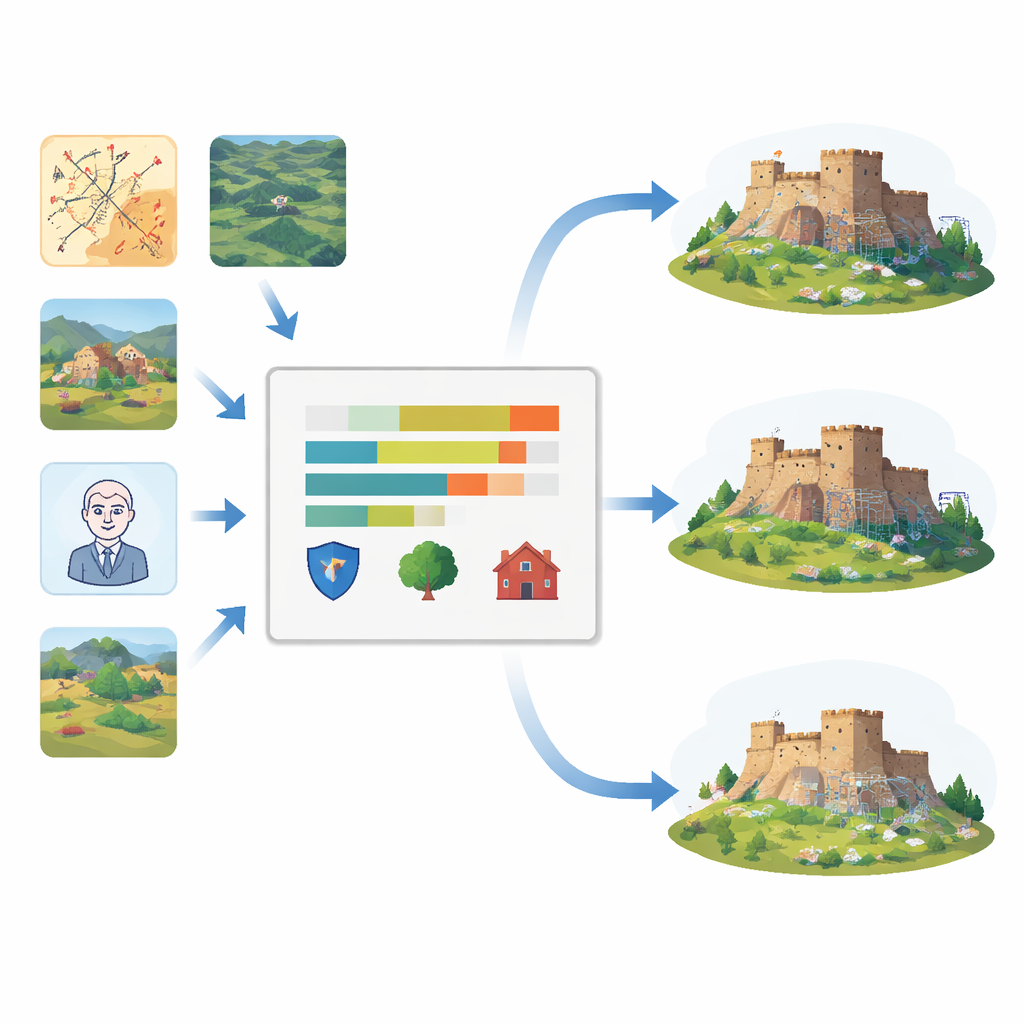
Mapping Where Revival Will Work Best
When the team applied their index to all of Miyun’s forts, clear patterns emerged. Fortresses in the northern and northeastern belt, especially around Gubeikou, scored highest: they tend to be better preserved, surrounded by rich clusters of related historic sites, and supported by stronger road access and tourism infrastructure. By contrast, many forts in the eastern part of the district showed weaker potential, either because the heritage fabric is badly damaged or because the surrounding communities lack the services and visitors needed to sustain reuse. Using a spatial statistics tool, the authors identified clusters of high-suitability forts and clusters of sites where revitalization would be difficult or unwise.
From Showpieces to Silent Guardians
On the basis of these results, the study divides fortresses into three practical categories. “Priority renewal” forts combine strong heritage and good access; here, careful adaptive reuse is encouraged—such as museums, education centers, or low-impact cultural tourism—while strictly protecting the historic fabric. “Conditional renewal” forts have promise thanks to their ecological or economic surroundings but require more cautious, small-scale development, often focused on ecotourism or support functions for nearby attractions. “Conservation” forts are too fragile, isolated, or poorly suited for active reuse; for these, the authors recommend a focus on protection, monitoring, and digital documentation rather than opening them up to visitors.
Why This Matters Beyond One District
For a general reader, the study shows how old military structures can become engines of rural renewal instead of relics left to decay. By combining archival sleuthing, satellite technology, local memory, and transparent scoring, the authors offer a model that other regions along the Great Wall—and indeed other large heritage corridors worldwide—can adapt. Their central message is straightforward: not every historic site should be turned into a tourist destination, but with the right tools we can identify which places can safely welcome new life, which should remain quiet witnesses to the past, and how both can contribute to the future of the communities around them.
Citation: He, D., Li, S., Fang, M. et al. Unraveling the revitalization suitability of Great Wall fortress heritage via RSI. npj Herit. Sci. 14, 171 (2026). https://doi.org/10.1038/s40494-026-02451-5
Keywords: Great Wall fortresses, heritage revitalization, rural development, cultural landscape, remote sensing