Clear Sky Science · en
The effect of temperature on the development of surface deterioration on the petroglyph-bearing rocks with black crust
Why ancient rock art is peeling away
Across the world’s deserts, people carved images of animals, humans, and symbols into bare rock thousands of years ago. Today many of these petroglyphs are quietly disappearing as thin slabs of rock bubble up and peel off, taking the carvings with them. This study looks closely at one famous site in northwestern China to answer a deceptively simple question: why is the rock skin that carries the art coming loose, and what does temperature have to do with it?
A fragile skin on desert stone
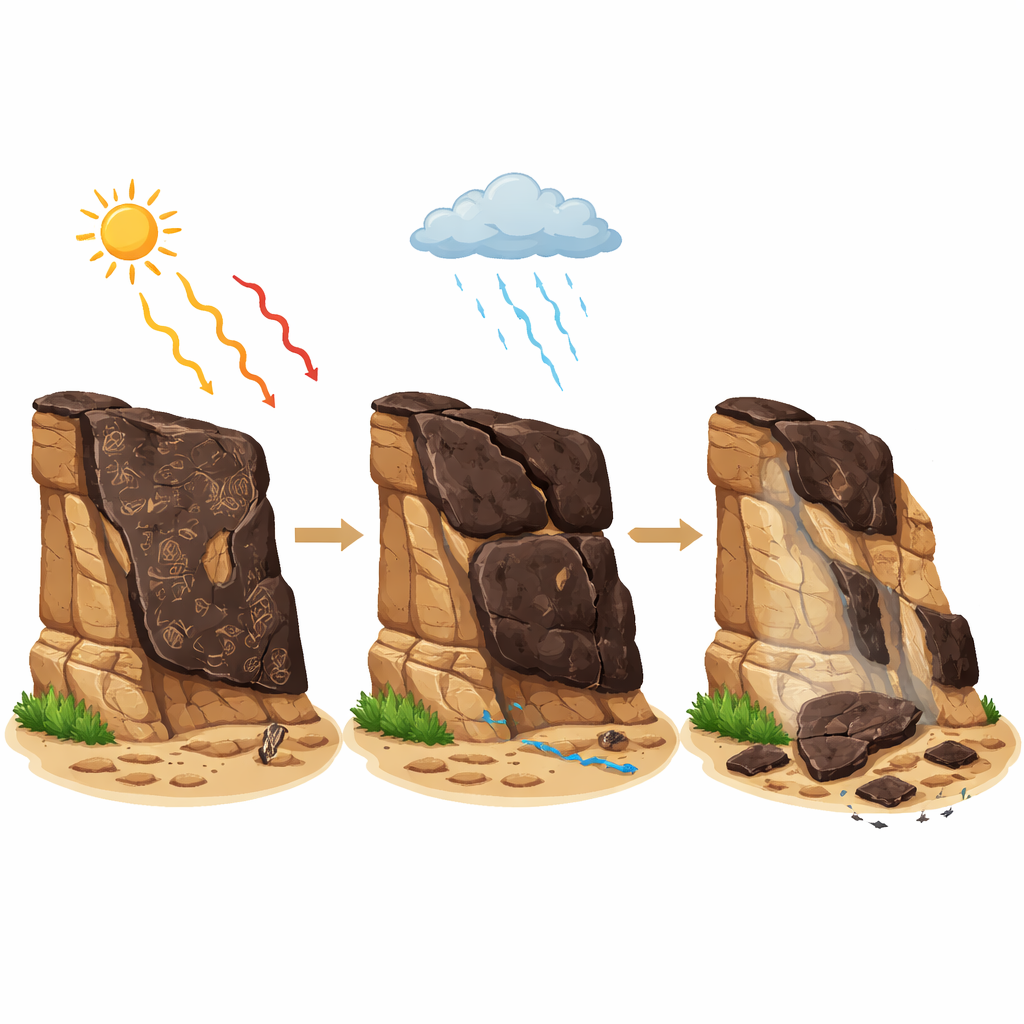
The researchers focus on the Damaidi petroglyphs in Ningxia, a dry region where more than 800 carved rock panels sit exposed on windswept ridges. The carving surfaces are coated by a thin, dark “black crust” that makes the images stand out but also seems oddly prone to damage. Field surveys showed that where the crust lifts into bubbles (called blistering) and then flakes away (scaling), the carvings are often lost. When flakes detach, they reveal a narrow band of weakened rock just beneath the crust, overlying stronger, solid sandstone. This layered structure—hard dark crust, soft weak interlayer, hard bedrock—turns out to be crucial for understanding how temperature attacks the rock.
Sun, rain, and rock orientation
The team monitored temperatures on and inside the rock for months, using sensors drilled to different depths and thermal infrared cameras to spot hidden blisters. They found that the top 10 centimeters of rock experience strong daily swings in temperature, rising steeply under midday sun and cooling at night. Rock faces pointing roughly south (about 180 degrees in this Northern Hemisphere site) received the longest and most intense sunshine. These sun-facing panels had the highest rates of blistering and scaling, strongly linking damage to solar heating. Sudden rain on hot rock added a second kind of stress: rapid cooling at the surface, much faster than the rock’s interior could follow.
Measuring how the rock layers behave
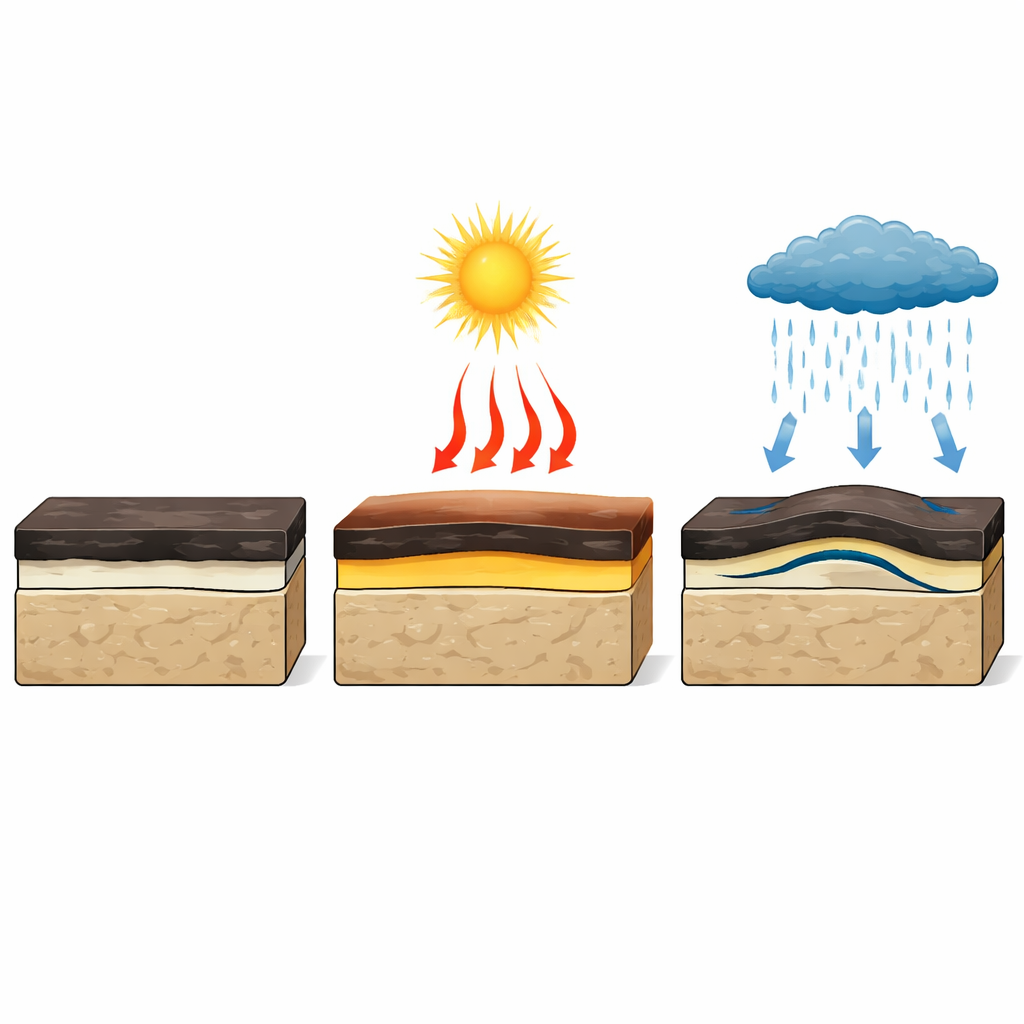
To understand why the crusted surface behaves differently from the stone beneath, the scientists collected small pieces of the black crust, the weak interlayer, and the intact bedrock from areas near, but not on, the carvings. In the laboratory they measured how fast sound waves travel through each material (a proxy for stiffness and cracking) and how easily each layer conducts heat and expands when warmed. The fresh sandstone at depth was stiff, conducted heat well, and expanded relatively strongly. The black crust was also relatively stiff and expansive, though less conductive. The weak interlayer, sandwiched between them, was softer, conducted heat poorly, and expanded the least. In simple terms, the rock surface is built like a hard shell glued to a soft, more fragile band, which in turn sits on a hard core.
Simulating stress inside the rock
Using these measurements, the team built computer models of a block of rock that included the black crust, weak interlayer, and strong bedrock. They then imposed two types of temperature change: slow, daily warming and cooling, and abrupt cooling like a summer storm hitting hot stone. In the simulations, everyday cycles produced modest stresses but consistent, uneven stretching and shrinking at the interfaces between layers. Sudden cooling produced much stronger stresses and sharp jumps in strain across the weak interlayer. These jumps concentrated within the soft band, encouraging cracks to form parallel to the surface. Depending on the temperature pattern, the first separation could occur either between the crust and the weak interlayer or between the weak interlayer and the deeper bedrock—matching field observations of thin crust flakes versus thicker slabs peeling off.
What this means for saving rock art
The study shows that petroglyph-bearing rocks are not failing randomly; their layered structure, combined with strong sun and occasional rapid cooling, actively drives blistering and scaling. Because the outer crust and the inner bedrock expand and contract more than the softer middle band, thermal stresses repeatedly tug at the weak interlayer until cracks propagate and surface slabs detach. This means that conservation efforts should focus on reducing extreme temperature shocks—especially direct intense sunlight and sudden rain on overheated surfaces—by using measures such as shading structures or controlled water management. More broadly, the work helps explain similar peeling and flaking seen on other desert rocks worldwide, offering a clearer picture of how climate and rock structure together threaten irreplaceable ancient art.
Citation: Wu, C., Liu, C., Wang, J. et al. The effect of temperature on the development of surface deterioration on the petroglyph-bearing rocks with black crust. npj Herit. Sci. 14, 173 (2026). https://doi.org/10.1038/s40494-026-02447-1
Keywords: petroglyph preservation, rock weathering, thermal stress, desert rock art, stone conservation