Clear Sky Science · en
Reanalysis of the Zongri culture chronology based on new excavations and radiocarbon dates from Dongguotan
Ancient lives on a high plateau
High on the northeastern edge of the Tibetan Plateau, long before written history, small communities of hunters and farmers were working out new ways to live. Archaeologists call one of these traditions the Zongri Culture, but until recently nobody could agree exactly when it flourished. This study re-examines that puzzle using fresh excavations, careful study of pottery, and modern radiocarbon dating to pin down when Zongri people lived and how they fit into the wider story of early farming in this mountain world.
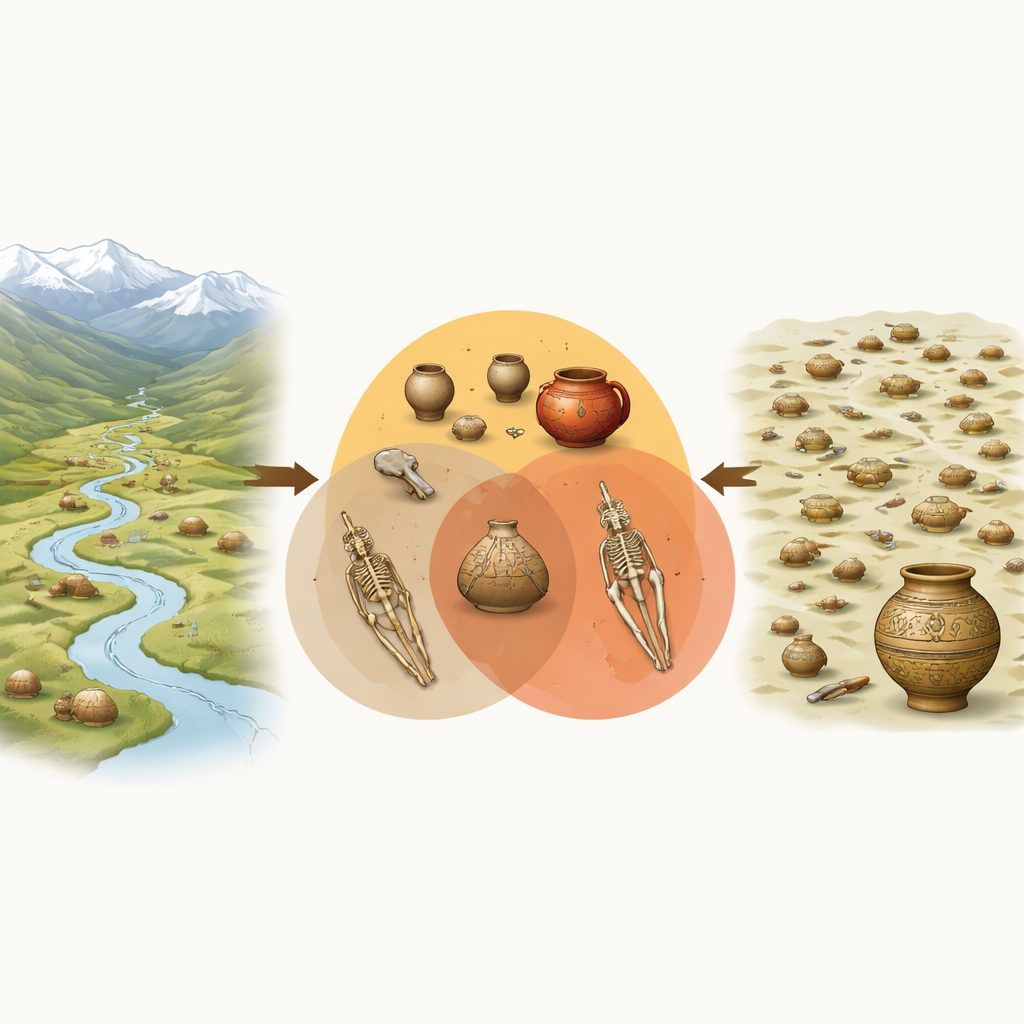
A meeting place between hunters and farmers
The Zongri Culture is important because it sits at the crossroads between older foraging lifeways on the plateau and farming societies spreading westward from lower, warmer lands. Zongri communities used both coarse local pottery and finer painted vessels that clearly came from farming neighbors known as the Majiayao Culture. They buried their dead in distinctive ways and relied on a mix of hunting, gathering, and millet agriculture. This blend of local and imported habits makes Zongri a key case for understanding how high-altitude hunter-gatherers gradually adopted crops and settled life.
A new site with a layered story
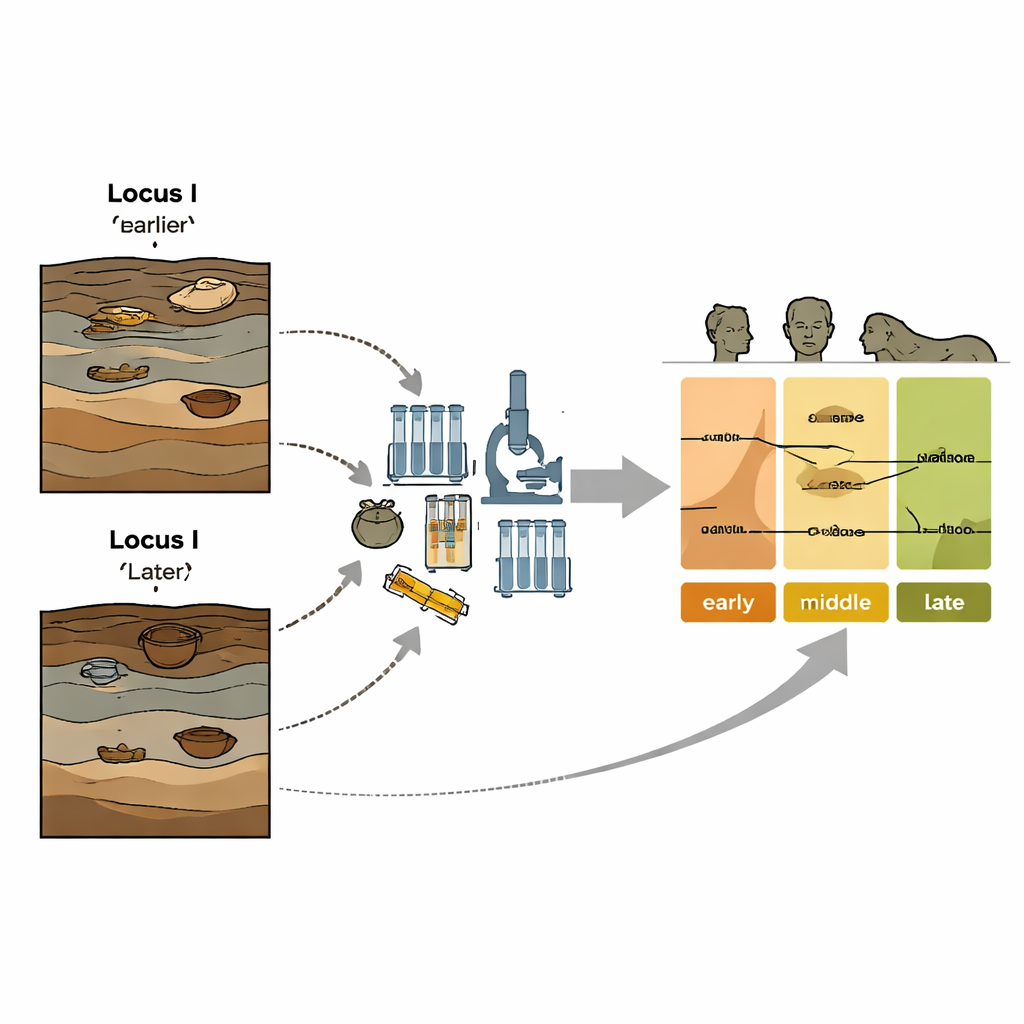
The authors focus on Dongguotan, a large site above the Yellow River in the Gonghe Basin, not far from the classic Zongri cemetery. They opened two main excavation areas, or loci, revealing stacked layers of soil and hundreds of features such as postholes, pits, and a house floor. In Locus II, deeper layers held classic Majiayao remains: fine yellow and orange painted pottery with sweeping dark patterns, alongside thicker, cord-marked utility vessels. In Locus I, higher up, the pottery changed: pale, sand-tempered jars and flasks with cord marks and reddish painted bands typical of Zongri became dominant, while Majiayao-style fine wares appeared only in small numbers. This vertical sequence showed that pure Majiayao deposits came first, followed later by clearly Zongri settlements that still carried some farming influences.
Reading time in seeds, bones, and clay
To turn this relative order into an actual timeline, the team dated charred millet grains, wild seeds, animal bones, and a piece of bark from carefully chosen layers and pits. These samples were processed in a radiocarbon laboratory and calibrated with the latest global curves. The Majiayao deposits in Locus II consistently dated to about 5000–4800 years before present, while the Zongri-dominated remains in Locus I fell between roughly 4820 and 4500 years ago. By combining these dates with detailed comparisons of pottery styles from other key sites, the authors could show that the first hints of Zongri traits appeared in the middle phase of the Majiayao Culture, and that fully developed Zongri communities overlapped with later painted-pottery traditions such as Banshan and Machang.
Reweighing old evidence across the region
The Dongguotan results were then woven together with a wave of new radiocarbon dates from the original Zongri site and nearby settlements along the Yellow River. Earlier dates from the 1990s, measured on decayed wood and calibrated with outdated methods, were found to be misleadingly old and are likely affected by the so-called “old wood” problem, where long-lived trees can make a site seem older than it really is. Newer accelerator mass spectrometry dates on human bones and plant seeds at Zongri, plus matching pottery at places like Gamatai, Lajia, and Zengbenka, instead cluster tightly between about 4850 and 3900 years ago. Within this band, the dates naturally form three groups that align with shifts in pottery shapes, painted designs, and burial customs.
A clearer timeline for a changing way of life
Putting all of this together, the authors propose a refined life span for the Zongri Culture from about 4850 to 3900 years ago, with an early, middle, and late phase. In the early phase, Zongri-style coarse pots appear alongside classic Majiayao painted ware, signaling the first blending of local hunter-gatherers with incoming farmers. The middle phase sees stronger ties to Banshan-style pottery and a more firmly settled lifestyle, while in the late phase Zongri potters move away from eastern painted traditions and develop more local forms that continue into later cultures. For non-specialists, the key message is that by carefully layering new excavations, modern dating techniques, and close visual study of pottery, archaeologists have transformed a confusing set of dates into a coherent timeline. This sharper picture helps explain when—and in what sequence—people on the high plateau shifted from foraging to farming and built the foundations for later Tibetan societies.
Citation: Meng, Q., Du, Z., Han, F. et al. Reanalysis of the Zongri culture chronology based on new excavations and radiocarbon dates from Dongguotan. npj Herit. Sci. 14, 178 (2026). https://doi.org/10.1038/s40494-026-02444-4
Keywords: Zongri Culture, Neolithic Tibet, radiocarbon dating, Majiayao pottery, Qinghai–Tibet Plateau