Clear Sky Science · en
Pirate gold provides new insights into West African trade using pXRF and SEM EDS analysis
Lost Treasure, New Story
Gold from a legendary pirate shipwreck might seem like the stuff of adventure novels, but it also holds answers to a historical mystery: was West African gold being secretly watered down before it reached European traders? By studying tiny gold beads and nuggets from the early 1700s, researchers used modern laboratory tools to test long‑standing accusations that Akan merchants on the Gold Coast (in present‑day Ghana) routinely cheated their European partners. The findings challenge old stereotypes and reveal a more nuanced picture of global trade, technology, and trust in the age of sail.
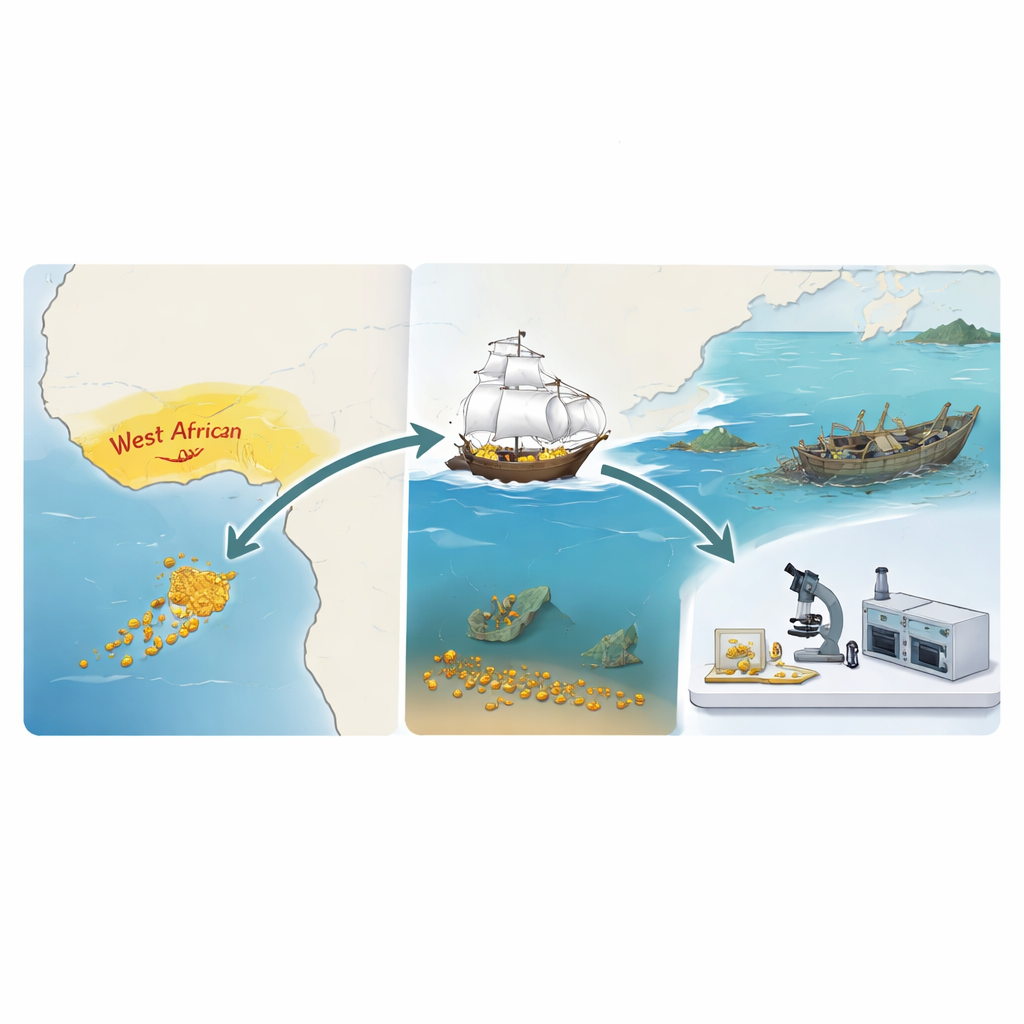
Gold Roads Across Continents
For more than a thousand years, gold from West Africa flowed north across the Sahara and later out along the Atlantic coast, feeding the wealth of empires and the hunger of European markets. By the 15th century, European powers were building forts along what became known as the Gold Coast to tap into rich deposits in the Ashanti Gold Belt, an inland zone of ancient rock packed with gold‑bearing ores. Among the peoples who controlled this trade were the Akan, famed for their artistry in gold jewelry and regalia. Yet most of what we thought we knew about the quality of that gold came from European travelogues—accounts that were often biased, secondhand, or more moral tale than measured report.
Accusations and Assumptions
Those old writers frequently accused Akan traders of adulterating gold—mixing in cheaper metals like silver, copper, or brass, or even hiding bits of stone or glass inside thicker pieces. Some claimed that Europeans had themselves taught local smiths how to blend gold with silver, only to be fooled by their own lesson. These stories have long colored views of West African trade, suggesting a market riddled with fraud. But they lacked one crucial ingredient: hard data. No one had systematically tested well‑dated Akan gold from the height of the Atlantic trade to see whether these charges held up.

Pirate Ship as Time Capsule
The wreck of the Whydah Gally, a slave ship captured by the pirate Samuel “Black Sam” Bellamy and lost off Cape Cod in 1717, unexpectedly supplied that missing evidence. Archaeologists have recovered more than 300 Akan gold pieces from the site—mostly tiny beads, nuggets, and fragments of ornaments that had been traded for their metal value rather than as art. Because the ship’s route is known and its sinking precisely dated, this gold forms an unusually clear snapshot of what was actually being traded on the Gold Coast in the early 18th century. The researchers selected 70 items for close inspection and analyzed 27 of them in detail.
Looking Inside the Pirate Gold
To probe what these objects are made of, the team turned to two non‑destructive techniques. A handheld X‑ray device allowed them to quickly scan each piece and estimate the proportions of gold, silver, copper, and other elements. They then used a scanning electron microscope to zoom in on small, clean patches of metal and measure composition more precisely. Working with artifacts that had spent 300 years in seawater posed challenges: many surfaces were coated with crusts rich in iron and lead from the surrounding seafloor, and even traces of nearby silver coins. By comparing readings from different spots and cross‑checking the two methods, the researchers separated true metal content from contamination.
What the Numbers Really Say
When the dust settled, the pirate gold did not match the lurid tales of widespread cheating. Most nuggets closely resembled naturally occurring gold from the Ashanti Gold Belt, especially deposits known to be rich in silver. Their silver levels fit comfortably within the range expected from local geology, and copper was very low. Cast ornaments and fragments sometimes showed slightly higher copper, likely from workshop practices—small amounts of copper can harden delicate goldwork, or seep in from tools and crucibles used for other metals. Only one analyzed fragment had clearly elevated silver and copper compared with natural ore, and even that piece appears to be casting overflow rather than a finished item meant for trade. Overall, the gold is far from chemically pure, but its impurities look natural rather than calculated tricks.
A New View of Trust and Trade
To a non‑specialist, the conclusion is straightforward: this carefully dated cache of Akan gold from a pirate ship does not support the old claim that African traders routinely and heavily adulterated their gold. Instead, the metal’s make‑up mostly reflects the natural variability of local deposits, with only subtle signs of workshop influence. The study does not prove that fraud never happened, nor does it pinpoint the exact mines the gold came from. But by replacing rumor with measurement, it shows that much of the gold Europeans bought on the Gold Coast was genuinely high‑quality—and that their written complaints tell us as much about prejudice, politics, and market anxiety as they do about the metal itself.
Citation: Skowronek, T.B., Clifford, B. & DeCorse, C.R. Pirate gold provides new insights into West African trade using pXRF and SEM EDS analysis. npj Herit. Sci. 14, 169 (2026). https://doi.org/10.1038/s40494-026-02441-7
Keywords: Akan gold, West African trade, Whydah shipwreck, gold composition, heritage science