Clear Sky Science · en
Preparation and properties of hydroxyapatite modified B72 composites for adhesion of partially-fossilized bone cultural relics
Saving Fragile Bones from the Past
Archaeological digs often uncover not sturdy skulls or tusks, but bone and ivory so fragile they crumble at a touch. Conservators rely on glues to hold these pieces together, yet many common products age badly, crack, or are difficult to undo if a better method appears later. This study describes a new type of adhesive designed specifically for delicate, partly fossilized bone relics, aiming to keep them stronger, safer, and reversible for future generations of researchers and museum visitors.
Why Old Bones Are Hard to Save
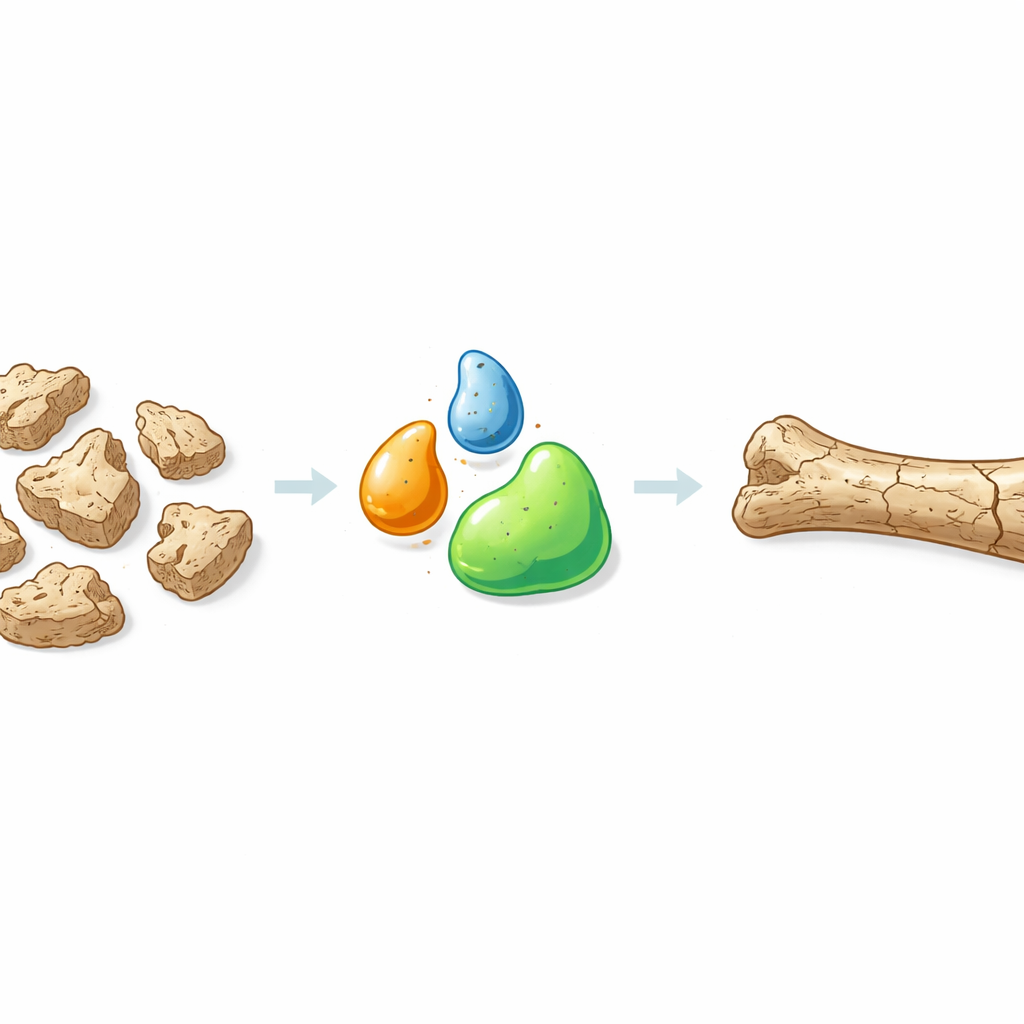
Partially fossilized bones and horns have endured centuries or millennia underground. Over time, their once-solid structure turns into a complex mix of organic material and minerals riddled with pores, micro-cracks, and weak spots. When such objects are excavated and exposed to changing moisture, temperature, and handling, they can flake, loosen, or break into many pieces. Standard synthetic glues, while strong, are often too rigid compared with the bone itself. This mismatch can concentrate stress at the glued joints, causing brittle failure. Many of these polymers also yellow, become brittle under light and humidity, and are difficult to remove without harming the artifact.
Borrowing from Bone Itself
The researchers set out to build a more bone-friendly glue by combining an established conservation resin, known as B72, with hydroxyapatite, a mineral that is a major ingredient of natural bone. To help these two very different materials mix and cling together, they added a silane coupling agent—a small molecule that can bond with both the mineral particles and the organic resin—as well as a small amount of plasticizer to reduce brittleness. By adjusting how much hydroxyapatite and coupling agent they used, they created several versions of the composite and then examined their internal structure, flow, curing behavior, bonding strength, and resistance to environmental stress.
How the New Glue Behaves
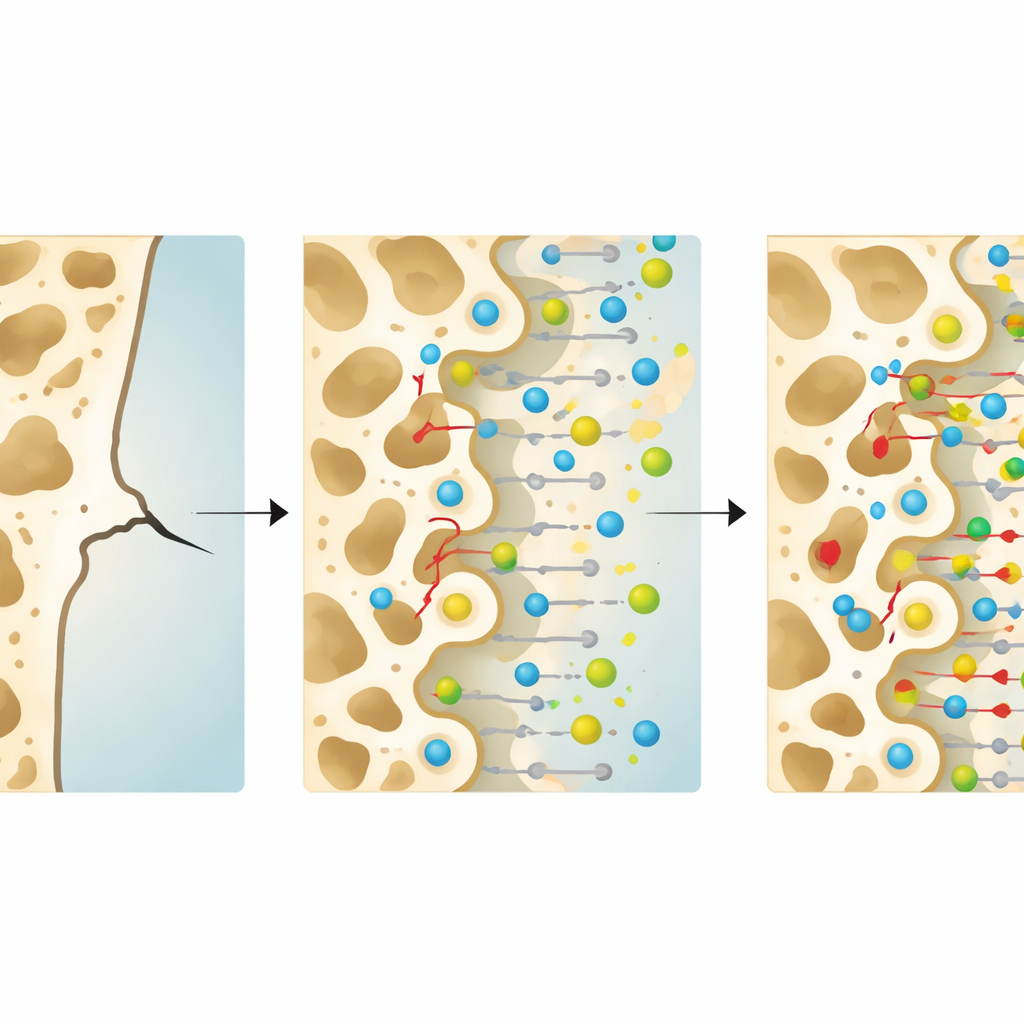
Microscope images showed that pure B72 forms a smooth, continuous layer, whereas adding hydroxyapatite introduces tiny pores and particles into the resin. With too much mineral, the structure becomes overly loose and porous, but when the coupling agent is present in the right amount, the particles disperse evenly and the adhesive layer becomes denser and more uniform. Tests of viscosity and flow revealed an important trade-off: more mineral thickens the mixture and limits its ability to seep into tiny cracks, while too little misses out on added strength. The team also measured how quickly different recipes hardened, how easily water vapor could pass through them compared with bone, and how readily they could be dissolved again in common solvents. All versions remained dissolvable within a few hours, an essential feature for re-treating artifacts in the future.
Strength, Aging, and Heat
Mechanical tests using artificially aged mammoth ivory—chosen as a stand-in for real relics—showed that adding hydroxyapatite increased the shear strength of glued joints by up to roughly 50 percent compared with pure B72. However, the strongest mixture (with the most mineral) flowed poorly and formed a more porous solid that could be less reliable over the long term. Accelerated aging experiments, including repeated wet–dry cycles, salt exposure, and ultraviolet light, highlighted another balance: moderate mineral content improved resistance to mass loss, color change, and loss of strength, whereas excessive amounts could introduce weak points. Thermal tests indicated that the mineral particles also helped the adhesive withstand higher temperatures before breaking down, suggesting better overall stability.
From Lab Bench to Dig Site
Weighing all these factors together—ease of use, strength, environmental durability, compatibility with the porous bone structure, and the ability to reverse the treatment—the authors identified one formulation as the best compromise: an adhesive containing 20 percent hydroxyapatite and 5 percent coupling agent by weight. This blend was viscous enough to hold, but still flowed into fine cracks, bonded more strongly than pure B72, aged more gracefully under moisture, salt, and light, and could still be removed with standard solvents. In a real restoration of broken bone remains from a Chinese archaeological site, the composite allowed careful alignment of fragments and produced stable, visually unobtrusive joins. To a non-specialist, the takeaway is that by mimicking the mineral makeup of bone and fine-tuning how it interacts with a proven resin, conservators can now glue fragile relics in a way that is stronger, more compatible, and kinder to the future than traditional adhesives.
Citation: Chen, D., Zhang, C., Zhang, L. et al. Preparation and properties of hydroxyapatite modified B72 composites for adhesion of partially-fossilized bone cultural relics. npj Herit. Sci. 14, 168 (2026). https://doi.org/10.1038/s40494-026-02437-3
Keywords: bone conservation, archaeological adhesives, hydroxyapatite, cultural heritage restoration, Paraloid B72