Clear Sky Science · en
Multi-scale degradation of mechanical properties in limestone cultural relics under long-term acid rain leaching
Why ancient stone faces are quietly crumbling
Limestone cave temples and stone statues, like those at China’s Longmen Grottoes, have survived for more than a thousand years. Yet today, an invisible modern threat—acid rain—is slowly eating away at them from the outside in. This study explores how that rain not only roughens the surface of these monuments but also weakens the stone’s inner strength, helping conservators decide how best to protect these irreplaceable works of art and history.
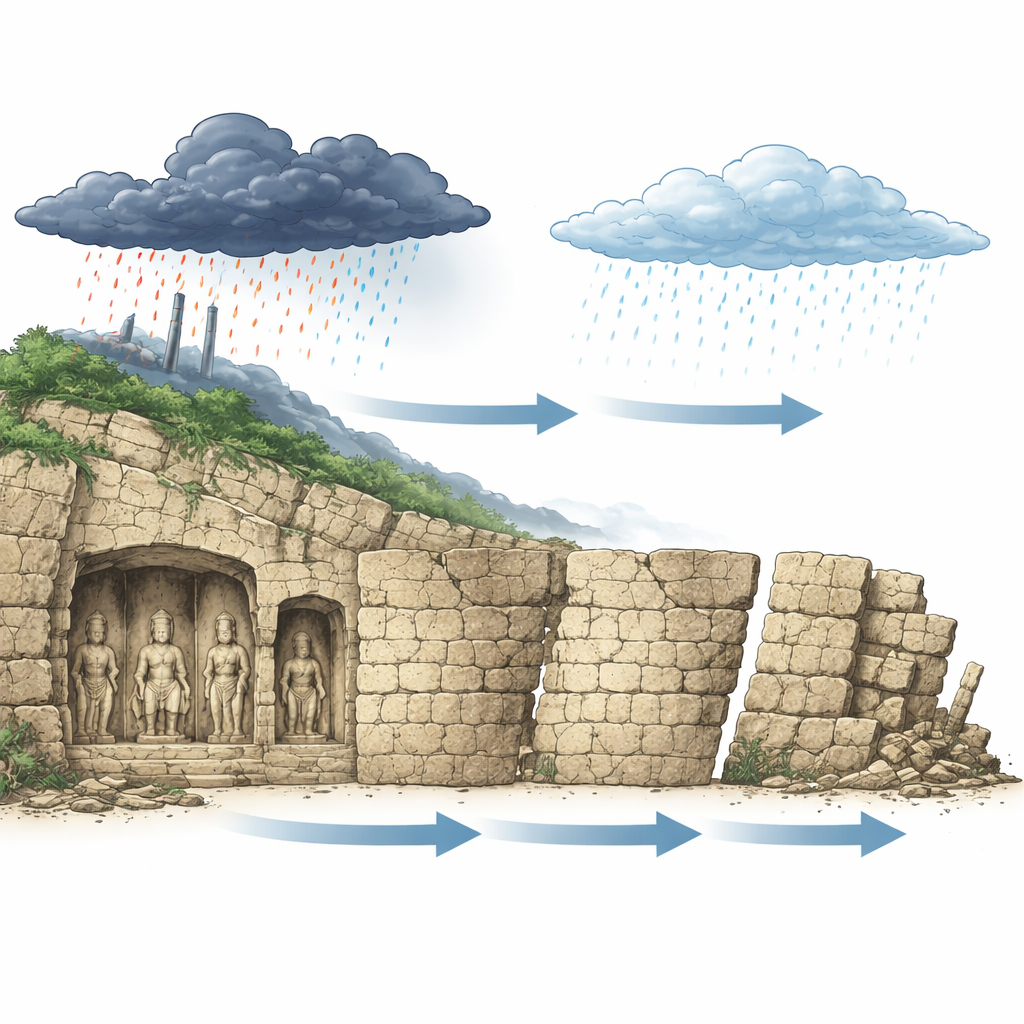
Rain, pollution, and fragile carvings
Limestone is mostly made of calcium-rich minerals that react easily with acids. When rain picks up pollutants from the air, it becomes acidic and can dissolve these minerals. At the Longmen Grottoes, rainwater often collects at the base of the cliffs, soaking the carvings for long periods. This does more than cause surface stains and flaking: the rock can lose mass, crack, and gradually lose the strength needed to support its own weight. Until now, it has been hard to study this process in real artifacts, because conservators cannot cut large blocks from protected monuments for destructive testing.
Miniature tools for tiny stone samples
To overcome this, the researchers used small, already-detached fragments from the Longmen site and recreated long-term acid rain exposure in the lab. They soaked limestone pieces in artificial rain of different acidity levels (from strongly acidic to nearly neutral) for up to 1,800 hours—about ten weeks. They then combined several methods: nanoindentation, which presses a tiny probe into the stone to measure local hardness and stiffness; standard compression tests on small cylinders to measure overall strength; electron microscopy to image pores and cracks; and computer analysis of those images to estimate how much of the stone volume had turned into voids.
From solid rock to honeycomb stone
The experiments showed that damage happens in stages. Early on, acid in the water reacts strongly with the limestone, quickly raising the water’s pH as dissolved minerals wash out. The stone loses mass rapidly, and white mineral grains appear in the solution. Microscopic measurements reveal that both hardness and stiffness plunge during the first few hundred hours of soaking. Electron microscope images confirm what is happening inside: a once-flat and dense grain structure begins to sprout small pores, which then grow and merge into a honeycomb-like network. After around 1,080 hours, the rate of change slows as the chemical reactions approach a kind of balance and many of the easily dissolved minerals are already gone.
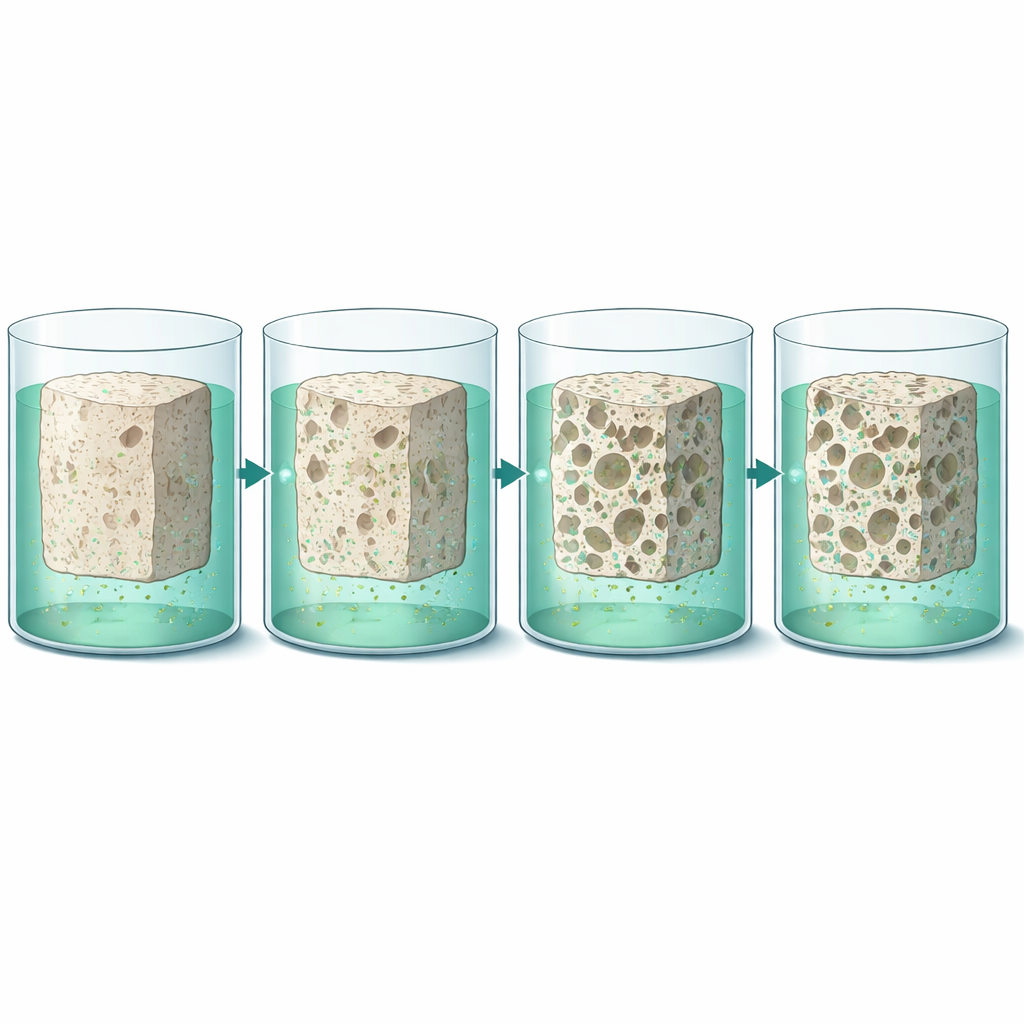
Strength loss from the inside out
The same pattern appears at larger scales. As soaking time increases and the acid becomes stronger, the stone cylinders lose both stiffness and crushing strength. Eventually these properties level off at much lower values than those of fresh limestone. By comparing strength data with the fraction of the surface taken up by pores and cracks in binary images (where defects appear as bright areas), the team found a simple, nearly straight-line rule: the more defect area, the weaker the stone. In other words, the key to understanding mechanical decay is the quiet growth and linking of microscopic voids, rather than just visible chips or flakes on the surface.
Guiding smarter protection for stone heritage
For non-specialists, the main takeaway is that acid rain slowly turns once-solid carvings into something more like a sponge. This internal weakening follows a predictable path that can be tracked with tiny samples and advanced microscopes, without carving up the monuments themselves. The findings suggest practical steps: monitor local rain chemistry, prevent water from pooling at the bases of cave temples, and control pollution levels around heritage sites. By understanding how and when the stone’s strength stabilizes after long exposure, conservators can better judge the urgency of repairs and design treatments that slow or halt the hidden erosion of the world’s limestone treasures.
Citation: Yin, S., Li, S., Zheng, S. et al. Multi-scale degradation of mechanical properties in limestone cultural relics under long-term acid rain leaching. npj Herit. Sci. 14, 186 (2026). https://doi.org/10.1038/s40494-026-02431-9
Keywords: acid rain, limestone heritage, stone weathering, cultural relics conservation, rock microstructure