Clear Sky Science · en
Evaluating the environmental response of Rembrandt’s The Night Watch (1642) using water sorption experiments and diffusion modelling
Keeping a Masterpiece Safe from the Air
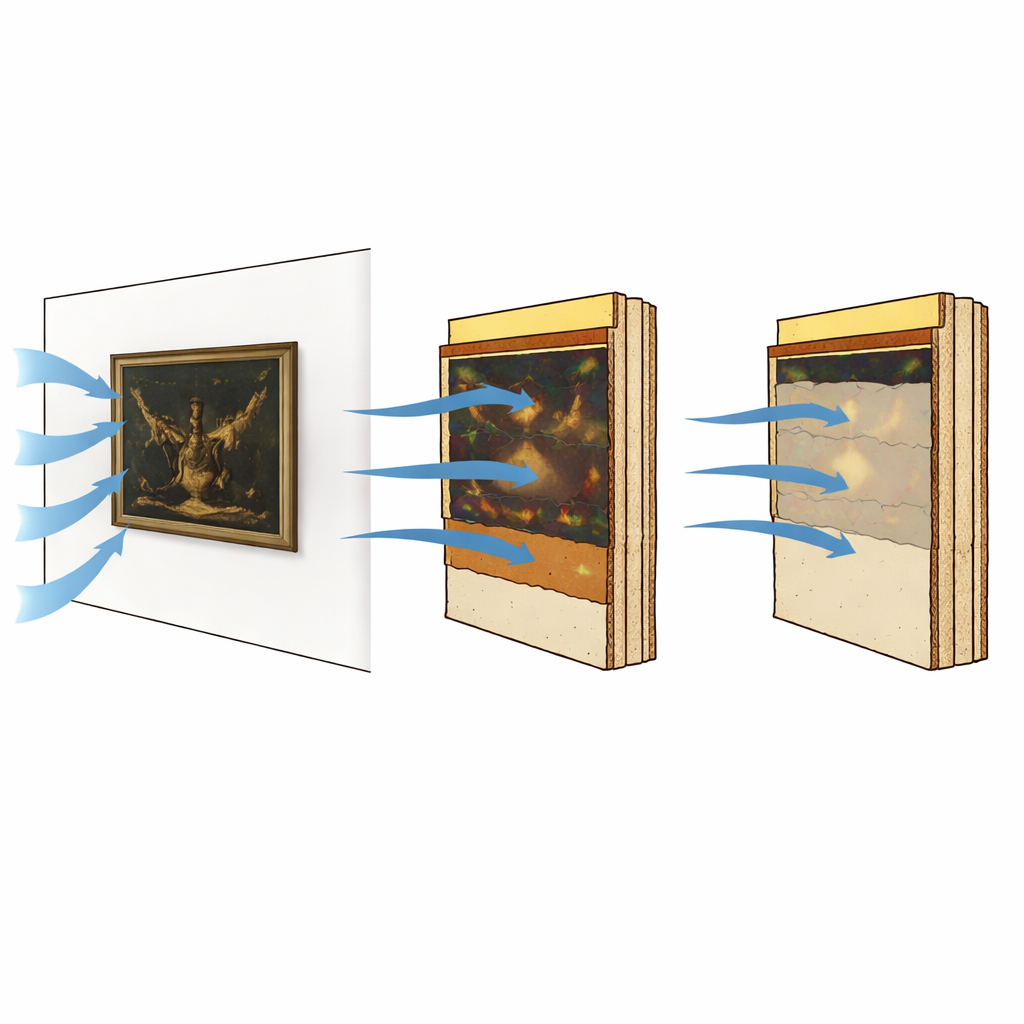
Rembrandt’s The Night Watch is one of the world’s most famous paintings, but like all canvases, it quietly breathes with the air around it. Changes in humidity can make its many layers swell and shrink, building up stress that may eventually crack paint or warp the canvas. This study asks a deceptively simple question with big implications for museums everywhere: under modern, more energy-efficient climate standards, how does The Night Watch actually respond to daily humidity swings—and does its historic wax-resin lining still help to shield it?
Why an Old Treatment Still Matters
In the nineteenth and twentieth centuries, many Dutch paintings on canvas—an estimated 90 percent of seventeenth-century works—were treated with a wax-resin lining. Conservators glued a new canvas to the back of the original using a hot mixture of beeswax and natural resin. This treatment was meant to reattach flaking paint, stiffen weakened canvas, and, crucially, slow the passage of moisture from the surrounding air into the painting. Today, however, museums are relaxing climate control to save energy, following the BIZOT Green Protocol, which allows relative humidity to swing between 40 and 60 percent with faster day-to-day changes than before. That shift makes it urgent to understand whether old linings like the one on The Night Watch are still helping—or possibly even harming—the painting.
Taking Paintings Apart on Paper
Rather than experimenting directly on Rembrandt’s masterpiece, the researchers built a detailed physical and mathematical picture of how water moves through a typical lined canvas. They treated the painting as a stack of layers—varnish, paint, ground, original canvas, wax-resin, and an added lining canvas—and described how water diffuses through each one. To feed this model with realistic numbers, they measured how small samples of relevant materials gained weight as humidity was stepped up in a controlled chamber. This technique, called dynamic vapor sorption, revealed how much water each material can hold at a given humidity and how quickly it soaks in. With these data, the team could simulate how water concentration changes over time at any depth inside the layered structure when the surrounding air suddenly becomes more humid or cycles up and down.
What the Layers Really Do
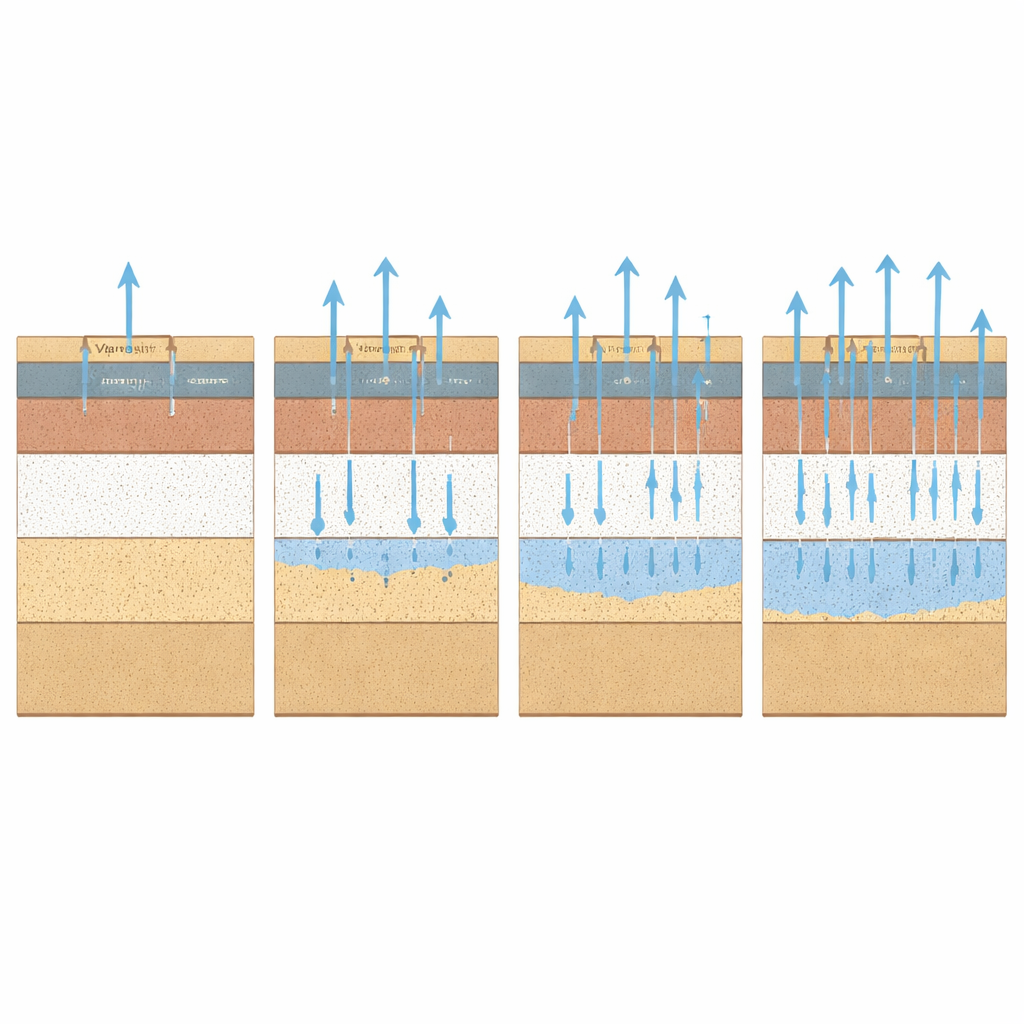
The experiments and simulations show that adding wax-resin and a lining canvas turns the back of a painting into a kind of moisture brake and buffer. The wax-resin itself remains strongly water-repelling, but by filling the gaps in the original canvas it slows down the initial rate at which moisture travels inward. The extra canvas and impregnated original canvas together act as a reservoir, soaking up water gradually and releasing it slowly. Under the fastest humidity swings allowed by the BIZOT guidelines, the centre of the paint layer in a wax-resin-lined painting only reaches roughly one third of the water content it would have under steady, constant humidity at the upper limit. Thicker paint adds further protection: a paint layer ten times thicker responds significantly more slowly at its centre than a thin one, meaning different parts of a single painting can experience quite different moisture histories.
How Age Changes the Shield
Over time, beeswax and resin undergo chemical changes, forming more water-attracting groups and developing microcracks. By comparing freshly made wax-resin with material removed from the tacking edge of The Night Watch, the team found that the historic mixture now takes up more water than it did when new. Yet modelling suggests that this increased capacity only slightly alters the overall behaviour: the lining still slows down moisture transport, and the extra sorption in the lower layers can even enhance short-term buffering of the paint. Even in a deliberately pessimistic scenario where cracks expose more of the lining canvas and the wax-resin lets water through faster, the layered structure as a whole continues to dampen and delay humidity changes reaching the paint compared with an unlined canvas.
What This Means for The Night Watch
For a lay observer, the key message is reassuring: under the new, more flexible climate rules, The Night Watch—and similar wax-resin-lined paintings—do not track every wiggle of museum humidity. Their many layers, including the aged wax-resin lining, slow and smooth the impact of environmental swings on the fragile paint. At very rapid humidity changes, the paint layer hardly notices; at slower shifts, the lining still offers substantial shielding, though less than when conditions are perfectly stable. The study does not claim that such paintings are risk-free, but it does provide a more solid, quantitative basis for balancing energy savings with the long-term safety of irreplaceable works of art.
Citation: Duivenvoorden, J.R., van Duijn, E., Vos, L. et al. Evaluating the environmental response of Rembrandt’s The Night Watch (1642) using water sorption experiments and diffusion modelling. npj Herit. Sci. 14, 165 (2026). https://doi.org/10.1038/s40494-026-02430-w
Keywords: painting conservation, museum climate, wax-resin lining, humidity effects, heritage science