Clear Sky Science · en
Comparative study of color in traditional and contemporary flower and bird paintings
Why colors in old bird-and-flower art still matter today
From museum galleries to social media feeds, East Asian bird-and-flower paintings captivate viewers with their quiet beauty. But behind the blossoms and feathers lies a rich language of color that has carried cultural meanings for centuries. This study asks a deceptively simple question: how have the colors in these paintings changed from traditional times to the present, and what does that say about shifts in taste, technology, and symbolism? By using modern computer tools to read color the way an art historian reads brushwork, the work reveals how harmony, contrast, and cultural codes have evolved across generations of artists.
From quiet scrolls to bold experiments
Bird-and-flower painting, or huaniao hua, has long been one of the most cherished genres in East Asian art. These works are far more than pretty nature scenes. Specific flowers and birds—such as peonies for wealth, plum blossoms for resilience, orchids for refined character, and cranes for longevity—have carried layered symbolic meanings shaped by Confucian, Daoist, and Buddhist ideas. For centuries, especially during the Song and Qing dynasties, artists favored restrained, naturalistic palettes that underscored these meanings. In the twentieth and twenty-first centuries, however, painters have blended this heritage with Western influences, new pigments, and even digital tools, opening the door to more experimental color use while still referencing traditional motifs.
Turning paintings into data
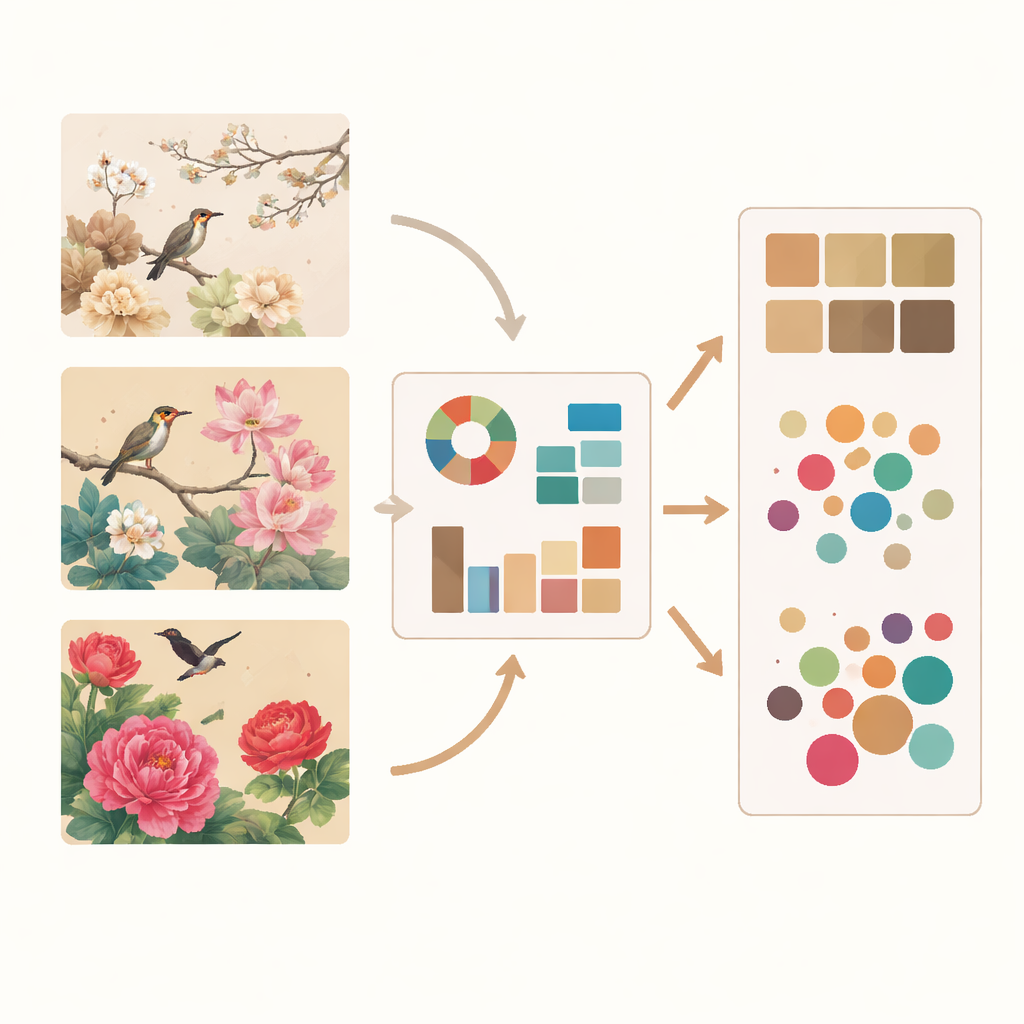
To trace this chromatic story, the researcher assembled a large digital collection of bird-and-flower paintings labeled as traditional (before the 20th century), modern (early to mid-20th century), contemporary (late 20th century onward), or unknown. After carefully standardizing each image—removing borders, resizing, and putting all colors into the same digital color space—computer algorithms extracted the dominant colors used for flowers and for birds in each work. Instead of looking at every pixel, the method summarized each painting as a compact “palette” of key colors, then treated those palettes as data points that could be compared, clustered, and statistically tested.
Measuring harmony and change
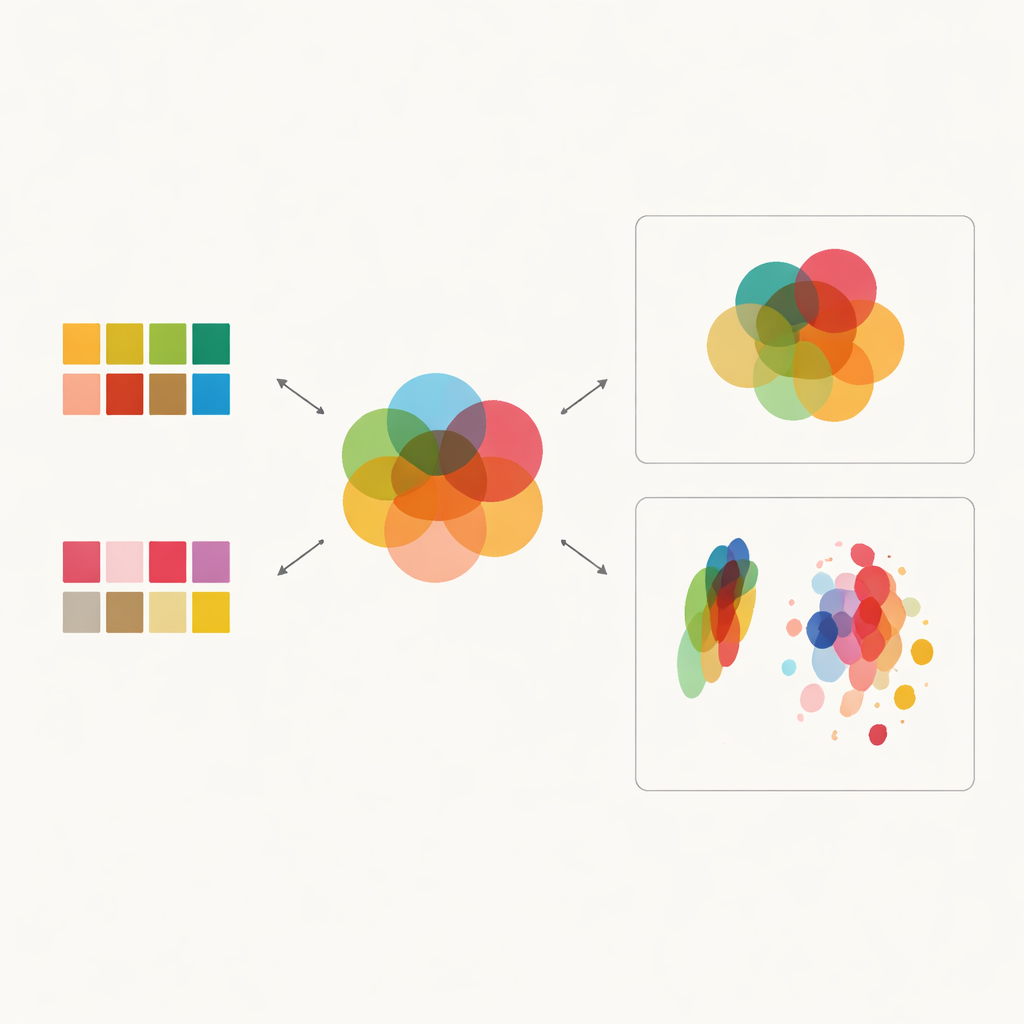
With the palettes in hand, the study used perceptual color measures that mimic how human eyes judge differences. One set of tools estimated how far bird and flower colors would need to “move” to match each other; smaller moves meant higher harmony, larger moves meant greater contrast. Another metric compared the average colors of birds and flowers in each era, again asking: are they close cousins or distant relatives? Repeated resampling of the data tested whether apparent differences could just be chance, an important step because there were many more traditional paintings than modern or contemporary ones. The study also built networks linking paintings with similar palettes and let a clustering algorithm group them into “communities” of shared color style.
What the colors reveal about tradition and innovation
The results show a clear trajectory. Traditional bird-and-flower paintings favor muted earth tones and gentle contrasts, with bird and flower colors closely aligned. Quantitative measures confirm that in these works, the distance between the two palettes is small and the “cost” of matching them is low, echoing long-standing ideas about classical harmony and balance. Modern paintings widen the palette, adding deeper reds, golds, and cooler blues, yet still keep birds and flowers relatively coordinated. Contemporary works, by contrast, often pair sober, dark birds with bright, highly varied flowers, producing larger measured gaps and higher transport costs. In other words, newer artists are more willing to let colors clash, using contrast and saturation as expressive tools rather than strictly following traditional, nature-like schemes.
Enduring symbols beneath shifting hues
Despite this growing freedom, certain color choices remain strikingly stable. Peonies still tend to appear in rich reds and pinks linked to wealth and status, and orchids often stay within violet and purple ranges associated with elegance and purity. The network analysis shows that paintings naturally cluster into groups that match historical styles and mixed, transitional practices, suggesting gradual evolution rather than abrupt breaks. For a general viewer, the takeaway is that computers can now “see” and quantify patterns in art that scholars have long sensed by eye, revealing both how faithfully some symbolic colors have been preserved and how modern and contemporary artists have stretched the chromatic language of bird-and-flower painting in new directions.
Citation: Zhang, C. Comparative study of color in traditional and contemporary flower and bird paintings. npj Herit. Sci. 14, 189 (2026). https://doi.org/10.1038/s40494-026-02429-3
Keywords: Chinese flower-and-bird painting, color harmony, digital art history, cultural symbolism, computational color analysis