Clear Sky Science · en
Exploring city-level climate risks for immovable cultural heritage in Beijing
Why old buildings and sites face new weather dangers
Beijing is famous for its ancient temples, city walls, and historic neighborhoods. But the same weather extremes that worry city planners—stronger heat waves, heavier downpours, and shifting seasons—are now posing growing dangers to these irreplaceable places. This study looks across more than 3600 outdoor cultural heritage sites in Beijing to find out which ones face the greatest climate risks now and in the future, and what that means for how we protect them.

Looking at a whole city of historic places
Instead of focusing on a single landmark, the authors treat Beijing’s cultural heritage as a city-wide system. They include ancient buildings, tombs, stone carvings, and modern historic structures that stand outdoors and are directly exposed to the elements. These 3619 sites are spread across central districts, foothills, and mountainous areas, forming a clear pattern of dense clusters in the old city and scattered sites in the surrounding hills. By working at this larger scale, the study can compare risks between different districts, types of sites, and protection levels—from world-famous national monuments to little-known local shrines.
How climate, fragility, and exposure combine
The researchers break climate risk into three parts: the strength of the weather hazards, how fragile each site is, and how much is at stake if it is damaged. They focus on temperature and rainfall, using detailed climate data for the past and for two future paths: a medium-emissions future and a high-emissions future. For each path, they map how average and extreme heat and rain change across Beijing. They then describe each heritage site by its age and building material, its surrounding landscape—such as steep slopes, nearby landslide-prone areas, vegetation, and land use—and the fiscal strength and population of its district, which affect money, staff, and community care for preservation.
What happens under stronger climate change
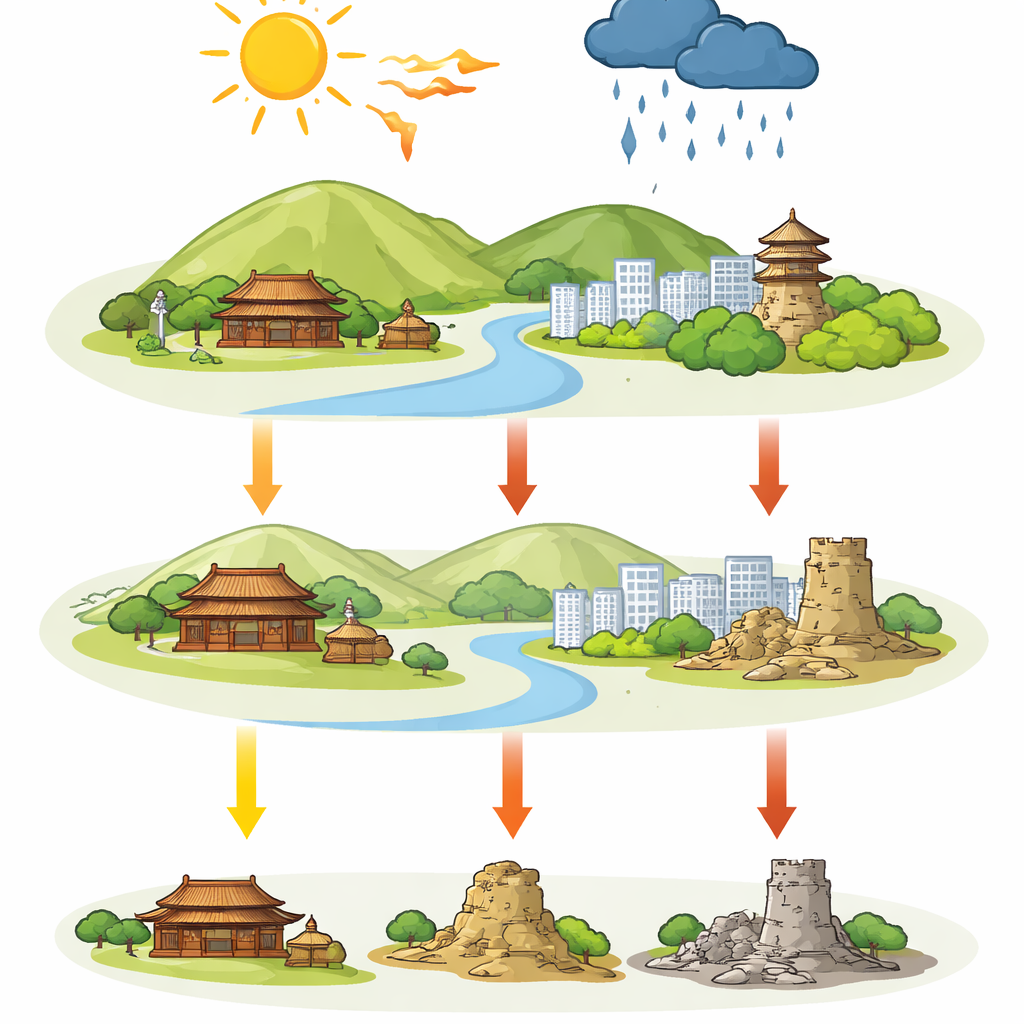
When the team compares the two futures, the picture is clear: under the high-emissions path, the average climate risk to Beijing’s cultural heritage is about 41% higher than under the medium path. Heat becomes more intense, especially on the plains, stressing wood and earth structures; heavy rainfall increases in the southwestern mountains and parts of the plains, raising the chance of flooding, erosion, and landslides that can undercut walls and carvings. High-risk areas tend to cluster in the western mountains and in central urban districts, where important cultural belts such as the Great Wall and historic garden complexes coincide with strong hazards and high heritage value. A careful uncertainty test shows that while exact numbers may shift, this basic pattern of higher risk in these zones remains stable.
The hidden vulnerability of “ordinary” heritage
One of the study’s most striking findings is that less celebrated sites are often more at risk in a warming world. On average, national-level sites currently show higher risk scores, reflecting their importance and size. Yet when moving from the medium to the high-emissions scenario, the percentage increase in risk is largest for district-level and district-wide surveyed heritage. These lower-grade sites are many, often sit in transitional zones between city and mountains, and are more likely to suffer from weak funding, limited monitoring, and fragile materials such as earth. The result is a quietly accumulating threat to the everyday layers of history that give Beijing much of its character.
What this means for protecting the past
The authors argue that safeguarding cultural heritage cannot be separated from tackling climate change itself. Cutting global greenhouse gas emissions reduces the strength of future hazards and therefore lowers the ceiling on possible damage. At the same time, Beijing needs more proactive local plans: better monitoring of weather impacts on key sites, risk maps built into conservation rules, and practical manuals that spell out which measures to prioritize for different types and levels of heritage. Because resources are finite, they recommend a “differentiated” approach—offering advanced protection and technology to flagship monuments, while empowering communities and local governments to care for the thousands of smaller, more vulnerable sites. In plain terms, the study shows that the city’s historic fabric can endure a changing climate, but only if both global emissions and local policies change in time.
Citation: Li, H., Li, R. Exploring city-level climate risks for immovable cultural heritage in Beijing. npj Herit. Sci. 14, 153 (2026). https://doi.org/10.1038/s40494-026-02428-4
Keywords: climate risk, cultural heritage, Beijing, historic buildings, adaptation planning