Clear Sky Science · en
Understanding how destination attributes shaping tourist visitation on cultural routes through social media data and interpretable machine learning
Why the Paths of Pilgrims Still Matter Today
Cultural routes like Japan’s ancient Kumano Kodo were once walked by emperors and monks; today they are also hiked by tourists with smartphones in hand. This study asks a practical question with big implications for heritage and tourism: not why people say they want to travel, but how the concrete features of places along a route actually shape where visitors go. By mining thousands of geo-tagged social media posts and using transparent machine-learning tools, the authors show how shrines, scenery, shops, beds, and buses combine to create the modern geography of pilgrimage.
Following Digital Footprints Along an Old Road
Instead of relying on surveys and memories, the researchers turned to traces people leave online when they travel. They collected 24,569 geo-tagged Flickr photos taken between 2010 and 2025 in the wider Kumano Kodo area. After carefully filtering out likely local residents and everyday life scenes, each remaining photo was treated as one concrete visit in space and time. To check whether this digital crowd really followed tourist paths, the team compared their points with independent data from Google Maps and TripAdvisor. The Flickr visits clustered strongly around known attractions, suggesting that social media posts provide a realistic picture of where visitors actually spend time.
What Visitors Notice Along the Way
The next step was to understand what kinds of places matter most along this historic route. The authors analyzed the words people used in their Flickr titles, tags, and descriptions, translating and cleaning the text and then using topic modeling to find recurring themes. From these themes they distilled 17 types of destination attributes, grouped into four broad families: cultural and heritage resources such as shrines and traditional buildings; natural settings including coastlines, rivers, and forests; tourism and leisure services like lodgings, hot springs, restaurants, and shops; and travel infrastructure such as roads, railways, stations, and parking areas. They then linked each type to detailed geographic data—maps of temples, train lines, slopes, vegetation, and more—so they could study how these attributes line up with real visitation patterns.
Teaching a Model to Read the Landscape
To relate these many layers to where people actually went, the researchers divided the region into a grid of one–kilometer squares. For each square they summarized how close it was to each kind of attraction or facility, and how strong each natural feature was there. These numbers became the model’s inputs; the observed number of Flickr visits became the output to be explained. They compared several machine-learning approaches and found that a random forest model, using distance-based measures of each attribute, best reproduced the observed visitation patterns. Importantly, they then “opened the black box” with interpretable tools that show how each factor nudges predicted visitation up or down, both alone and in combination.

How Shrines, Services, and Streets Work Together
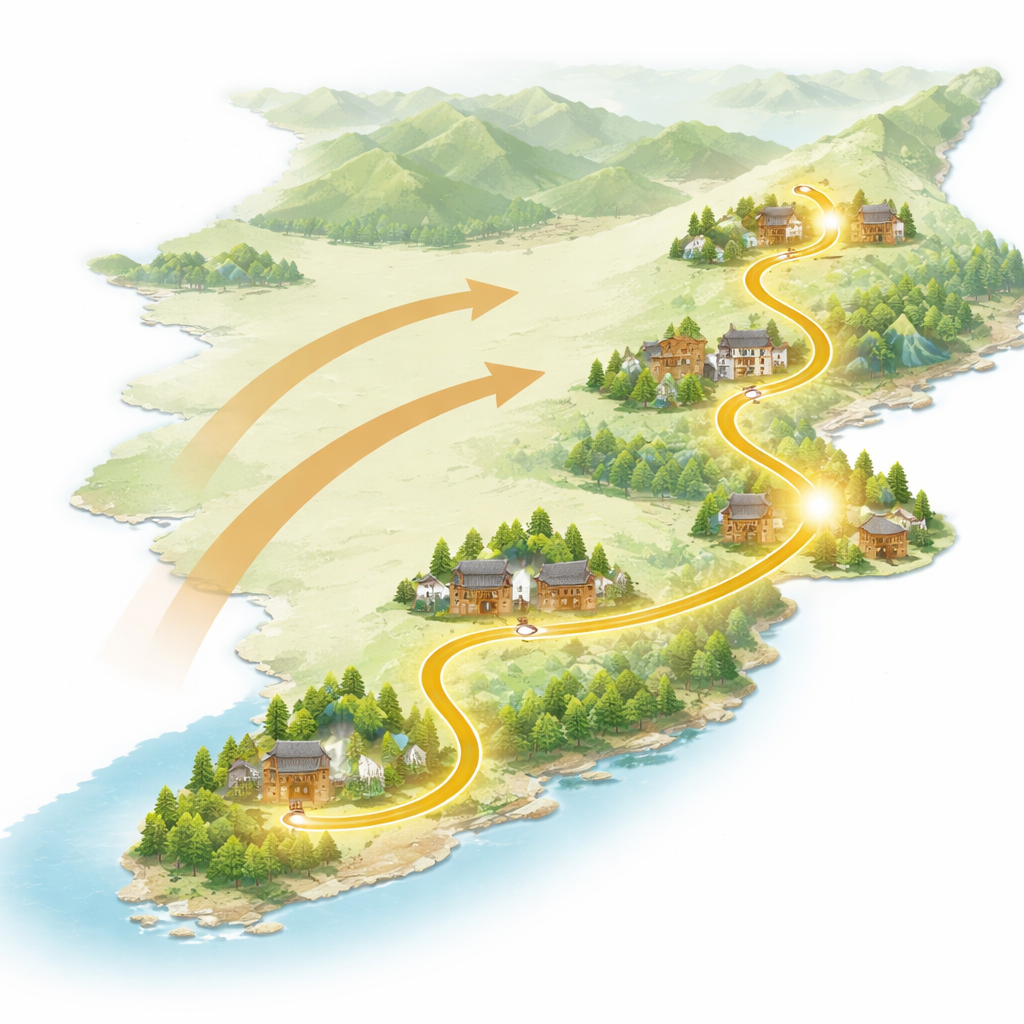
The results reveal that hotspots along the route are rarely driven by a single attraction. Cultural and heritage places—religious sites, traditional streets, monuments, and museums—act as the main magnets: the closer a grid square is to them, the more visits it tends to receive. Yet these magnets are strongly reinforced by nearby services and easy access. Areas with lodgings, hot springs, restaurants, and shopping clusters, tied into rail lines, stations, roads, and parking lots, attract far more visitors than isolated shrines in hard-to-reach locations. Natural features such as mountains, rivers, and dense vegetation play a subtler role, providing the backdrop that can enhance or temper these patterns rather than driving them outright. The balance among these ingredients also shifts with the seasons, travel modes, and visitor types: for instance, winter visitors lean more on indoor attractions and transport hubs, while hikers on foot gravitate toward scenery-rich sections supported by basic public transport.
Turning Insight into Better Routes
For non-specialists, the key takeaway is that successful cultural routes function less like single monuments and more like living networks. This study shows that people are drawn to places where meaningful heritage sites are woven together with simple comforts and reliable access, all framed by a distinctive landscape. By quantifying these relationships using real behavior instead of just stated motives, the authors provide a practical recipe that can be adapted to other historic routes worldwide. Strengthening cultural anchors, coordinating services and transport around them, and tailoring management to different seasons and traveler styles can help keep ancient paths both walkable and meaningful in the twenty-first century.
Citation: Lin, X., Teng, X., Shen, Z. et al. Understanding how destination attributes shaping tourist visitation on cultural routes through social media data and interpretable machine learning. npj Herit. Sci. 14, 197 (2026). https://doi.org/10.1038/s40494-026-02427-5
Keywords: cultural routes, tourism patterns, social media data, heritage management, machine learning