Clear Sky Science · en
Characterising terpenic plant resins, wood tars and pitches in heritage science: analytical methods and applications
Sticky gifts from trees
From Stone Age toolmakers to Viking shipbuilders and modern conservators, people have long relied on the sticky substances that seep from trees or are made by heating wood. These resins, tars, and pitches have glued blades to handles, waterproofed boats, coated musical instruments, and even preserved mummies. This article explores what these materials are made of, how they have been used across history, and how scientists today decode their chemical fingerprints to reveal lost technologies—and to inspire greener materials for the future.
From campfires to cathedrals
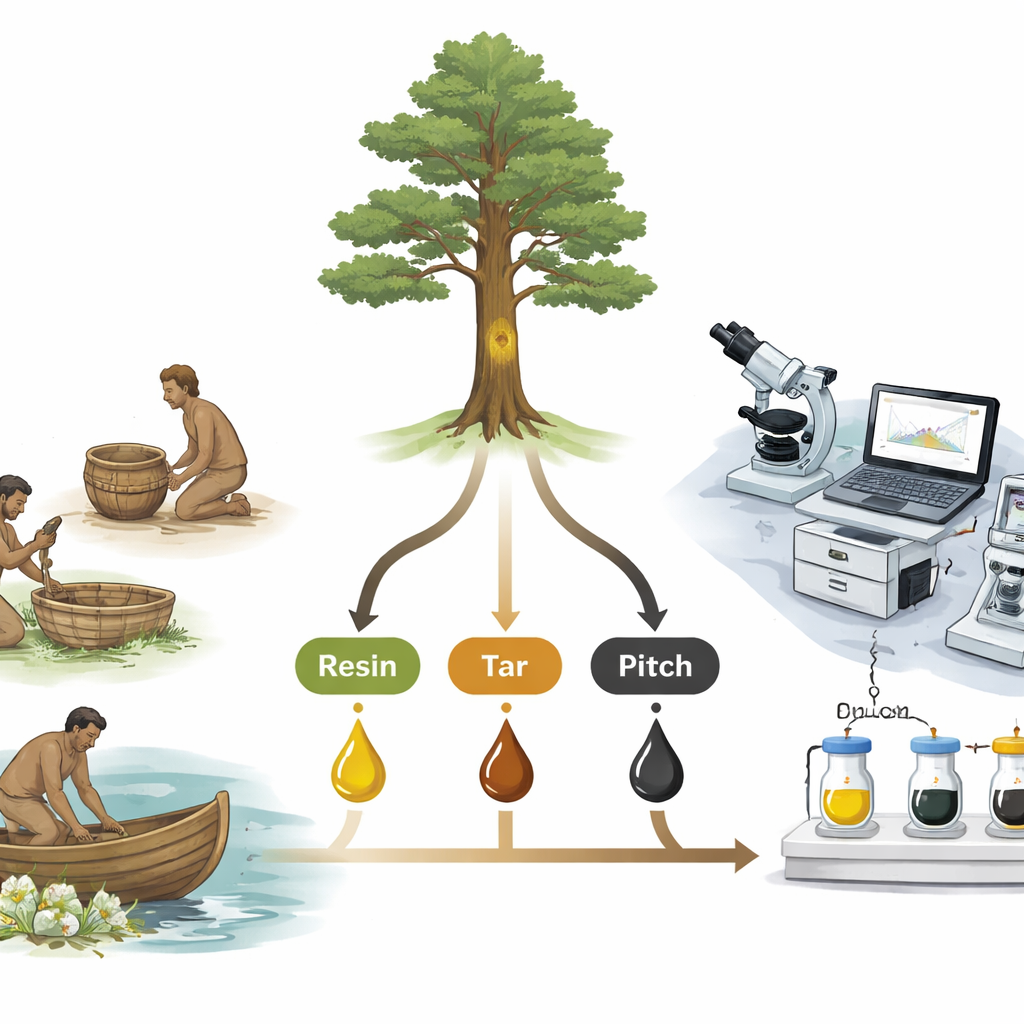
Plant resins and wood tars form a technological thread that stretches back at least 200,000 years. Early humans heated birch bark to make one of the first known synthetic materials: a tar that could glue stone tools to wooden handles and may also have repelled insects. Later, people across the Mediterranean and northern Europe refined techniques for making tar from pine and other woods, using it to seal containers, protect wooden buildings, and caulk ships. In Roman times, pine pitch lined amphorae and ship hulls; in medieval Scandinavia, tar kept stave churches and longboats dry. Resin from various trees also perfumed temples as incense, coated artworks as varnish, and served in medicines and chewing gums.
What makes these tree substances special
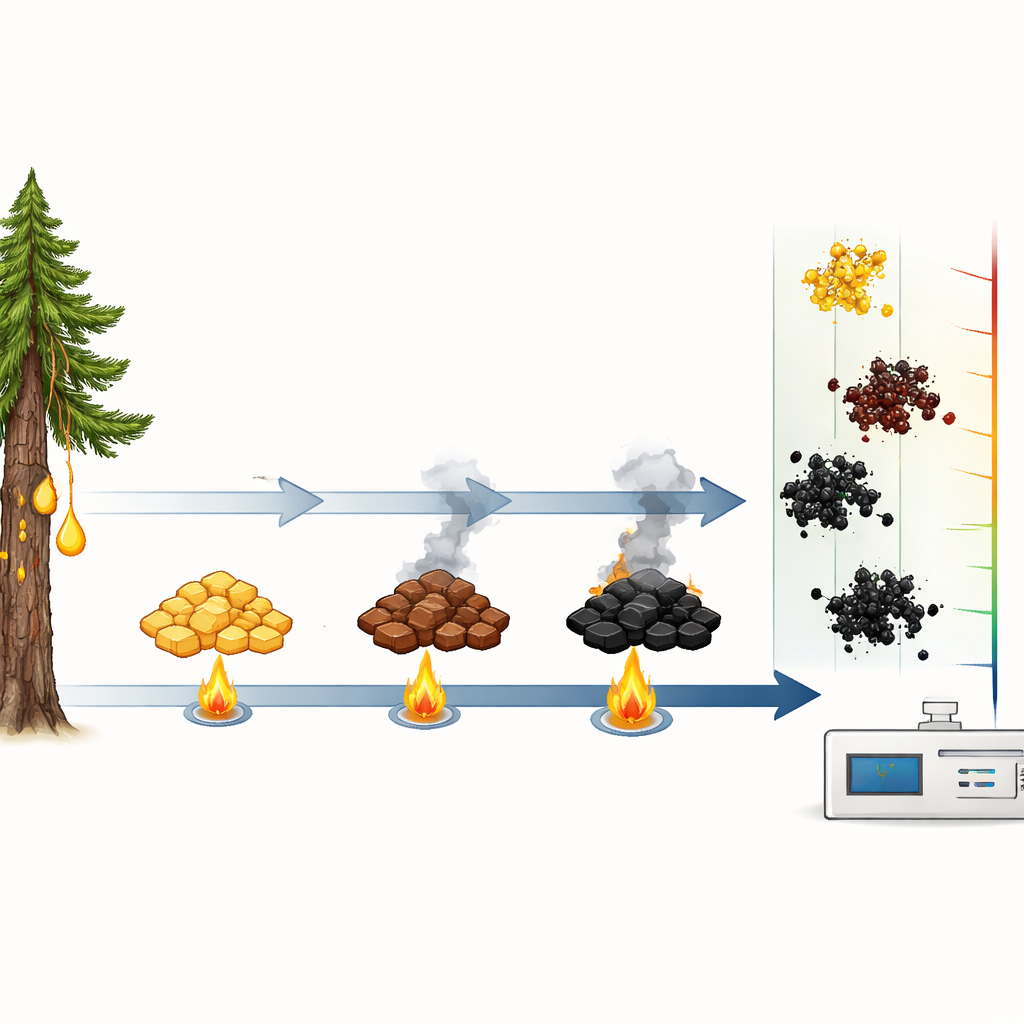
Resins are complex natural mixtures built from a huge family of plant molecules called terpenes. Some, which evaporate easily, give resins their strong scent and fluidity. Others are larger and less volatile, and over time they harden into tough, glassy solids. The article distinguishes two broad families: diterpenoid resins, common in conifers like pine and fir, and triterpenoid resins, typical of many flowering trees whose products include frankincense, myrrh, mastic, dammar, and historic copals. When people heat resinous wood to make tar or pitch, these molecules are broken down and rearranged, becoming more aromatic, darker, and more stable. Each plant group—and each processing method—leaves behind a characteristic blend of long‑lived compounds that can survive for millennia.
Reading chemical fingerprints from the past
Unraveling the story locked in a speck of ancient tar is challenging. The sample is usually tiny, mixed with minerals, waxes, fats, or oils, and altered by heat, oxygen, microbes, and time. Scientists therefore look for durable “molecular markers”: specific compounds, or families of compounds, that point to a particular plant source or treatment. For example, certain abietane derivatives signal heated pine resin; other marker molecules highlight birch bark tar or triterpenoid resins such as mastic or frankincense. By comparing these markers with well‑documented reference materials, researchers can tell whether a black coating came from pine wood, birch bark, or a mixture with beeswax or fats, and whether it was gently warmed or strongly charred in a kiln.
Tools for seeing the unseen
The review surveys a toolkit of methods used to study resins, tars, and pitches. Vibrational spectroscopies such as infrared and Raman can often be applied on-site, shining light on an object to reveal the main functional groups and to distinguish broad classes like diterpenoid versus triterpenoid resins, or fresh versus strongly aged material. Gas and liquid chromatography combined with mass spectrometry provide much finer detail, separating complex mixtures and weighing individual molecules to identify precise markers and oxidation products. Thermal analysis tracks how a material loses mass or absorbs heat as it is warmed, revealing glass transitions, decomposition steps, and interactions with additives like beeswax or pigments. Nuclear magnetic resonance offers structural insights, while emerging ancient DNA techniques can sometimes identify the tree species, and even capture human and microbial DNA from chewed mastics.
Why it matters today
Understanding these age‑old sticky substances does more than solve archaeological puzzles. By reconstructing historical recipes and processing methods, scientists can see how craftspeople deliberately blended resins with waxes, oils, and fats to tune strength, tackiness, and resistance to water or light. This knowledge helps conservators choose compatible materials for restoring artworks and historic buildings, and it informs efforts to design modern, bio‑based coatings and adhesives that could replace petroleum‑derived products. The article concludes that no single test can fully describe such complex, time‑worn materials; instead, a carefully chosen combination of techniques, backed by good reference collections and smart data analysis, is needed to bridge chemistry, history, and conservation—and to carry the lessons of tree resins, tars, and pitches into a more sustainable future.
Citation: Łucejko, J.J., Bertelli, I., Costa, R. et al. Characterising terpenic plant resins, wood tars and pitches in heritage science: analytical methods and applications. npj Herit. Sci. 14, 162 (2026). https://doi.org/10.1038/s40494-026-02426-6
Keywords: plant resins, wood tar, archaeological adhesives, heritage science, analytical chemistry